DORA came into effect in January 2025, pushing financial institutions to rethink operational resilience well beyond cybersecurity and core banking. The scope extends to any system that keeps critical business operations running, including customer communications.
CCM platforms handle account statements, regulatory disclosures, fraud alerts, payment notifications, and other legally required correspondence. When they fail, compliance notices get delayed, regulatory obligations can be missed, and customers are left without the information they need.
Under DORA, enterprises need to demonstrate that CCM platforms are resilient, secure, and properly monitored. This blog looks at what DORA means for CCM platforms and how financial enterprises can support communication compliance and continuity.
What is DORA and Why was it Introduced?
Effective since January 2025, DORA brought EU financial services under a single operational resilience framework. It covers banks, insurers, investment firms, payment service providers, and third-party Information and Communication Technology (ICT) vendors. It aims to ensure that critical systems remain operational during events like cyberattacks or unexpected technical failures. The DORA regulation is built around five pillars:
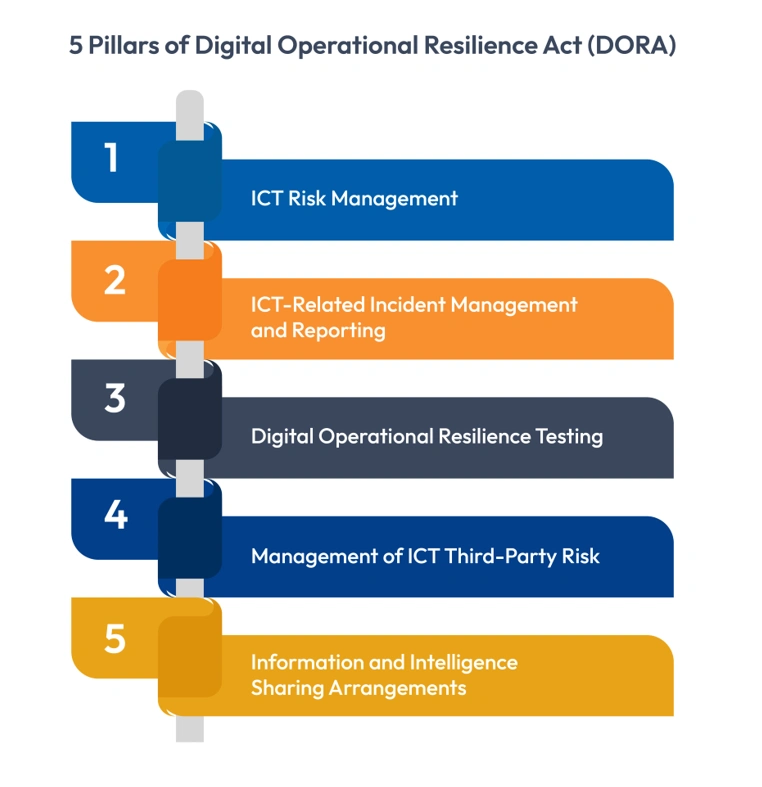
1. ICT Risk Management: This pillar emphasizes the need for financial entities to identify, assess, and mitigate ICT-related risks. Businesses must have robust frameworks to monitor key digital systems, data, and connections. This is to ensure that vulnerabilities are surfaced and addressed before they translate into operational disruptions.
2. ICT-Related Incident Management and Reporting: This pillar emphasizes standardizing the process of incident reporting. Financial entities are required to implement management systems that enable them to monitor, describe, and report any significant ICT-based incidents to relevant authorities, bringing consistency and accountability to how the sector surfaces and communicates risk events.
3. Digital Operational Resilience Testing: DORA corroborates this view by insisting that financial institutions periodically test their ICT risk management frameworks through digital operational resilience testing. These tests include:
- scenario-based tabletop testing
- vulnerability assessments
- open-source analyses
- performance testing, and
- threat-led penetration testing, amongst others.
This pillar also emphasizes the need to close the gaps that emerge from the results of testing. The implementation of recommendations and remediations must be validated, and their effectiveness must be demonstrated.
4. Management of ICT Third-Party Risk: This pillar requires financial organizations to thoroughly conduct due diligence on ICT third parties. The aim is to guarantee that these third parties comply with the same standards of security and resilience as the financial entities themselves, effectively extending DORA’s obligations across the entire supplier ecosystem, not just the regulated institution.
5. Information and Intelligence Sharing Arrangements: This pillar promotes the sharing of information and threat intelligence amongst the EU financial community. By enabling institutions to pool knowledge on emerging threats and vulnerabilities, DORA seeks to strengthen the collective resilience of the sector, rather than leaving each entity to defend against threats in isolation.

How DORA Affects Your CCM Platform
Here is where DORA impacts the CCM platform you use:
Incident Detection and Reporting
Under DORA, any significant disruption to a critical ICT system must be detected quickly, assessed, and reported to the regulator. For major incidents, the initial notification must reach the authority within four hours of classification.
This means CCM platforms can no longer rely on basic error logs and manual checks. They need real-time monitoring, automated alerts, and complete audit trails to capture every step, from creation to delivery.
ICT Risk Management and Asset Classification
DORA requires every system that supports a critical or important function to be formally identified and included in the firm’s ICT risk management framework. That classification determines how much protection the system receives, how often it is tested, and what continuity plans must exist if it fails. CCM platforms almost certainly qualify as critical or important under DORA’s definitions. A system that sends regulatory disclosures, fraud notifications, and financial statements is central to customer service and regulatory compliance.
Third-Party ICT Risk and Vendor Governance
Most financial institutions use third-party platforms as part of their CCM infrastructure. That dependency doesn’t sit easily with DORA. The regulation is specific about what vendor contracts need to contain, including audit access, data residency commitments, resilience SLAs, and portability arrangements. A lot of existing contracts don’t cover this. Reviewing and renegotiating is the starting point, though some institutions may find their current vendor simply isn’t in a position to comply with.
Key CCM Capabilities Needed for DORA Readiness
DORA compliance requires the CCM platform to function with certain capabilities that make it resilient, secure, and transparent, and not just on paper, but in daily operations.
Secure Data Handling
CCM platforms process highly sensitive financial data, making strong data governance a core requirement under DORA. End-to-end encryption for data, role-based access to customer data, and automated data classification all need to be in place, so sensitive content is handled by policy rather than left to individual judgment. Retention policies must also be automated. DORA requires audit data to remain accessible for incident reviews, while data protection rules require personal data to be deleted once it has served its purpose.
Audit-Ready Reporting
DORA’s four-hour incident reporting window leaves very little room for slow or incomplete data retrieval. CCM platforms must maintain audit logs that reflect what occurred and cannot be altered after the fact. Real-time dashboards showing delivery performance and incident flags give teams the visibility to act quickly. Integration with the firm’s broader incident management systems is equally important.
Omnichannel Delivery with Built-In Resilience
DORA requires that critical communications reach customers even when a channel fails. If the email channel goes down, the platform must automatically reroute to SMS or another available channel, ensuring no delay, no missed delivery. Every message sent across every channel must be properly recorded. When a regulator asks for evidence of what was communicated, to whom, and when, that information needs to be immediately available.
Cincom Eloquence for DORA-Ready Communications
Cincom Eloquence enables financial enterprises to manage high-volume and compliant customer communications. It supports centralized document management, automated workflows, and omnichannel delivery, to support businesses when disruptions occur.
For organizations focused on DORA readiness, Eloquence aligns closely with operational resilience requirements, including:
- Secure handling of sensitive customer and financial data
- Centralized management of customer communications across channels
- Audit trails and tracking for communication activities
- Automated document generation and delivery workflows
- Integration with enterprise systems and incident management processes
- Reliable delivery of time-sensitive customer communications
See how Cincom Eloquence supports secure and compliant customer communications.
Conclusion
DORA draws a clear line: financial institutions must know their critical systems, protect them, test them, and be able to account for what happens when they fail. CCM platforms, which carry sensitive customer data and deliver communications, sit firmly within that definition.
The good news is that a CCM platform built for DORA readiness is also a better platform for customers. Resilient delivery means fewer disruptions. Strong data governance means fewer errors. Complete audit trails mean faster resolution when something does go wrong.
DORA compliance and excellent customer communications are not alternatives. Both are required simultaneously to strengthen customer relationships.
FAQs
1. What is DORA and who does it apply to?
DORA is an EU regulation that came into effect in January 2025. It sets mandatory standards for how financial institutions manage technology risk and maintain operational continuity. It applies to banks, insurers, investment firms, payment service providers, and third-party technology vendors.
2. Does DORA apply to our CCM platform even if we use a third-party vendor?
Yes. DORA’s third-party ICT risk pillar means that outsourcing your CCM to a vendor does not transfer your compliance responsibility, but it extends it.
3. What happens if a financial institution does not comply with DORA?
Non-compliance can result in supervisory action from national competent authorities, including investigations, mandatory remediation orders, and financial penalties.
4. How do we know if our CCM platform qualifies as a “critical or important” system under DORA?
If your CCM platform delivers regulatory disclosures, fraud notifications, mandatory financial statements, or any communication that affects a customer’s legal or financial position, it is very likely to qualify.