Introduction
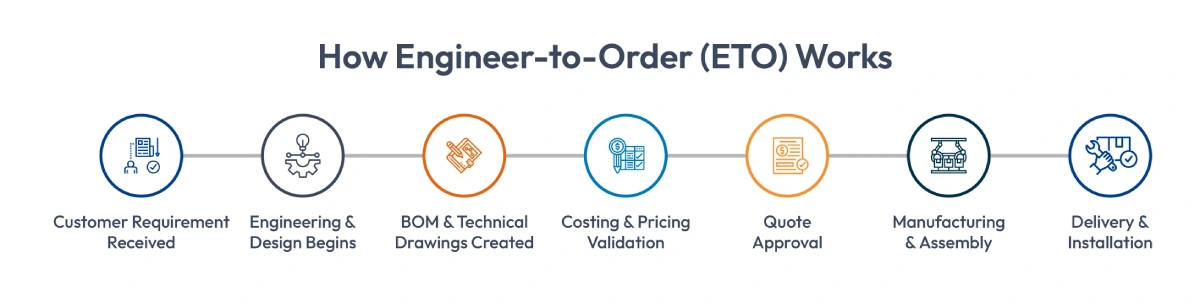
Engineer to order (ETO) is a manufacturing strategy where products are designed and built entirely to customer specification, after the order comes in. There’s no inventory to pull from, no standard design waiting in a drawer. The engineering, the drawings, the bill of materials, all of them start from scratch, every single time.
For manufacturers working this way, ETO is more about a commitment than an operational model. You’re telling customers: bring us your exact requirements, and we’ll build something specifically for you. That’s a strong promise to make. And keeping it, consistently, from first quote all the way through to delivery, is genuinely one of the harder things to do in manufacturing today.
What is Engineer to Order?
At its core, engineer-to-order means the product doesn’t exist until the customer orders it. There’s no pre-built stock or configurable base unit waiting to be customized. Engineering starts when the purchase order lands, and everything flows from there.
Three things tend to define a true ETO product:
- It can’t be fulfilled from any existing catalogue
- The customer’s own requirements shape the engineering work
- The end result is, in some real sense, unique
ETO in manufacturing spans a surprisingly wide range of industries. Industrial equipment manufacturers build custom presses, mixers, and processing lines to exact operational specs. Aerospace and defence contractors design platforms and subsystems to stringent performance and compliance standards. Power generation companies engineer turbines and switchgear around site-specific load conditions. Specialty vehicle manufacturers build emergency response, military, and heavy haulage vehicles to precise operator requirements.
What truly separates ETO from other manufacturing models isn’t just the technical complexity but the order of operations. In make-to-stock or even make-to-order environments, most of the engineering is done before a sale happens. In ETO, the sale is what kicks the engineering off. That single difference reshapes how you quote, how you price, how your sales and engineering teams interact, and how long your customers are waiting.

The Challenges of ETO Manufacturing
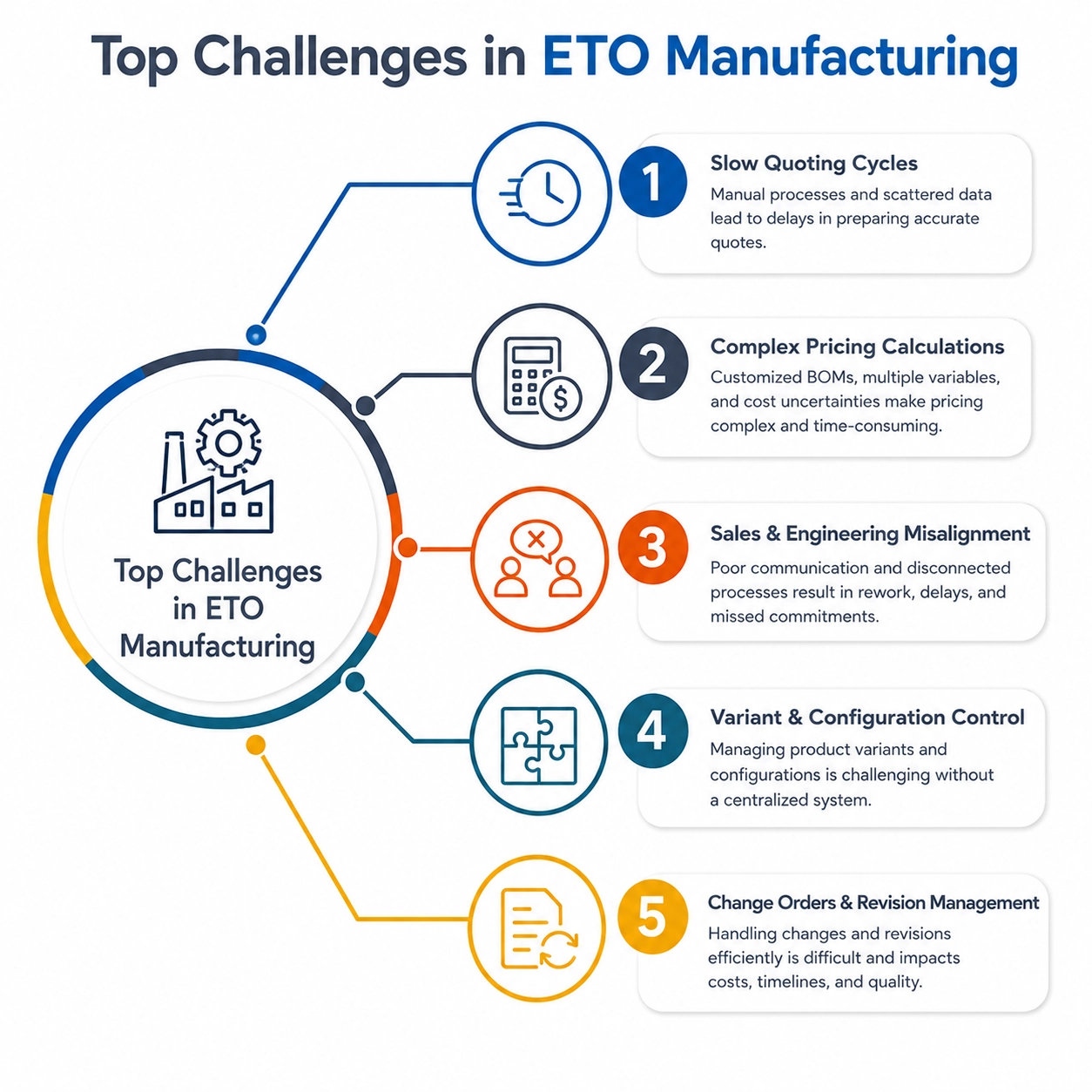
Most VPs of Sales and Operations Directors at ETO manufacturers don’t need to be told that this is a complex model. They’re living it. But it’s worth naming the specific pain points, because they show up in ways that cost time, margin, and customer confidence.
1. Quoting takes too long
In ETO, every quote is essentially a small engineering engagement. Before a quote can go to a customer, sales has to gather detailed technical requirements, loop in engineering for a feasibility check, and wait for cost estimates to come back. That process can stretch across days or weeks. The problem is that speed genuinely matters here. Research shows that about 50% of B2B sales go to the vendor that responds first. When your quoting process is slow by nature, closing that gap must become a priority.
2. Pricing is never straightforward
There’s no standard price list in ETO. Every job is a different mix of materials, labour, engineering hours, and subcontracted parts. Getting pricing right means having visibility across all those variables, in real time, for every unique order. Even the slightest mistake at the quoting stage becomes hard to find until the project is halfway through production and by then, the margin hit is already locked in.
3. Sales and engineering aren’t always on the same page
This one causes more operational friction than most companies want to admit. Sales is focused on winning. Engineering is focused on what’s actually buildable, on time. In ETO, those two goals come into conflict regularly. Sales commits to timelines engineering can’t meet. Engineering pushes back on specs that sales thought were standard. Without a clear, structured handoff between the two, these tensions play out in delays, rework, and conversations no one wants to have with the customer.
4. Managing variants without losing control
ETO products aren’t always built from nothing; they often share common frames, base assemblies, or proven subsystems across orders. But managing those shared elements consistently, and making sure configuration decisions don’t create downstream engineering conflicts, is harder than it sounds. A wrong assumption early in the quoting process can surface as an expensive revision problem once production is already underway.
5. Change orders and revision cycles
ETO projects change constantly. Customers update their specifications. Site conditions shift. Regulatory requirements get updated mid-project. Each of those changes means another round of engineering review, re-costing, and schedule renegotiation. Without a system that can handle revisions cleanly and quickly, your engineering team ends up spending bandwidth managing changes rather than delivering the actual product.
In modern CPQ software for ETO, a configured quote isn’t a throwaway document; it’s a persistent commercial record. When specifications change, revisions, re-costing, and approvals occur against that same governed record, enabling engineering teams to manage the change instead of rebuilding the quote from scratch.
Which Industries Use ETO Manufacturing?
ETO isn’t a niche corner of manufacturing. It’s the standard model across several large, capital-heavy sectors.
Industrial Equipment: Custom machinery manufacturers of presses, conveyor systems, processing lines, typically run pure ETO operations. Every installation is built around a customer’s specific facility, throughput targets, and process requirements. No two jobs are the same. Explore how CPQ supports industrial equipment manufacturers.
Aerospace & Defence: Products in this space must hit exact performance, safety, and compliance targets. Beyond the engineering complexity, there are configuration control requirements, traceability obligations, and regulatory documentation demands that simply don’t exist in standard manufacturing environments.
Power Generation: Turbines, transformers, generators, and switchgear all get sized and configured to site-specific conditions like local grid requirements, environmental constraints, and load profiles. The engineering content on each order is high, and there’s very little room for error.
Specialty Vehicles: Emergency response vehicles, military transport, and heavy haulage equipment are built to operator and mission specs. Drivetrain configuration, body layout, and equipment fit-out all vary considerably from order to order. Learn more about CPQ for specialty vehicle manufacturers.
HVAC Systems: Commercial and industrial HVAC projects are engineered to the specific thermal load, floor plan, and usage pattern of each building. Ductwork routing, unit sizing, and controls are all specified per project. Rarely does one installation look like the last.
Pumps & Valves: In oil and gas, water treatment, and chemical processing, pumps and valve assemblies are specified to precise flow rates, pressure ratings, and material compatibility requirements. Off-the-shelf products rarely meet the exact operating envelope, which is why this sector has run on ETO for decades.
Why ETO Manufacturers Choose Cincom CPQ?
Standard ERP was designed for repeatability. PLM tools manage product lifecycles, not sales conversations. Neither was built for the core ETO challenge: taking a complex, custom customer requirement and turning it into an accurate, profitable quote, without it taking three weeks and pulling your engineering team off actual project work.
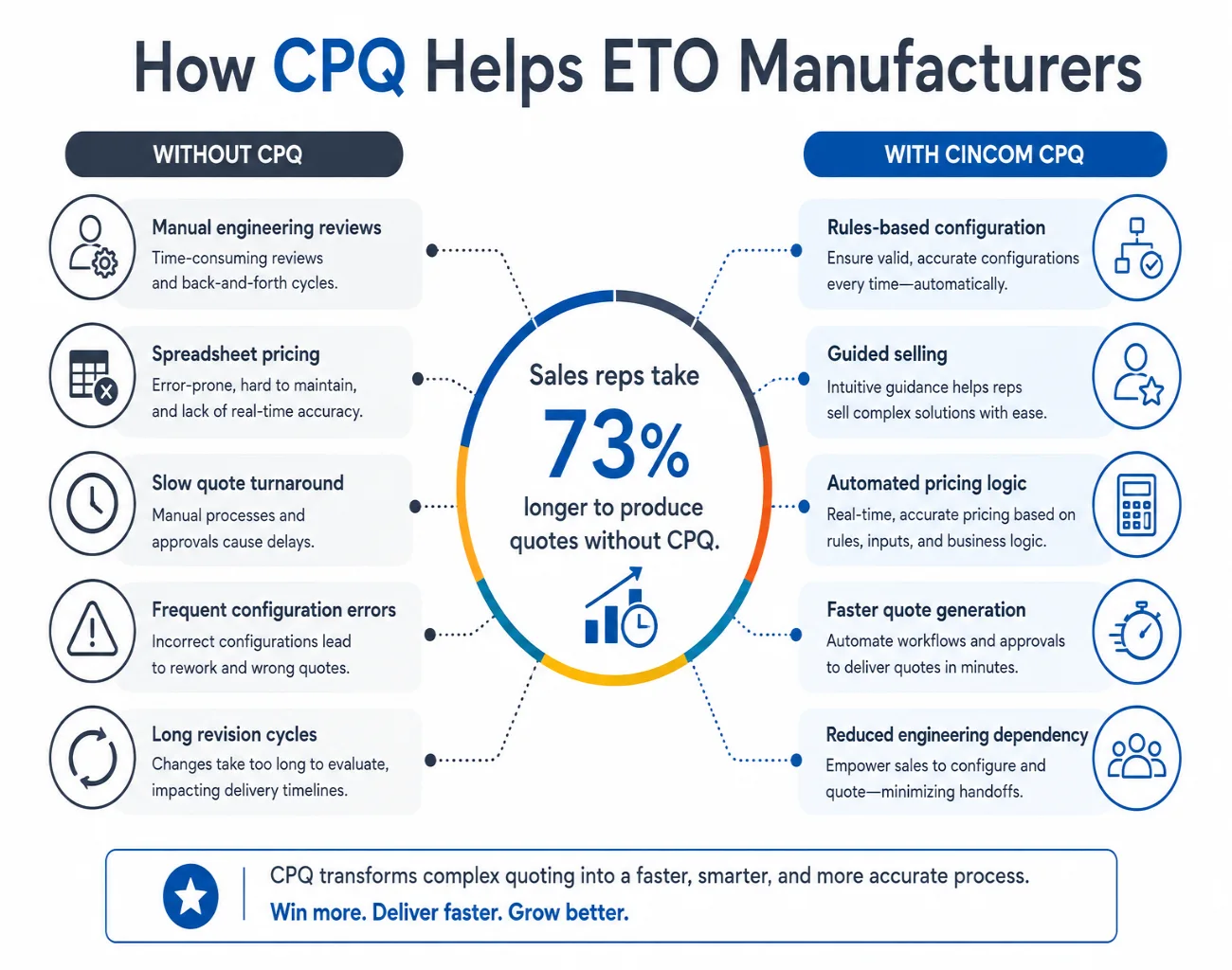
Without CPQ, the data reflects how significant the gap is without it. Without CPQ, sales reps take 73% longer to produce a typical quote or proposal, a gap that becomes especially painful in ETO environments where quoting already demands significant engineering input.
Here’s the list of features that give Cincom CPQ users an upper hand:
Rules-based configuration, built for complex products. Engineering logic gets encoded into the system once. After that, sales teams work through a guided configuration process that only surfaces valid combinations; no more back-and-forth with engineering to check every quote before it goes out.
Guided selling that doesn’t require a technical expert in the room. Most sales reps in ETO don’t have the engineering background to specify a complex product from scratch. Cincom’s guided selling walks them through the right questions, in the right sequence, and produces a technically valid configuration without needing an engineer on the call.
Pricing that reflects reality from the start. Materials, labour, subcomponents, margin thresholds, all of them are embedded in the system. Quotes come back reflecting real costs, not estimates that get revised once engineering reviews them. That’s what reduces revision cycles and keeps deal timelines on track.
Cincom has worked with ETO manufacturers across industrial equipment, specialty vehicles, and power generation for decades. The platform is built around the reality of complex product configuration, not adapted from a retail or high-volume manufacturing context. For manufacturers evaluating software to manage ETO complexity, that distinction matters.
Learn how CPQ helps manufacturers overcome their toughest operational challenges.
FAQs
1. What does ETO stand for in manufacturing?
ETO stands for Engineer to Order. It’s a manufacturing strategy where products are custom-designed and built to individual customer specifications, with engineering work beginning only after an order is received.
2. What is the difference between ETO and CTO?
Configure to Order (CTO) means selecting from a set of pre-engineered options where the engineering is already done, and the customer picks from valid choices. Engineer to Order starts from scratch: the product is designed around the customer’s specific requirements, so the engineering scope, cost, and lead time are all worked out after the order comes in.
3. What software do ETO manufacturers use?
Most ETO manufacturers run some combination of ERP, PLM, and CPQ. CPQ tends to be the most impactful at the front end of the process; it’s what allows sales teams to produce accurate quotes for custom products without pulling engineering into every single deal.
4. How does CPQ help engineer-to-order companies?
CPQ cuts quoting time, improves pricing accuracy, and gets sales and engineering working from the same information earlier in the process. By encoding product rules and pricing logic into a configuration engine, it lets sales teams produce technically valid, commercially accurate quotes for complex products faster, and with fewer errors.
5. What industries are engineer to order?
The main ETO industries are industrial equipment, aerospace and defence, power generation, specialty vehicles, HVAC, and pumps and valves. What they all have in common are customer orders that can’t be fulfilled from a standard catalogue.