Global supply chains have been facing significant disruptions. Component shortages, geopolitical issues, unpredictable demand, and port congestion made it increasingly difficult for manufacturers to operate efficiently.
In response, manufacturers have invested heavily in inventory buffers, additional workforce, and ERP enhancements. While these measures can help mitigate immediate issues, they often address the effects of supply chain disruptions rather than the processes that contribute to them.
One area that is frequently overlooked is the connection between sales, product configuration, and supply chain. Every quote generated by a sales team impacts raw material supply, final products to be manufactured, and capacity allocation. When product configurations and pricing are inaccurate, or sales teams lack visibility, supply chain challenges become harder to manage.
That is where CPQ solutions can make a significant difference. CPQ connects configuration, pricing, quote, inventory, and business workflows into a single process. When properly connected, it becomes one of the more effective levers a manufacturer has for managing supply chain challenges. Here are five of the most common supply chain pain points, and how CPQ addresses them.
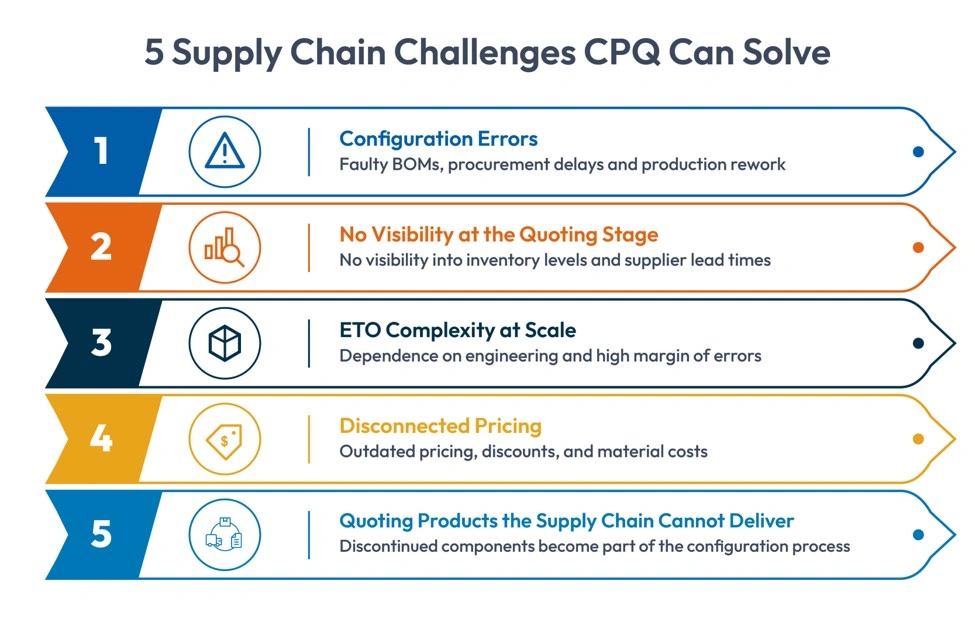
#1 Configuration Errors That Create Procurement Chaos
In engineer-to-order (ETO) and configure-to-order (CTO) environments, a bill of materials is an essential document as it acts like a blueprint for producing a product. An invalid BOM with invalid components can lead to procurement delays, configuration rework, and missed timely deliveries. The root cause of this issue is usually a gap between what the sales team can specify and what the production team can actually build. When those two functions operate from different sources of truth, errors are inevitable.
CPQ software closes this gap by embedding constraint-based rules in the configuration process. These rules prevent incompatible component selections from being made in the first place. Sales teams can only select configurations that are valid. Required sub-assemblies are added automatically. What comes out is a valid BOM that manufacturing can use directly.
#2 Poor Supply Chain Visibility During Quoting
One of the more persistent manufacturing supply chain challenges is quoting lead times that no longer reflect reality. A sales rep promises a 6-week delivery based on historical norms. Improving supply chain visibility is not just an operations problem. It has to extend into the quoting process itself. If the sales rep generating a quote does not have access to current inventory levels, supplier lead times, and capacity constraints, they are essentially guessing.
CPQ, integrated with ERP and supply chain systems, changes the inputs available at quote time. Current stock positions, delivery dates from suppliers, and production queue data can inform lead time commitments before a quote is issued. That is a fundamentally different position than fixing the problem after the order is placed.
#3 Inability to Handle Engineer-to-Order Complexity at Scale
ETO manufacturers face a particular version of the manufacturing supply chain challenges. Every order is potentially unique. Components may need to be sourced specifically for that configuration. Lead times depend on engineering decisions that have not been made yet. Pricing has to account for materials that fluctuate. Scaling this manually is manageable when volumes are low. When order volumes grow or product complexity increases, the quoting team becomes a bottleneck, and the margin of error expands. These are amongst the most persistent supply chain challenges CPQ can solve.
CPQ solutions were designed with this environment in mind. Nested configurators allow complex sub-assemblies to be configured within a parent product structure, with each layer governed by its own constraint logic. CAD design automation integrations can trigger drawing generation from configuration outputs, compressing the engineering review cycle.
The supply chain benefits are real. When engineering specifications are captured accurately during quoting, procurement has what it needs to source the first time correctly. That reduction in configuration ambiguity translates directly into fewer emergency orders, and therefore shorter lead times.
#4 Pricing Disconnected from Actual Input Costs
Raw material costs are not stable. Neither are freight rates, tariff classifications, or supplier surcharges. For manufacturers with quote validity windows of 30, 60, or 90 days, a pricing model that does not account for input cost volatility is a slow margin leak. The problem is usually not that pricing teams are unaware of cost changes. It is that those changes do not flow into active quotes in a structured way. They get communicated by email.
When pricing rules in a CPQ system are linked to cost data, adjustments in raw material prices, supplier surcharges, or duty rates can be reflected in quotes systematically rather than relying on someone remembering to update a spreadsheet.
#5 Sales Team Quoting Products the Supply Chain Can No Longer Support
Product change management is one of those problems that feels administrative until it is not. The problem includes:
- A component gets discontinued
- Engineering updates the approved sub-assembly list
- A new product variant is added to the catalog with a different source
Each of these changes has to flow through to the quoting process, or the sales team will keep offering configurations that create problems the moment they hit procurement. In most organizations, this synchronization happens slowly and manually. Someone sends an update to the sales team. The product and component spreadsheets get edited when someone remembers to do it.
CPQ integration with product management and supply chain systems creates a direct connection between catalog status and what sales can offer. End-of-life components get removed from available configurations as soon as they are flagged, not when a sales ops person gets around to it. New variants with confirmed supply availability can go live for quoting immediately. As a result, the sales team is always working from an options list that the supply chain can actually support.
How Cincom CPQ Addresses These Challenges
Cincom CPQ is a purpose-built CPQ solution for manufacturers. It handles complex product configurations through constraint-based logic. Pricing and discount rules are handled automatically, so margins are protected without manual intervention. Integration with ERP and supply chain systems ensures the data flow between systems remains accurate and consistent.
Especially for ETO and CTO products, Cincom CPQ supports guided selling, CAD drawings, and BOM generation to help sales teams generate accurate quotes and manage inventories effectively.

Revealing how world’s top industrial machinery manufacturers leveraged Cincom CPQ
Moving Ahead
If your sales team is quoting without live supply data, if configuration errors are creating rework, or if pricing updates are not reaching quotes consistently, those are not isolated process gaps. They are related problems with a connected solution.
CPQ connects configuration, pricing, quoting, and supply chain data to stop inaccurate quotes, missed delivery commitments, and revenue loss.
For manufacturers looking to solve supply chain challenges in this tough time, the next step should be to identify gaps in their existing processes and strategically address them with the right CPQ solution.
FAQs
1. How does CPQ software help in improving supply chain visibility?
CPQ software pulls real-time supply chain data by integrating with supply chain solutions to ensure deep visibility into current inventory levels, supplier lead times, or production capacity.
2. Can CPQ integrate with existing ERP and supply chain systems?
Yes. CPQ is designed to work alongside ERP and supply chain platforms to connect live inventory data, supplier lead times, and production capacity directly into the quoting process. This connection helps manufacturers address supply chain pain points.
3. Can CPQ prevent sales reps from quoting components facing vendor shortages?
Yes. When CPQ is connected to supply chain and inventory data, components that are on allocation, facing supplier delays, or below safety stock thresholds can be flagged or removed from available selections automatically.
4. How does CPQ address pricing accuracy in volatile input cost environments?
CPQ solutions implement pricing and discount rules based on cost inputs, so whenever there is a change in the cost of materials and components, the pricing is updated to protect profit margins.
5. Can CPQ prevent sales reps from quoting discontinued components?
When a component is marked discontinued, CPQ software eliminates the component during the configuration stage, so the sales rep can only make valid configurations.