


Introduction
Configure-to-order (CTO) manufacturing presents a unique set of challenges:
- Demands a high degree of customization to meet customer requirements.
- Sales teams must navigate thousands of configuration possibilities.
- Manage complex pricing structures.
- Ensure compliance with technical and regulatory requirements.
- All this without slowing down the sales process.
In such a dynamic environment, CPQ for sales automation is essential. Sales quoting software automates product configuration, pricing, and quoting, accelerates sales, and reduces errors.
Among the top performers in this space, Cincom CPQ stands out as the best CPQ system for sales efficiency in complex CTO sales, helping teams sell faster, smarter, and more profitably.
What Defines Sales Efficiency in B2B Configure-to-Order Manufacturing?
In a Configure-to-Order (CTO) environment, sales efficiency means enabling sales teams to quickly and accurately deliver quotes for highly customizable, complex products without relying heavily on engineering or back-office teams.
It’s about eliminating manual steps, reducing errors, and streamlining the entire quote-to-order process so reps can focus on selling, not troubleshooting.
Key features of sales efficiency in CTO manufacturing include:
- Fast, accurate quoting for tailored product configurations.
- Reduced dependency on engineering for validation and approvals.
- Eliminate errors in pricing, configuration, and documentation.
- Shorter sales cycles from first contact to order confirmation.
- Higher win rates driven by speed and precision.
Achieving true sales process optimization in this environment requires tools like CPQ for sales automation that can manage product complexity, enforce business rules, and integrate seamlessly with CRM and ERP.
5 Costly Quoting Bottlenecks That Slow Down CTO Manufacturing Sales
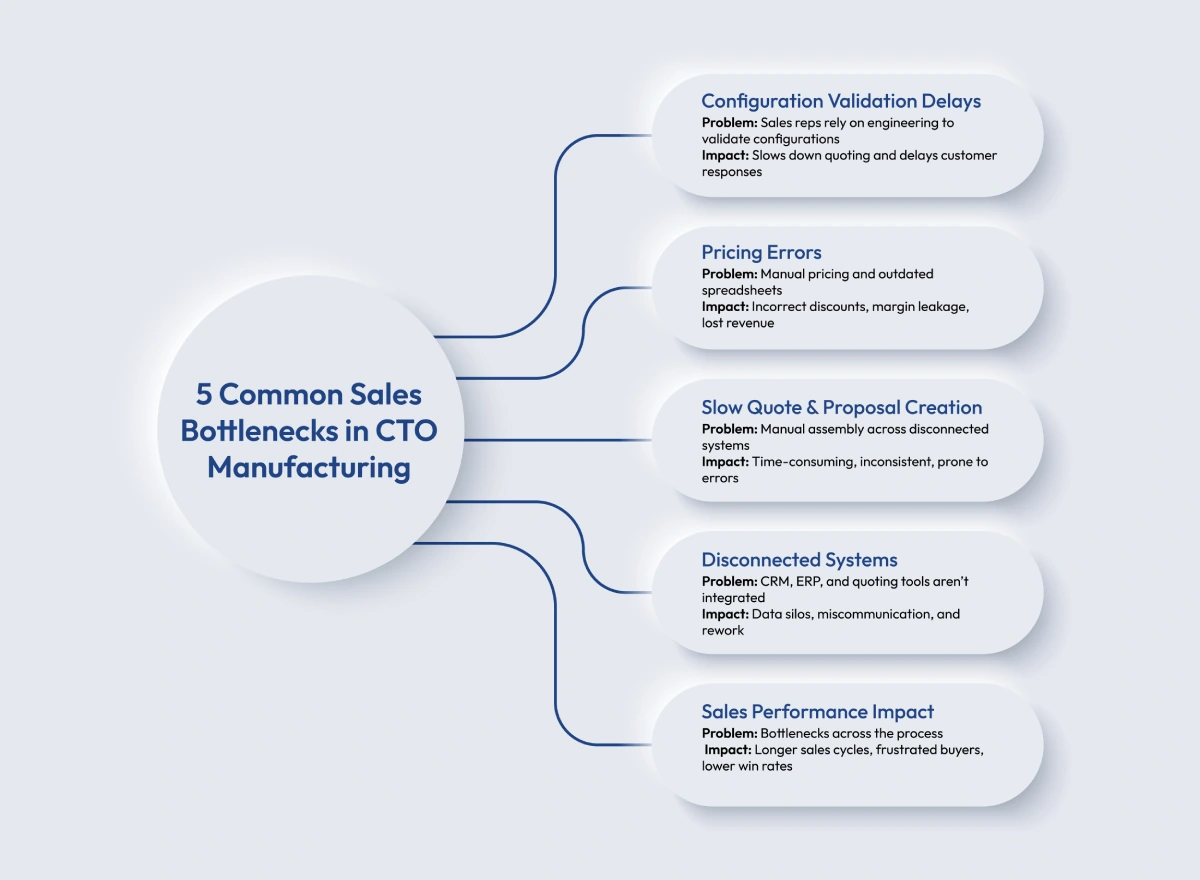
1. Configuration Validation Delays
Sales reps often lack the technical knowledge to configure complex products for which they rely on engineering for validation. This leads to frequent back-and-forth communication. It slows down the quoting process and delays customer response times.
2. Pricing Errors
Using spreadsheets or manual pricing methods increases the chance of errors. Reps may apply incorrect discounts or outdated pricing, which can result in lost revenue or margin leakage.
3. Slow Quote and Proposal Creation
Manually assembling quotes and proposals is time-consuming. Sales teams often switch between multiple systems to gather product, pricing, and customer data which slows down the process and increases the risk of inconsistencies.
4. Disconnected Systems
When CRM, ERP, and quoting tools aren’t integrated, teams work in silos. This leads to miscommunication, repeated data entry, and errors that require rework, further delaying the sales process optimization.
5. Impact on Sales Performance
These bottlenecks cause longer sales cycles, missed deadlines, and lost deals. Customers become frustrated with delays or inaccurate quotes, and sales teams struggle to hit targets due to inefficiencies.
An integrated sales quoting software solution like Cincom CPQ removes these roadblocks, making quoting faster, more accurate, and scalable.
10 Ways Cincom CPQ Drives Measurable Sales Efficiency for CTO Manufacturers
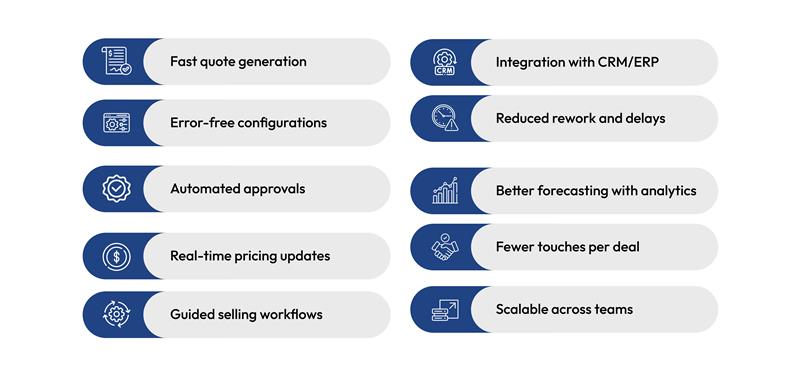
- Eliminates manual work: CPQ automates the entire quoting process. No more spreadsheets, manual pricing, or copying data between systems.
- Reduces quote errors: Built-in pricing rules and product logic ensure every quote is accurate, eliminating the need for rework or corrections.
- Speeds up quote generation: Sales reps can generate complex, customized quotes in minutes instead of hours or days.
- Minimizes approval delays: Automated discount and pricing approvals streamline internal workflows and reduce bottlenecks.
- Guided selling support: Reps receive real-time prompts to select the right products and options based on customer needs. In-depth product knowledge is not mandatory.
- Product visualization tools: Visual configurators help reps and customers see the final product during configuration, making it easier to understand and approve.
- Improves team collaboration: Sales, engineering, and finance use a single platform with shared data and workflows, ensuring better communication and fewer errors.
- Frees up selling time: Reps spend less time on admin tasks and more time engaging with prospects and closing deals.
- Accelerates deal velocity: Faster, error-free quoting leads to quicker decision-making and shorter sales cycles.
- Drives more revenue: With improved efficiency and accuracy, sales teams can handle more deals and convert opportunities faster.
This is why Cincom is the best CPQ system for sales efficiency in CTO environments.
Quoting Velocity Benchmark: Cincom CPQ vs. Manual Spreadsheet Methods
While manual quoting slows deals and invites errors, Cincom CPQ delivers speed, accuracy, and automation. Reports suggest that switching from manual processes to modern sales quoting software reduces the sales cycle by 28%.
| Capabilities | Manual Quoting (Excel, Emails) | Cincom CPQ |
| Quote Creation Time | 2–3 days or more | Under 30 minutes |
| Configuration Process | Manual, error-prone, needs engineering input | Rules-based, guided, self-serve configuration |
| Pricing Accuracy | Depends on manual updates and spreadsheets | Real-time pricing pulled directly from the system |
| Approval Workflow | Email chains, delays, manual checks | Automated, built-in approval logic |
| Document Generation | Manually compiled in Word/PDF | Auto-generated quotes, proposals, and BOMs |
| Risk of Errors | High – due to manual entry and miscommunication | Low – validations built into every step |
| Sales Efficiency Impact | Slower cycles, lost deals, frustrated teams | Faster response times, higher win rates, more revenue |
| Estimated Time Savings | — | Up to 80% faster quote turnaround |
Calculating CPQ Return on Investment (ROI) in Discrete Manufacturing
Implementing a CPQ solution like Cincom CPQ delivers measurable ROI across multiple areas of the sales process.
- Faster Sales Cycles = More Closed Deals
Cincom CPQ shortens the quote-to-order cycle, helping sales teams respond to prospects in minutes instead of days. - Fewer Errors = Reduced Cost of Rework
Rule-based validation ensures quotes are accurate, reducing costly errors and production delays. - Better Pricing Discipline = Margin Protection
Centralized logic and approval workflows help avoid unnecessary discounts and protect profit margins. - Scalability Without Growing Headcount
Handle more quotes, more deals, and more complex configurations without needing to grow the sales team.

Are you still unsure about the impact? Contact us to see how much time and revenue Cincom CPQ can save.
Leveraging CPQ Quoting Analytics for Strategic Sales Intelligence
| Category | Key Benefits |
| Built-in CPQ Analytics | Tracks quoting trends, identifies bottlenecks, and uncovers pricing and discount patterns. |
| Data-Driven Decisions | Enables managers to optimize strategies, coach teams, and plan pricing and resources effectively. |
| End-to-End Visibility | Integrates with CRM/ERP to sync data and provide a single source of truth across departments. |
| Smarter Selling Outcomes | Supports faster decisions, improves forecasting, and aligns sales with operations and finance. |
Summary: Transforming Quoting Efficiency into a Manufacturing Competitive Advantage
Cincom CPQ stands out with its intuitive interface, powerful configuration engine, and seamless integration with CRM, ERP, and eCommerce platforms—making it ideal for complex CTO environments.
Unlike generic tools, Cincom CPQ is purpose-built for industries where customization, compliance, and speed are critical. Its rules-driven engine simplifies complexity, while its scalability supports growing sales.
With decades of experience in CTO manufacturing, Cincom CPQ offers a future-ready platform for sales quoting software that drives real results. For manufacturers looking to lead with sales efficiency, Cincom is the best CPQ system.
Ready to accelerate your sales process? Explore how Cincom CPQ can streamline your CTO quoting.
FAQs
1. How does CPQ software improve sales efficiency in Configure-to-Order manufacturing?
CPQ software automates product configuration, pricing, and quote generation, helping reduce errors and shorten sales cycles. By streamlining repetitive tasks, it also allows sales reps to spend more time engaging customers and closing deals.
2. What is the difference between Configure-to-Order (CTO) and Engineer-to-Order (ETO) quoting?
CTO quoting uses pre-engineered products, components, and rules, allowing reps to configure and price orders quickly. ETO quoting requires more engineering input because products are customized or designed for individual orders. CPQ can support both models.
3. How does Cincom CPQ prevent sales reps from quoting invalid product configurations?
Cincom CPQ uses rules-based configuration to ensure selected components, options, and pricing are compatible. If a rep chooses an invalid combination, the system flags it immediately, preventing errors from reaching the customer or production team.
4. Why is CPQ-ERP integration critical for sales efficiency in complex manufacturing?
CPQ-ERP integration connects sales with accurate product, pricing, and inventory data. This reduces duplicate data entry, eliminates disconnected information, and helps ensure quotes are based on current business and operational data.
5. How much faster can sales teams generate quotes using CPQ compared to Excel spreadsheets?
Traditional quoting with spreadsheets, emails, and manual calculations can take days, especially for complex products. CPQ can automate configuration and pricing to generate accurate, tailored quotes much faster. With Cincom CPQ, quotes can be generated in under 30 minutes.
6. How does automated quote generation reduce the workload on sales engineering teams?
CPQ automates configuration validation, pricing, and other repetitive quoting tasks that often require sales engineering review. This reduces manual workload and allows engineers to focus on complex requirements and higher-value technical work.


