For many organizations, the thought of delivering communications digitally can be challenging. Customers now expect quick, convenient, and personalized communications. Research shows that most organizations are still in the early stages of their digital-communication initiatives. While larger and more innovative enterprises are making progress, many still rely heavily on print and mail.
The opportunity is clear. A recent survey found that only 39% of insurance carriers offer digital delivery of ID cards. That means 61% do not provide this service, even though sending a digital ID card by email or web link is one of the simplest forms of digital client communications. This gap highlights both the progress made and the untapped potential for organizations across industries.
This is where digital customer communication management (CCM) comes into play. CCM platforms provide the tools needed to manage all customer-facing communications in one place. More importantly, they help organizations adapt to customer expectations without losing control over compliance, personalization, and cost.
The key questions for most organizations are:
- How can organizations begin the journey toward digital communications?
- What lessons can be learned from early adopters?
This article breaks down the practical steps, benefits, and challenges of digital customer communication management, showing how businesses can build strategies that meet customer needs today and prepare for tomorrow.
Why Digital Customer Communication Management Matters
Customer communication has become a central part of the customer experience. Every policy update, invoice, or service reminder impacts how people see a brand. In today’s environment, where customers are quick to compare services and switch providers, those perceptions directly impact loyalty and retention.
Sticking with traditional models creates several problems. Customers have to wait for important information to arrive, which leads to frustration. Furthermore, messages from different departments can appear inconsistent, raising compliance risks and confusing customers.
Digital customer communication management changes this dynamic. CCM brings strategy, consistency, and customer preferences to the process. It allows organizations to balance efficiency and compliance with the flexibility that customers expect.

Modernizing Customer Communication Systems: A Critical Step Towards Compliance and Efficiency
Discover how modernizing customer communication systems helps organizations gain a competitive edge.
The Core Strengths of Modern CCM Platforms
Modern CCM platforms provide a foundation for managing customer interactions across multiple formats and channels.
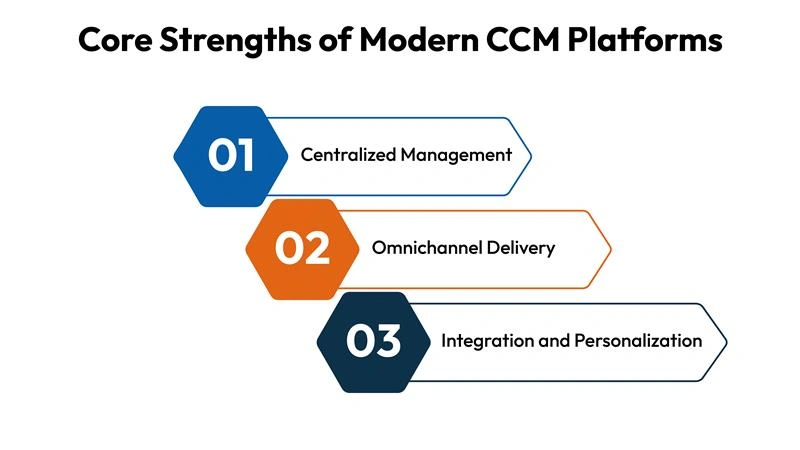
Centralized Management
CCM platforms help organizations create, store, and manage documents in a consistent way.
- Templates and content libraries reduce the risk of errors and ensure brand consistency.
- Built-in approval workflows also help organizations meet compliance requirements.
For industries like insurance, banking, or medical equipment manufacturing, where organizations face strict regulations, centralized management ensures communication is managed accurately and effectively.
Omnichannel Delivery
Customers want to choose how they receive communications. Some prefer the convenience of email. Others still rely on print. Younger customers may expect mobile notifications or online portals. A CCM solution supports all of these channels from a single system. This flexibility means businesses do not need separate processes for each channel. They can create once and deliver everywhere.
Integration and Personalization
Another strength lies in integration. CCM systems connect with CRM and core administration platforms, allowing them to pull in real-time data for accuracy. This integration also enables personalization. Instead of sending generic updates, organizations can use customer information to tailor content, making it more relevant and engaging. A bank, for instance, could include specific account details in a monthly update, while a healthcare provider could add personalized reminders to a treatment plan.
How CCM Enhances Customer Experience
Adopting digital customer communication management is about creating better customer experiences across channels every time. Here are the key benefits that organizations may get:
Faster Delivery – Documents that once took days to complete and arrive can now be sent instantly. Organizations can use emails, SMS, or secure links to ensure customers get the information they need without waiting. For instance, a bank confirming a loan approval or an insurer sending a claim letter can now do it in minutes.
Greater Accessibility – Organizations can provide customers with access to information anytime. Digital documents make this possible. Customers can check records or confirmations on their phone, tablet, or computer at any hour. This reduces dependence on office hours or customer support teams.
Reduced Errors – Manual document preparation often leads to mistakes. Automation reduces this risk by pulling the latest information directly from existing systems, such as CRM systems. Customers get accurate, updated documents every time. For organizations, this builds trust and avoids confusion.
Increased Transparency – Real-time updates keep customers informed at every step. Notifications confirm when a payment is processed, a request is approved, or an order is shipped. This clarity reduces follow-up questions and creates confidence.
Building a Practical Roadmap for Digital Customer Communication Management
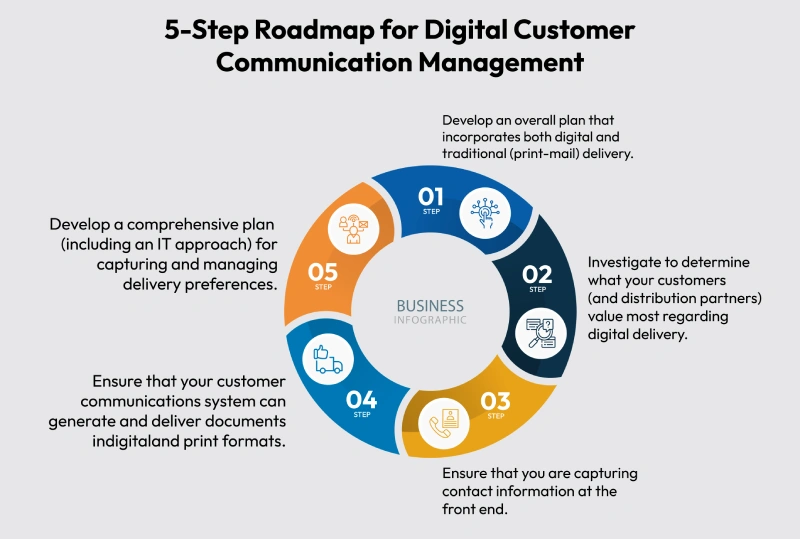
1- Develop an overall plan that incorporates both digital and traditional (print-mail) delivery. Many of the early movers in digital communications are funding their efforts by reducing print and mail costs. Map out a multi-year strategy on how you will ramp up digital delivery and gradually decrease physical paper output and mailings. Consider the assets currently owned for print and mail or the terms of the outsourcing contracts you may have in this area.
2- Investigate to determine what your customers (and distribution partners) value most regarding digital delivery. Of course, there are many types of customer communications, and it is not necessary to digitize all of those right away. And, not everyone is clamoring to get all of their documents via e-mail or their mobile device. Understand which segments are pushing for more digital communications and what specific kinds of documents will provide the highest value.
3- Ensure that you are capturing contact information at the front end. Most legacy administration systems do not capture e-mail addresses or mobile phone numbers for SMS/texting. When independent distribution partners are in the customer-lifecycle loop, it may be even more difficult to secure this information. Consider building the capture of e-mail and mobile phone numbers into standard question sets at the beginning of the customer relationship.
4- Develop a comprehensive plan (including an IT approach) for capturing and managing delivery preferences. Early adopters of digital communications built their own systems or extended legacy systems for this function, but now there are more software providers that are beginning to offer these capabilities within their offerings. It is important to understand customer (and distribution partner) preferences for the delivery of each individual type of document—it should not be just an overall “yes/no” decision. Some customers may want to have certain communications delivered digitally and others printed and mailed, while other customers may opt for all printed and mailed. Bottom line: Each customer will have their own unique needs.
5- Ensure that your digital customer communications solution can generate and deliver documents in traditional print formats and also produce the same content for digital delivery. Ideally, your customer communications system will not only handle traditional and digital communications, but it will also integrate directly with your core administration systems to leverage transactional data to help drive deeper personalization of content as well as delivery preference for each communication.
Conclusion
Digital customer communication management is critical for organizations that want to stay competitive. By adopting a modern CCM solution, they can improve customer experience, reduce costs, and ensure compliance across every interaction.
The journey to digital transformation in customer communication may seem complex, but the path is clear. Start small, capture customer preferences, and build toward omnichannel, personalized communication. Over time, digital client communications become a driver of trust, loyalty, and long-term success.
Digital communication tools for customer engagement create a win-win: customers get the convenience they expect, and organizations achieve efficiency, accuracy, and cost savings.
FAQs
1- What is digital customer communication management (CCM)?
Digital customer communication management is the process of creating and delivering customer communications across digital and print channels from a single platform.
2- Why should organizations invest in a digital CCM solution?
With digital CCM in place, organizations can reduce costs, speed up delivery, ensure compliance, and improve customer experience.
3- What types of communications can be digitized?
Account statements, bills, policy updates, claim letters, and reminders are common starting points for organizations to digitize their communications.
4- How can success with digital communications be measured?
The success of digital customer communication management can be measured by tracking digital adoption, cost savings, customer satisfaction, and engagement rates.