Introduction: The Cost of Inconsistency and Personalization
Acquiring a new customer in 2025 can cost as much as seven times more than retaining an existing one. This is no longer a statistic reserved for boardroom presentations. It is a lived reality for organizations operating in crowded, impatient markets.
Retention, therefore, is not a secondary objective. It is a financial imperative.
In response, organizations often turn to communication. More messages. More channels. More touchpoints. The assumption is simple. If customers hear from the brand often enough, they will stay. But does communication alone solve the problem? The evidence suggests otherwise.
Customers are not overwhelmed by silence. They are overwhelmed by noise. They notice when messages contradict each other. They disengage when communications feel generic, even if they are consistent.
Consistent customer communication is insufficient on its own. A uniform message that ignores context still feels impersonal. What customers now expect is something far more demanding. Communication that recognizes them. That adapts without fragmenting. That speaks with one voice yet listens closely to the individual. This is the new standard. And it is here that many brands quietly fall behind.
Customer Communications as a Core Brand Experience
Every interaction a customer has with an organization contributes, quietly but decisively, to how that brand is understood. Consistent customer communications are not peripheral to the experience. They are the experience.
This is where the importance of brand consistency in communication becomes impossible to ignore. Consistency is not about repetition. It is about recognition. A customer should never need to recalibrate their expectations when moving from one touchpoint to another. The brand should feel familiar, reliable, and intentional, regardless of channel or moment.
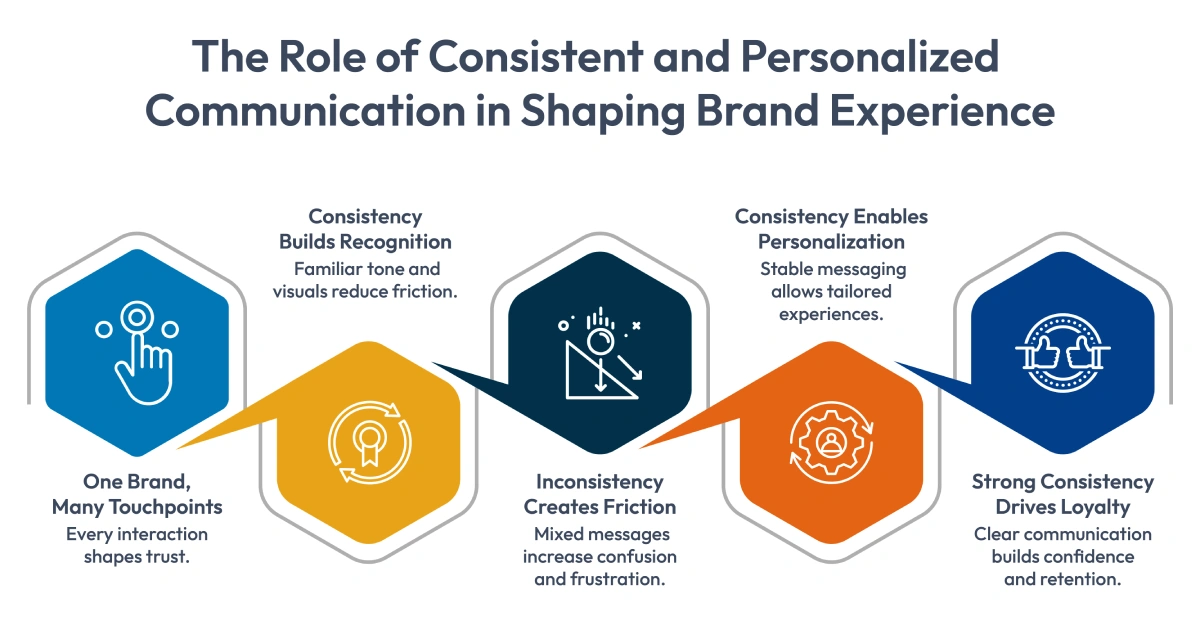
Consistency, however, is not a static achievement. It is an ongoing discipline. As organizations expand channels and accelerate outreach, the risk of dilution grows. The brands that succeed are those that treat communication as a system, not a series of isolated actions. They understand that consistency is the foundation upon which personalization, trust, and lasting customer relationships are built.

4 Key Strategies for Achieving Consistent Customer Communications and Impactful Interactions
4 Strategic Foundations for Consistent and Personalized Customer Communications
Consistency gives a brand its shape. Personalization gives it relevance. As customer expectations mature, organizations are learning that one without the other creates friction. The following four foundations address both, beginning with the one that determines whether anything else will succeed.
#1. Establish Organizational Ownership
Consistent and personalized communication does not emerge organically. It is the result of deliberate ownership. Forward-looking organizations address this by assigning clear accountability for how the brand communicates. This ownership often sits with senior leadership or a cross-functional body empowered to view communications through the customer’s lens rather than a departmental one.
Such ownership enables two critical disciplines. First, regular reviews of customer-facing communications across channels, timeframes, and scenarios. Second, the establishment of shared standards that allow personalization to occur without compromising brand integrity.
Effective organizational ownership typically includes:
- A defined leadership role or governance group responsible for customer communications.
- Periodic audits of letters, emails, statements, and service interactions.
- Clear guidelines that balance brand voice with contextual flexibility.
- Alignment between marketing, legal, compliance, and customer-facing teams.
Organizational Ownership: Impact on Communication Quality
| Without Clear Ownership | With Clear Ownership |
| Fragmented tone across channels | Unified brand voice |
| Personalization applied inconsistently | Personalization applied with intent |
| Reactive communication changes | Proactive, governed evolution |
| Higher risk of brand dilution | Stronger brand recognition and trust |
When ownership is clear, consistent customer communications become a foundation rather than a constraint. Personalization no longer feels improvised. It becomes deliberate, governed, and credible.
#2. Standardize the Communication Infrastructure
Consistency and personalization do not fail because organizations lack intent. They fail because intent is mediated through fragmented systems. A standardized communication infrastructure changes the nature of the problem. Customer communication management software is an architectural decision, which determines whether communication is governed by principle or by convenience.
The strategic value of CCM software for consistent branding and compliance lies in its ability to separate what must remain stable from what can, and should, adapt. This enables:
- Centralized control over brand language, formatting, and tone
- Reusable content components approved by marketing, legal, and compliance
- Rules-driven personalization based on customer data and context
- Reduced dependence on ad hoc documents and manual edits
This level of standardization liberates communication. It liberates it. Teams are no longer burdened with recreating correctness. They can focus instead on relevance. Customers, in turn, encounter communication that feels deliberate, coherent, and attentive without ever appearing formulaic.
#3. Centralize Template and Content Authority
Brands fracture not when messages differ, but when authority does. Content created in parallel inevitably reflects the priorities of its creator rather than the logic of the brand. Over time, this produces communication that is locally optimized and globally incoherent.
Centralizing the template and content authority corrects this imbalance. It establishes a clear hierarchy between what is immutable and what is negotiable. Structural elements, legal language, and brand expression remain fixed. Contextual language adapts. Personalization operates within bounds that are intentional, not improvised.
This distinction is subtle but decisive. Without it, personalization becomes performative. With it, personalization becomes credible.
Centralized content authority enables:
- A single interpretive standard for brand and compliance language.
- Controlled variation without semantic drift.
- Personalization governed by design rather than discretion.
Effect of Content Authority on Communication Integrity
| Fragmented Authority | Centralized Authority |
| Meaning shifts across touchpoints | Meaning remains stable |
| Compliance relies on review | Compliance is structural |
| Personalization feels arbitrary | Personalization feels deliberate |
The value of centralization is not operational efficiency, although it delivers that as well. Its true value lies in preserving meaning at scale. And meaning, once lost, is rarely recovered.
#4. Enable Teams Through Training and Usability
Tools, templates, and rules are inert unless the teams that interface with them understand not just how, but why. Communication becomes consistent not because of software, but because people choose to apply it correctly.
Training is not a one-off event. It is iterative, reflective, and tied to outcomes. Employees must internalize brand expectations, compliance boundaries, and personalization opportunities. Only then can consistency and adaptability coexist naturally.
Key principles for enabling teams:
- Intuitive platforms that require minimal translation from intention to action.
- Continuous skill reinforcement rather than episodic training.
- Visibility into approved content and personalization rules.
- Feedback loops that allow teams to learn from each interaction.
Teams empowered in this way are confident. They navigate the tension between uniformity and individuality. They deliver communications that are coherent, compliant, and personally resonant. In other words, they transform structured systems into living, responsive experiences for customers.
Organizational Focus: Establishing Communication Audits
Maintaining consistent customer communications at scale requires structured oversight—a mechanism to measure, evaluate, and correct communications across every touchpoint. Communication audits provide that mechanism.
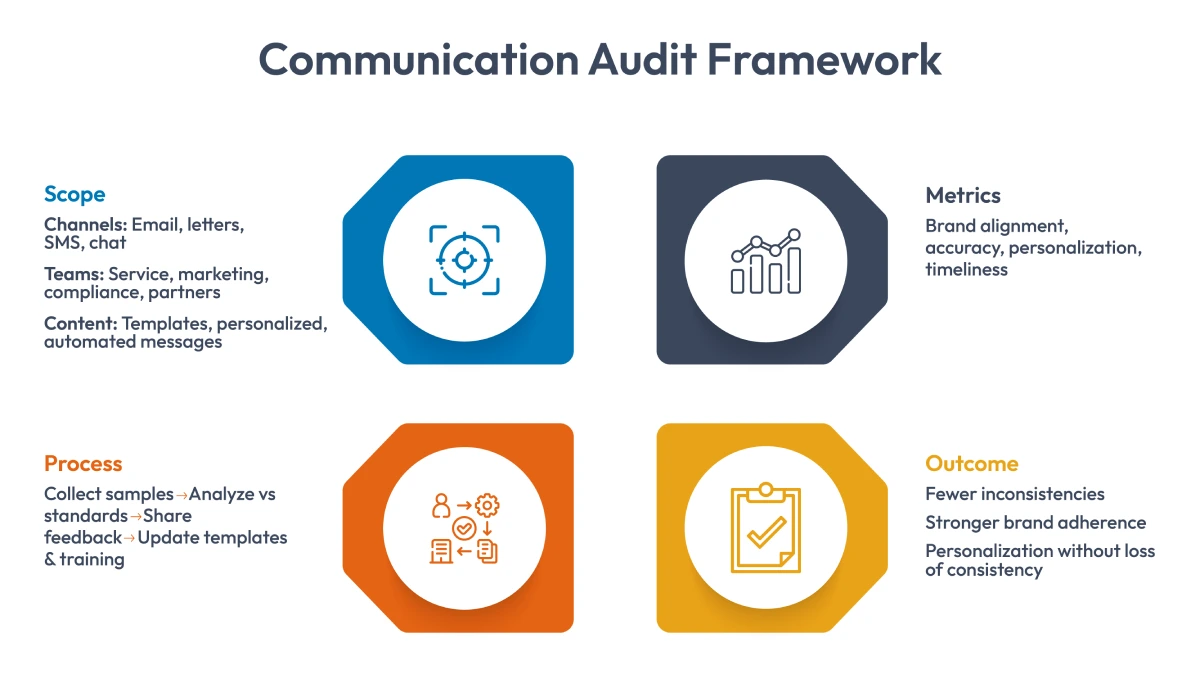
A structured audit process transforms oversight from reactive to proactive. It ensures consistent customer communications by design. Teams understand what matters, gaps are revealed early, and the importance of brand consistency in communication becomes actionable rather than aspirational.
Common Software Platform: Migrating to a Single CCM System
Consistency in customer communications is only achievable when every message originates from a controlled, unified environment. Migrating to a single CCM system directly addresses these risks. It clarifies ownership, enforces standards, and provides a framework where personalization is precise rather than improvised. This demonstrates the role of CCM in customer experience (CX) and operationalizes how to achieve consistent customer communications.
Benefits of a single CCM system:
- Unified Content Repository: All customer-facing content lives in one source of truth, reducing duplication and drift.
- Automated Compliance Enforcement: Legal and regulatory checks are embedded in the system, minimizing manual review.
- Template Standardization: Teams work from approved templates, ensuring consistent brand expression across channels.
- Controlled Personalization: Rules-based personalization adapts content without compromising brand integrity.
- Data-Driven Insights: Analytics monitor engagement, errors, and process efficiency, allowing continuous improvement.
Migrating to a single CCM platform for consistent branding and compliance is an operational pivot. Teams gain clarity, errors diminish, and every customer touchpoint reinforces both brand consistency and personalized relevance.
Conclusion: Shaping Customer Communication in 2026
As we move into 2026, communication is the architecture of brand perception. Consistent customer communications provide the structural coherence necessary to be recognized and trusted. Personalization, executed with precision, transforms those structures into experiences that resonate individually.
Organizations that integrate governance, centralized content authority, unified CCM platforms, and empowered teams do more than prevent errors—they orchestrate dialogue that feels deliberate, relevant, and anticipatory.
Consistency ensures clarity; personalization imparts nuance. Together, they create a living brand language, one that evolves without losing integrity.
Master consistency and personalization in 2026. Empower your teams with Cincom Eloquence to deliver every message with precision, relevance, and impact.
FAQs
1. Why is consistent customer communication critical for modern businesses?
Consistent customer communications reinforce trust, reduce errors, and ensure customers perceive a unified brand across all interactions.
2. How can organizations measure the effectiveness of their communication strategy?
Audits, engagement analytics, and feedback loops help evaluate the importance of brand consistency in communication and identify improvement opportunities.
3. What role does CCM software play in delivering a seamless customer experience?
CCM software for consistent branding and compliance centralizes content, enforces standards, and enables personalization, elevating the role of CCM in customer experience (CX).
4. How can teams maintain flexibility while keeping communication consistent?
By implementing governance frameworks and controlled personalization, teams can adapt messaging to context without compromising brand integrity.
5. What are practical steps for achieving consistent communication at scale?
Define ownership, centralize templates, standardize platforms, train teams, and leverage CCM software for consistent branding and compliance to operationalize how to achieve consistent customer communications.