Customers today move easily between multiple communication channels. They might open your email in the morning, check a delivery update on their phone at noon, and receive a printed invoice by evening. Every one of those moments shapes how they feel about your brand.
Now imagine what happens when those channels don’t talk to each other. The message gets lost in translation. Emails say one thing. Text messages say another. Printed letters follow their own format. What customers experience is not multi-channel communication—it’s a collection of disconnected voices.
This is the silent struggle behind many customer experiences. Organizations don’t set out to confuse their customers. They simply built their communication systems one piece at a time—an email tool here, a print vendor there, an SMS gateway somewhere else. Over the years, those pieces turned into silos.
When Communication Lives in Silos
In many companies, communication is split between departments. Marketing handles promotions. Operations send updates. Finance takes care of billing. Each team uses its own tools and templates.
Although this seems to be an efficient way of managing communication, it can create a quiet storm of confusion in the sea of multi-channel customer communication.
- Inconsistent branding: A marketing email might look modern, while the invoice still has an outdated logo or terms. Customers notice these differences even if you don’t.
- Clumsy customer experience: When systems don’t share information, one channel can’t see what another has already done. This creates confusion for customers receiving communication from different channels.
- Costs and workload rise: Every tool has its own process, vendor, and training needs. Teams can mistakenly repeat tasks, leading to excessive workload.
- Losing the bigger picture: Without a comprehensive view of customer interactions, teams can fail to see which type of communication is working best, or how people respond across channels.
What a Unified Multi-Channel Communication Software Offers
Imagine if all your customer messages, including emails, texts, and printed letters, came from one place. No separate tools and no juggling multiple systems. That’s what a Customer Communication Management (CCM) platform does.
It uses shared templates and real-time data from your core systems. That means an invoice, a shipping update, or a policy renewal notice all pull from the same approved content. One source of truth. One version of every message.
No manual edits. No missed updates. Everyone on your team works with the same correct information.
This makes life simpler for your team. It saves time. It reduces errors. And it makes your multi-channel communication feel polished and professional.
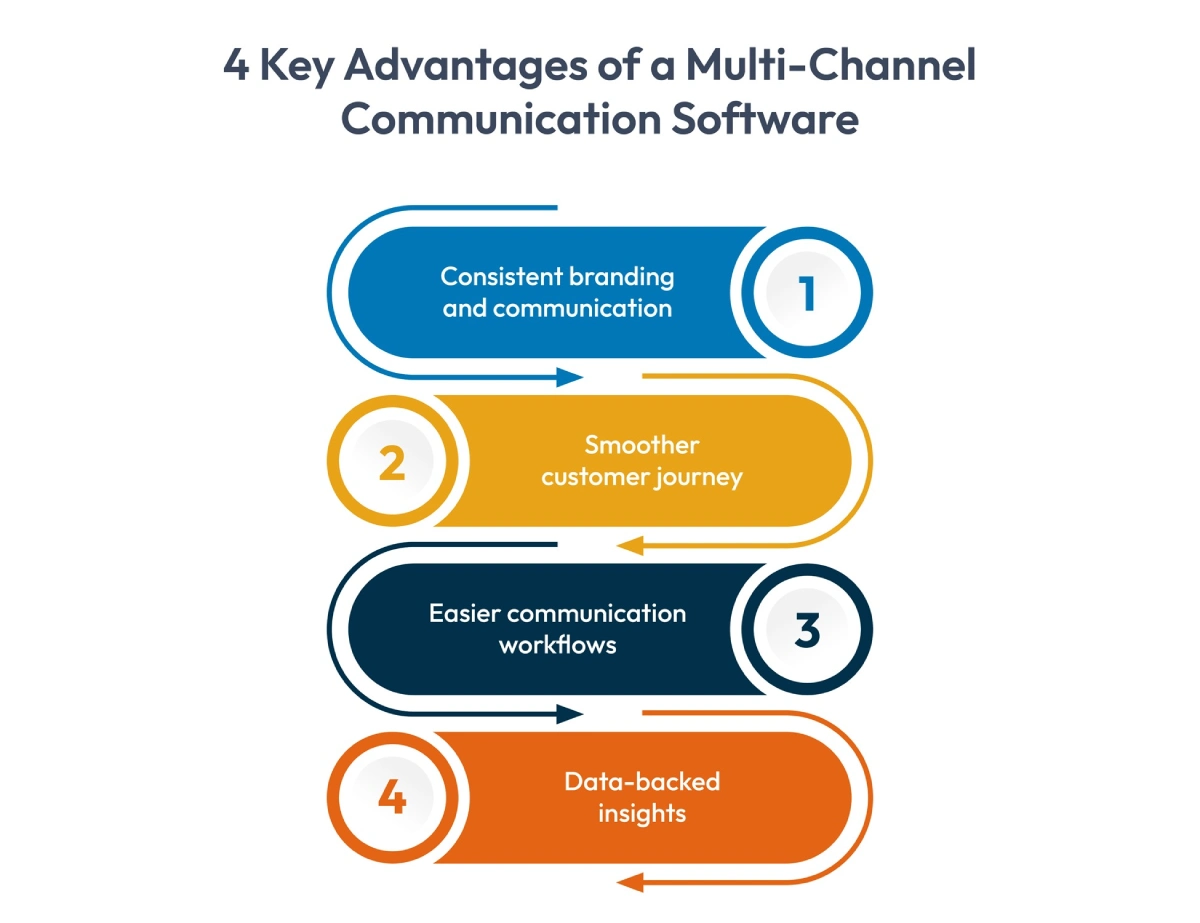
Why Multi-Channel Communication Matters
Here are key benefits of multi-channel communication that organizations can gain:
1. Every Message Feels Like Your Brand
Your organization’s communication should be instantly recognizable, whether someone opens an email, reads a text, or holds a letter. A multi-channel communication tool makes that easy.
Consistency builds trust. Customers start to recognize your voice and style. They know what to expect. And they remember your brand for the right reasons.
2. The Customer Journey Feels Smooth
When everything is centralized, customer preferences travel with them. Someone who prefers email won’t suddenly get texts from another department. Every interaction feels thoughtful and respectful.
It also helps with privacy and consent rules. Everything is stored and applied in one place. You don’t have to worry about accidentally sending messages the customer opted out of.
3. Workflows Become Easier
Switching between multiple tools takes time and energy. One multi-channel communication software simplifies all of that. Teams can focus on creating messages, not figuring out which system to use.
Making updates is faster too. Change a policy statement once, and it updates in emails, letters, and texts. Everyone is working with the latest information.
4. You See What Actually Works
Data is powerful, but only if it’s in one place. A CCM platform gives you a clear view of what works and what doesn’t work. Small insights like this let you fine-tune your communication and get visible results instantly.
How to Bring It All Together
Moving your multi-channel customer communication to one platform doesn’t have to be complicated. Here is how you can do it in your organization.
1. Review Your Current Messages
List all communications or documents your organizations produce, such as emails, texts, letters, notifications and alerts. Note which teams handle them and which tools they use. This shows where gaps and overlaps exist.
2. Choose a Platform and Start Small
Pick a CCM software that can handle all your channels and integrates with your core business systems. Begin with one type of communication, like invoices or account alerts. Test it, make adjustments, then expand.
3. Create Templates That Work Everywhere
Create templates that help you generate professional-looking documents quickly and effectively across all channels. Test them in email, SMS, and print to ensure consistency.
4. Train Your Teams and Monitor Results
Make sure everyone knows how to use the platform. Once live, track engagement, errors, and efficiency. Use the insights to improve and gradually add more messages.
Once you’re ready to unify multi-channel communication, the next step is choosing the right platform to make it happen. That’s where Cincom Eloquence fits in.
Cincom Eloquence is a Customer Communications Management (CCM) solution that helps you design, deploy, deliver, and manage all of your customer messages from one place. It handles both batch and real‐time distribution across channels. It also connects smoothly with your existing systems, including CRM, ERP, or policy management software, so every document has access to real-time and accurate data.

Discover how HM Insurance Group improved document generation and enhanced efficiency to meet high-volume demands.
Looking Ahead
Communication channels keep multiplying. Email, text, print, mobile apps—they’re all part of the multi-channel communication mix now. Managing them separately is no longer practical.
When every message comes from the same system, your brand speaks with one voice. Customers get messages that are clear, consistent, and professional. Teams spend less time juggling tools and fixing mistakes. Costs drop because there’s less duplication. Customers feel like they are dealing with one organization and not different departments working in silos.
A CCM platform ensures that every message comes from the same foundation. Templates, content, and data are shared between teams as a single source of truth. Ultimately, messages are accurate, timely, and personalized.
Customers might never see the platform behind the scenes. However, they will feel the difference. Every email, text, and letter will feel seamless. Every interaction will feel intentional.
FAQs
1. Why should companies use a multi-channel communication system?
Tools working in silos can create mistakes and lead to disconnected communication. As a result, customers may see mixed messages. A multi-channel communication system keeps messages consistent and makes work easier for teams.
2. How does multi-channel communication improve customer experience?
A multi-channel communication tool ensures that messages arrive on time, follow customer preferences, and every interaction feels clear and professional.
3. How does a CCM platform keep branding consistent?
A CCM platform uses approved templates and designs that ensure every message follows the same style, tone, and format. Customers see the same brand identity on every channel.
4. How does a CCM platform save time and effort?
With CCM software in place, teams no longer switch between tools. Updates happen in one place. Workflows are simpler. Mistakes are reduced.
5. Will a CCM platform work with existing systems?
Most CCM platforms connect with CRM or ERP systems. This integration ensures that customer data stays accurate, and messages reflect current information.