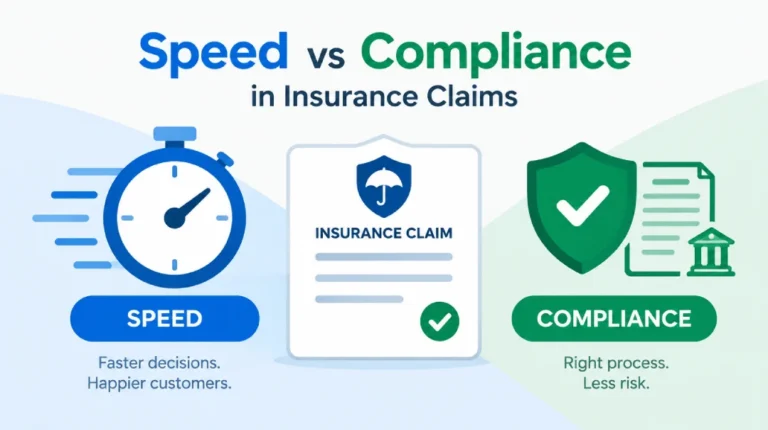
Financial institutions carry a two-fold responsibility when it comes to customer communications. They must meet compliance and regulatory requirements to be audit-ready while creating a seamless journey that offers valuable customer experience.
For decades, these responsibilities were handled by separate teams with separate priorities. As a result, gaps showed directly in the client’s experience. They had to pay the price through cumbersome processes, repetitive documentation requests, and communications written more for legal sign-off than for the reader receiving them. That said, this separation is no longer sustainable for modern financial organizations. They need to treat compliance and customer experience as two sides of the same coin.
Organizations today are redesigning how compliance is integrated into the customer experience journey. This is what compliance-driven CX means in practice. Let us dive deeper into it.
What Compliance-Driven CX Means for Financial Institutions
At its core, compliance-driven CX is about removing the wall between regulatory obligations and client-facing communications. Legal requirements do not disappear, but they are embedded into workflows in a way that makes sense to the client.
Consider a customer going through onboarding. Under a traditional model, they submit documents, wait, receive a request for additional information, wait again, and eventually receive a communication written in language only a compliance officer would recognize. Under a compliance-driven model, the same requirements are met — but the client knows what is needed, why it is needed, and what happens next. The regulatory outcome is identical. The client experience is fundamentally different.
This requires legal, product, compliance, and communications teams to work from the same brief. It is an organizational change as much as a technological one.

Safeguard Your Client Relationships: Mitigate Risks with a Modern Customer Communication Compliance Solution
Why Compliance-Driven CX has Become a Priority
Several reasons have led the concept to become a top priority for financial organizations today.
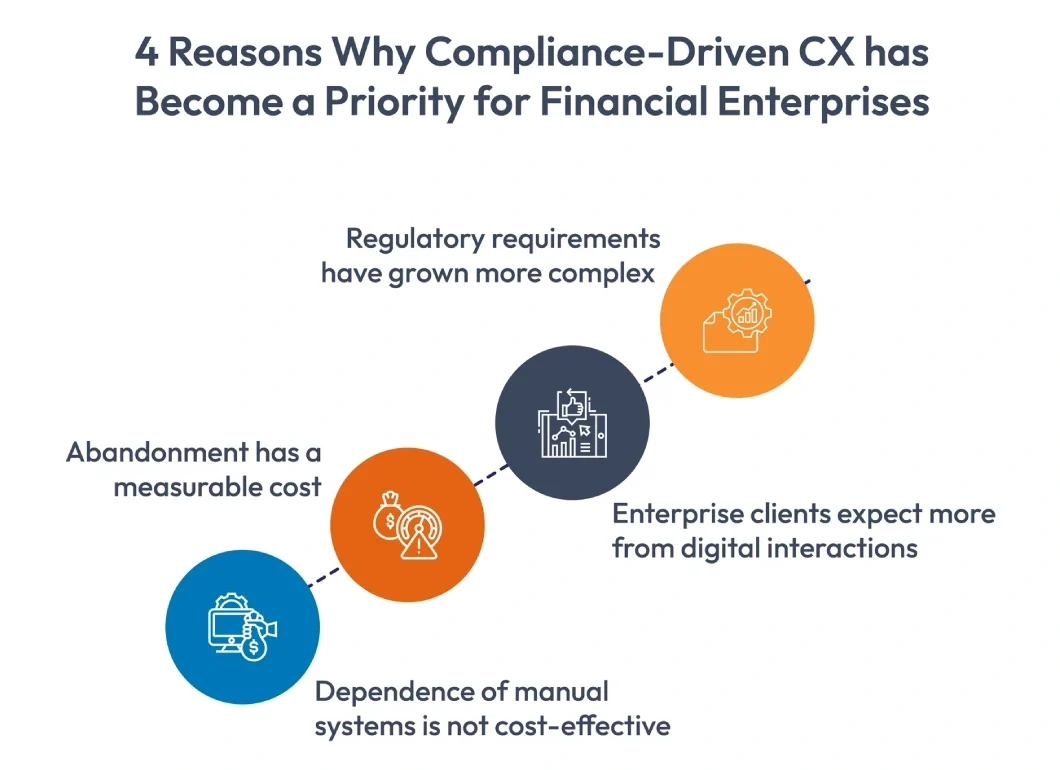
Regulatory requirements have grown more complex
The compliance surface area for financial institutions has expanded considerably over the past years. Institutions must collect more information, manage it properly, and document everything. As this burden has grown, so has its visibility to clients. More requirements, handled poorly, means more friction.
Enterprise clients expect more from digital interactions
B2B clients have less tolerance for friction in compliance processes than ever before. When onboarding takes too long or documentation requests are unclear and repetitive, clients question whether the institution can manage more complex aspects of the relationship efficiently.
Abandonment has a measurable cost
When a client exits an onboarding process midway, that relationship is rarely recovered. The institution loses not just the client, but the time and resources already invested in acquiring and partially processing them. Poorly designed compliance steps are a direct and often underestimated source of that loss.
Dependence of manual systems is not cost-effective
Many enterprises are still running manual compliance workflows. However, the tools to replace these processes exist and are widely adopted. That said, continuing to rely on manual systems is a choice that carries real cost, both operationally and in the client experience.
The Challenges Enterprises Face in Getting This Right
Despite clear motivation, most institutions encounter the same set of obstacles when trying to integrate compliance into client experience.
Fragmented communication ecosystems
Client communications get generated from multiple systems, including onboarding platforms, core banking tools, CRMs, and document generation solutions. Each carries its own copy of client data and its own version of compliance language. So, a client goes through onboarding on one system, receives a regulatory disclosure from another, and gets a follow-up that does not align with either. That is not just a frustrating experience but a compliance exposure. Outdated, duplicated, or misaligned messages across touchpoints are hard to defend when scrutiny arrives.
Lack of centralized control over compliance content
Regulatory language does not stay static. When requirements change, every disclosure across every channel needs to reflect that change quickly. For most enterprises, that rollout is manual and spread across multiple teams. Updates are slow. Outdated language lingers. From a regulatory standpoint, that is a liability. From the client’s standpoint, receiving inaccurate information from their financial institution is simply not acceptable, regardless of the internal reason.
Static, one-size-fits-all regulatory communications
Compliance documents are written to cover every possible scenario, which means no single client receives something written specifically for them. For many enterprises, this results in documents that are long, partially relevant, and difficult to act on. When clients cannot quickly identify what applies to their situation, it creates delays and unnecessary back-and-forth with support teams.
Limited visibility and audit traceability
When client communications are spread across disconnected systems, there is no single place to confirm what was sent, to whom, and when. Responding to a regulatory query means manually pulling records from multiple sources, which could be a slow process that becomes a serious liability as compliance requirements continue to grow.
Over-dependence on IT for communication changes
At many enterprises, updating a disclosure or modifying a client communication requires an IT request. This creates a lag between when a regulatory change is identified and when it actually reaches the client. Compliance and business teams cannot afford to wait on development cycles every time communication needs to change.
How CCM Addresses These Challenges
Financial enterprises do not need multiple tools to enable CX compliance relationship; they need one solution that connects compliance, content, and delivery in a single system. That is where the Customer Communications Management (CCM) platform comes into the picture. CCM tools like Cincom Eloquence replace fragmented workflows with centralized control, giving compliance and business teams the ability to manage every client-facing communication without operational bottlenecks.
- All client communications, including disclosures, onboarding documents, account correspondence, generated and managed from one place, eliminating channel inconsistencies.
- Client communications tailored to specific account structures, jurisdictions, and product holdings rather than generic templates that miss the mark.
- Every communication is automatically tracked and logged, so regulatory queries are answered in minutes rather than days.
- Regulatory updates applied centrally and pushed across every channel without manual intervention or IT involvement.
- Compliance and operations teams are empowered to update and deploy communications independently, without waiting for development queues.
Conclusion
CX compliance will always be a non-negotiable part of financial services. The question is not whether enterprises meet their regulatory obligations; it is whether they do so in a way that strengthens or weakens client relationships.
A CCM platform gives enterprises the infrastructure to change that by enabling centralized control, automated updates, personalized communications, and complete audit traceability.
The starting point is an honest audit of where compliance friction is costing you client confidence today. From there, the path to a better experience for your clients and your compliance teams will be clearer.
FAQs
1. What is compliance-driven CX in financial services?
Compliance-driven CX is the practice of embedding regulatory requirements directly into client-facing communication. Rather than treating compliance as a separate function, institutions design their processes so that mandatory steps feel like a natural part of the client’s journey, without compromising regulatory standards.
2. How does a fragmented communication setup create compliance risk?
When client communications are produced across multiple disconnected systems, consistency cannot be guaranteed. Different channels may carry different versions of compliance language, outdated disclosures may remain in circulation, and there is no central record of what was sent to whom. Each of these gaps represents both a client experience failure and a regulatory liability.
3. How does a CCM platform support regulatory audit readiness?
Every communication processed through a CCM platform is automatically logged with a complete record of what was sent, to whom, through which channel, and when. When a regulatory query is raised, that information is available immediately. Financial enterprises no longer need to manually reconstruct communication histories from multiple systems under tight deadlines.
4. Can a CCM platform handle the personalization requirements of complex B2B relationships?
Yes. Using built-in conditional logic and real-time data integration, a CCM platform tailors compliance communications to each client’s specific account structure, jurisdiction, and product holdings.