Let’s be honest about something the vendor brochures won’t tell you: most CCM platforms sold to healthcare organizations today are not actually built for healthcare. They’re horizontal platforms with a HIPAA compliance checkbox added somewhere in the sales deck. And for organizations managing chronic care populations, where patient communication isn’t a marketing function but a clinical one, that distinction matters enormously.
HIPAA-compliant patient communication isn’t about slapping encryption onto your existing outbound messaging workflow. It’s about rethinking how PHI moves through your organization from the moment a communication is triggered to the moment it’s confirmed delivered. That’s a systems problem. And it requires a platform built to solve it, not one that’s been retrofitted.
This blog is for the compliance leads, IT directors, and patient experience operators who already know the basics and need a sharper lens on what “compliant” actually demands from a CCM platform in practice.
What Is HIPAA and Why It Impacts Patient Communication?
HIPAA is a 1996 law applied to modern communication systems. That gap creates ambiguity.
The law, through the Privacy Rule, Security Rule, and Breach Notification Rule, was not designed for email, SMS, patient portals, or automated outreach. Regulators have had to interpret it as technology evolved, and those interpretations are not always consistent.
In practice, HIPAA compliance in patient communication is ongoing risk management.
- The Privacy Rule defines what PHI can be shared and with whom
- The Security Rule defines how ePHI must be protected
- The Breach Notification Rule defines what happens when controls fail
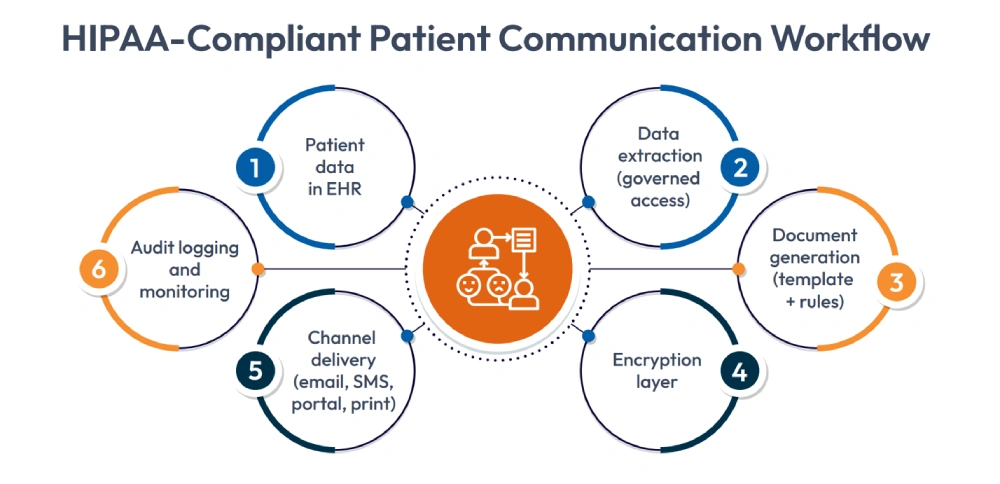
These apply to every outbound communication: appointment reminders, billing notices, care updates, discharge follow-ups, and lab notifications, anything that can identify a patient and relate to their care.
A common mistake is treating clinical communication as regulated and administrative communication as low risk.
It isn’t.
A billing statement with a name and procedure is PHI.
An appointment reminder mentioning a specialist, like oncology or psychiatry, can expose sensitive information through context.
The scope is broader than most teams assume. Most communication systems don’t enforce that boundary consistently.

Want a framework for auditing your current communication infrastructure against HIPAA requirements?
Common Challenges in Maintaining HIPAA-Compliant Communications
1. Protecting PHI Across Communication Channels
The omnichannel imperative has created a compliance problem that healthcare organizations underestimate until they face an OCR audit.
Every channel has its own threat model. Email is vulnerable to interception and misconfigured delivery. SMS runs through carrier infrastructure outside your control. Physical mail has chain-of-custody risks. Patient portals introduce authentication vulnerabilities. When organizations use separate tools for each channel, the security posture is only as strong as the weakest configuration.
The core issue is consistency. A patient who receives an encrypted portal message one week and an unencrypted SMS the next hasn’t experienced different service levels. They’ve experienced a compliance gap.
2. Managing High Volumes of Patient Communications
Chronic care management operations don’t work in small batches. A mid-sized health system may generate hundreds of thousands of patient touchpoints monthly, like care gap alerts, medication reminders, post-visit summaries, and enrollment communications.
At that volume, human review is not a meaningful compliance control.
Compliance only scales when the platform enforces it. Templates must be governed. Data pulls must be scoped. Delivery paths must be configured, not chosen as ad hoc. When these controls are embedded in the platform, they hold under volume pressure.
3. Risks of Manual or Fragmented Systems
The average cost of a healthcare data breach, according to IBM, is nearly $11 million per incident. That figure matters because it reframes the cost of not investing in compliant infrastructure.
Organizations that hesitate on CCM platform costs often ignore what they’re effectively self-insuring against by maintaining fragmented systems.
In 2024, over 275 million individuals had PHI exposed across 725 large breaches reported to HHS OCR, the third consecutive year exceeding 700. A significant share of these incidents traces back to fragmented, manually managed communication environments.
Do you think your organization is facing the same challenges? It’s time to find a solution. Schedule a Demo Now!
How CCM Platforms Support HIPAA Compliance
There’s a difference between a CCM platform that supports compliance and one that enforces it structurally. The former provides tools. The latter makes non-compliance harder than compliance. Cincom Eloquence falls into the second category, and that distinction shapes how PHI is handled in motion.
1. Secure Document Generation and Delivery
Document generation is a common source of PHI exposure. It’s where structured data is assembled into human-readable outputs.
If this process isn’t governed, if templates can pull unnecessary data or drafts exist in unencrypted states, the generation layer becomes a risk.
A properly designed CCM platform controls this process. Templates are approved in a controlled environment. Data sources are limited to what is necessary. Once generated, documents move through delivery workflows with predefined security controls, no manual decisions are required.
2. Encryption and Data Protection
ePHI must be encrypted at rest and in transit. TLS 1.2 minimum for transmission. AES-256 for storage.
Any platform that doesn’t meet these standards should not be used for patient communications.
Where issues arise is in multi-system environments. Data encrypted within a CCM platform can be exposed when passed to an unencrypted third-party service or cached in middleware without equivalent protections.
Vendors should be evaluated based on the encryption posture of every system their platform interacts with, not just the core platform.
3. Access Controls and Authentication
Role-based access control is expected. What matters is how granular and enforceable it is.
Platforms that allow broad access because granular control is difficult are prioritizing implementation ease over compliance.
Multi-factor authentication is essential. Credential-based breaches remain one of the most common causes of healthcare data exposure, making MFA a baseline requirement and not an enhancement.
Key Features Your CCM Platform Must Support for HIPAA Compliance
1. End-to-End Encryption for Communications
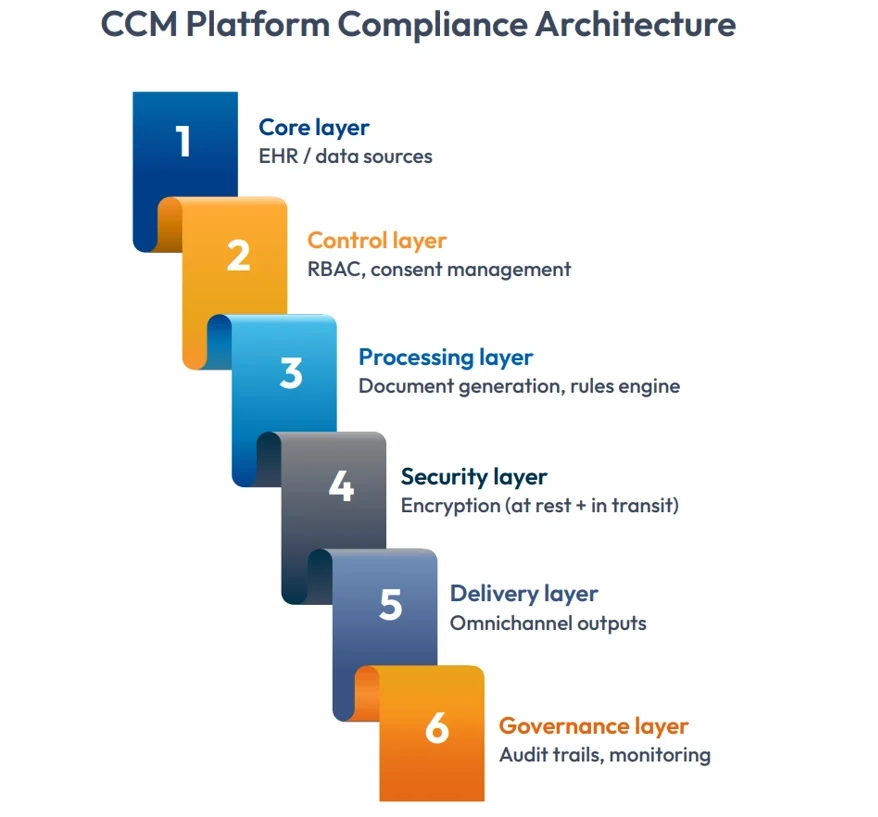
End-to-end encryption means data is protected across its entire lifecycle, not just the segments your vendor controls. When evaluating platforms, focus on what happens to PHI at integration points, when it’s pulled from your EHR, passed to a delivery partner, and stored in logs. These are the seams where encryption breaks down.
2. Role-Based Access Control (RBAC)
The principle of minimum necessary access is a requirement for HIPAA. RBAC operationalizes it. A CCM platform should offer fine-grained role architecture, not just “admin” and “user”, but roles mapped to communication types, patient populations, and workflow stages. These roles must be enforced by the platform, not by staff behavior.
3. Audit Trails and Activity Logging
HIPAA requires risk assessments, audits, and documented policies on data access and use. Audit trails make these requirements actionable.
Many organizations discover their audit logging is incomplete. They can confirm a message was sent but not who approved the template, who accessed the patient record, or what data was used. Complete audit trails capture the full action chain, not just delivery. If logs cannot reconstruct the lifecycle of a communication, they will not hold up in an investigation.
4. Secure Omnichannel Communication Options
The risk in omnichannel communication is inconsistent governance. A CCM platform that secures email but routes SMS through a third-party tool with weaker controls creates exposure.
The platform must enforce security across all channels, ensuring encryption, consent enforcement, and logging behave consistently across email, SMS, portals, and print.
5. Integration with Electronic Health Records (EHR) Systems
Ungoverned EHR integration is a compliance risk. Each time PHI is extracted into a system without equivalent controls, a secondary PHI environment is created.
A CCM platform must integrate with EHR systems through governed, audited data pipelines, with scoped access, logged transfers, and no uncontrolled data persistence.
Benefits of HIPAA-Compliant Communication Automation
1. Reduced Compliance Risk
The argument isn’t that compliant CCM platforms eliminate risk. They don’t. The argument is that they shift the risk profile from unpredictable human error at scale to bounded platform-level failure, which is a more manageable compliance posture. Human error is invisible until it surfaces. Platform-level control failures show up in monitoring, logs, and exception reports. They are catchable before they become reportable.
2. Improved Patient Experience
Research links effective, confidential health communication to improvements in patient outcomes, treatment adherence, and satisfaction scores.
That finding gets used a lot in marketing materials, usually stripped of its more interesting implication: patients who don’t trust that their information is protected disengage. They withhold information, avoid outreach, and limit interaction with care teams. The clinical consequences of communication distrust are real and show up in outcomes data before they appear in satisfaction surveys.
Secure communication is not just a compliance requirement. It is a prerequisite for effective patient engagement, particularly in chronic care management where communication extends over long periods.
3. Operational Efficiency for Healthcare Providers
Fragmented communication systems create compliance risk and operational drag that compounds over time. Staff spend time managing multiple platforms, reconciling consent records, manually reviewing communications, and troubleshooting delivery failures across disconnected tools. That cost is real and recurring.
A unified CCM platform like Cincom Eloquence, with compliance built into the architecture, eliminates most of this, not as a side benefit, but as a direct result of the same architectural decisions that enable compliance.
See how a workers’ compensation insurer reduced compliance risk and improved document communications with Cincom Eloquence.
Best Practices for Implementing HIPAA-Compliant Patient Communications
- Audit before you implement: The most common mistake is mapping new platform capabilities onto existing broken workflows. Before configuring a CCM platform, document every patient communication touchpoint you have, including channel, content, data source, frequency, and current security posture. The gaps will reshape your implementation priorities.
- Treat BAAs as a precondition, not a formality: Every vendor in your communication stack that touches PHI needs a signed Business Associate Agreement (BAA) before the relationship is operational. This includes your CCM vendor, delivery partners, and any middleware services. The BAA is not just legal protection; it extends your compliance obligations downstream and provides recourse when a vendor fails.
- Consent architecture belongs to enrollment, not delivery: Building consent capture into the communication workflow itself, prompting for consent at the point of sending, is architecturally flawed and a compliance risk. Consent must be captured during patient intake and enrollment, stored in a system of record, and surfaced to your CCM platform at the point of communication selection. This is the only model that scales.
- Train the whole team, not just IT: HIPAA guidance requires education across clinical and administrative roles, covering secure data transmission, device protocols, and breach prevention. A CCM platform with strong controls can still be undermined by staff who do not understand the risks, for example forwarding patient communication to personal email. Technology governs behavior to a point. Informed staff govern the rest.
- Run your incident response plan before you need it: The 60-day breach notification window sounds generous until you are trying to determine which patients received a communication, through which channel, and containing which PHI. Organizations that rehearse this process understand where their CCM platform supports them and where it creates friction. Others discover this during an incident.
Strengthening Patient Trust Through Secure Communication
There’s a version of this conversation that treats HIPAA compliance as a cost of doing business, a regulatory burden managed at minimum effort. That framing is understandable, especially for organizations under margin pressure. But it is shortsighted.
Healthcare organizations that invest in compliant communication infrastructure, not checkbox compliant but architecturally compliant, gain more than regulatory coverage. They build patient relationships that support long-term engagement. They create staff workflows that do not generate compliance debt. They maintain audit readiness without emergency remediation when OCR shifts enforcement priorities.
Cincom Eloquence is built for this approach. Not compliance as a feature. Compliance as infrastructure, so every patient communication reflects what the organization stands for.
If your communication workflows are difficult to govern or audit, it’s time to rethink the architecture. Talk to an Expert!
FAQs
1. What is HIPAA-compliant patient communications?
Any patient-facing message, digital or physical, that protects PHI through technically sound, documented safeguards. The channel does not determine compliance. The architecture around it does.
2. How does HIPAA affect patient messaging and notifications?
Every outbound message containing PHI, clinical or administrative, falls under the Privacy and Security Rules. That means encryption, access controls, consent management, and audit logging are not optional for appointment reminders or billing notices.
3. What features should a CCM platform include for HIPAA compliance?
End-to-end encryption, fine-grained role-based access control, complete and immutable audit trails, governed omnichannel delivery, and native EHR integration, backed by a signed BAA and a vendor whose security posture extends to every system they touch.
4. Can healthcare providers send patient communications via email or SMS under HIPAA?
Yes, with conditions. Encrypted emails are compliant. Unencrypted email requires documented patient acknowledgment of transmission risk. SMS requires a secure delivery layer or explicit consent, plus logging. The channel is not the issue. The controls around it are.
5. How do CCM platforms protect patient data?
By making compliant behavior the default rather than the exception, through encryption enforced at the platform level, access governed by role, every action logged for auditability, and integration architectures that do not create ungoverned secondary PHI environments.