Introduction
Customer communication has moved from being a back-office task to a visible measure of competence and trust. Every message carries an expectation of relevance, timing, and clarity, and those expectations surface immediately when communication feels delayed, generic, or disconnected from the situation that triggered it.
At the same time, IT teams face mounting pressure from system responsibilities that leave little room for frequent template revisions. Communication changes arrive continuously, driven by regulatory shifts, operational updates, and customer events that demand precision rather than technical interpretation.
This reality has forced organizations to reconsider who should guide communication template changes. Business users operate closest to customer intent, timing, and language, and their proximity to these elements shapes communication that feels deliberate rather than procedural. Bringing business users into communication template development acknowledges where communication insight truly lives and why it matters at scale.
The Traditional IT-Centric Approach to CCM Template Development
For years, communication templates have lived inside technical teams by default rather than by design. What began as a practical decision gradually hardened into an operating model where IT became the gatekeeper for content changes, approvals, and deployment, even when the substance of the message had little to do with technology itself.
This structure placed communication alongside code releases and system updates within the broader document template lifecycle, subjecting everyday content changes to processes designed for technical risk rather than customer relevance. Over time, the distance between message intent and message execution widened, and the cost of that distance surfaced in both speed and quality.
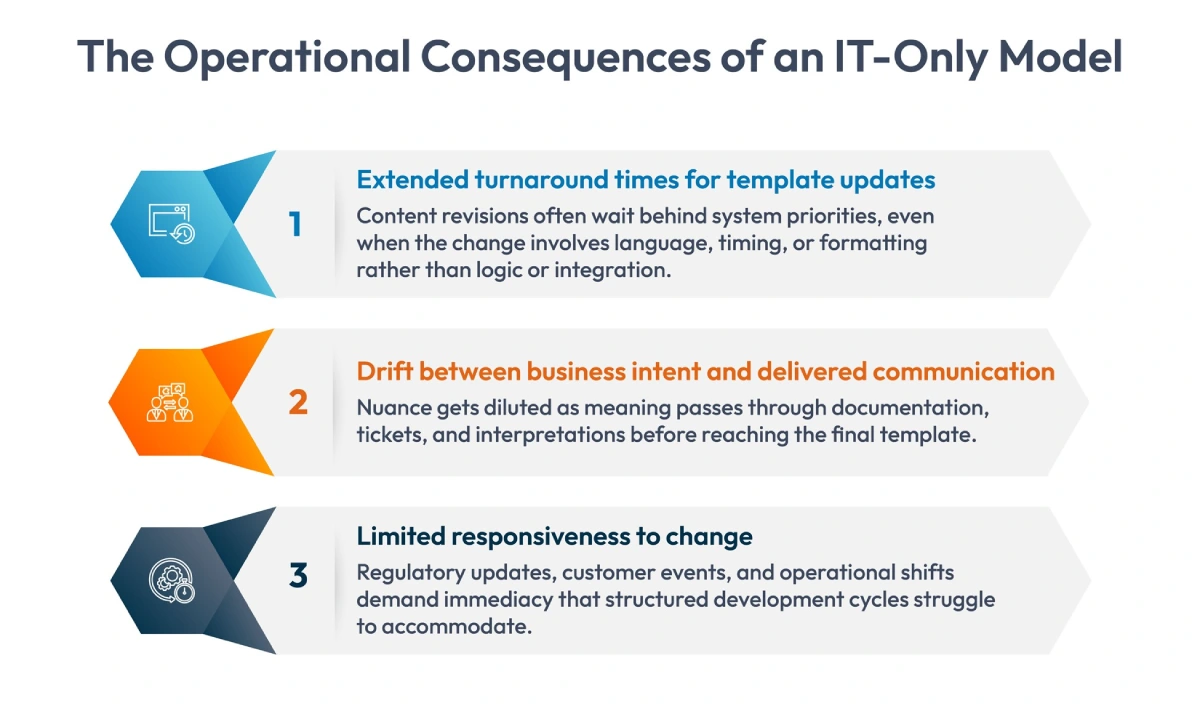
The result is a communication environment that feels technically controlled yet operationally constrained, where accuracy is protected but relevance arrives late. This approach served organizations when communication moved slowly and uniformly. The current pace and sensitivity of customer interaction expose its limits with little forgiveness.

Modernize Customer Communications Without Compromising Compliance
See how modern communication systems give compliance teams control, visibility, and confidence while reducing manual effort and regulatory risk.
Establishing Accountable and Relevant Roles for Business Users
Clarity around ownership determines whether communication template development remains disciplined or dissolves into inconsistency. When business users are given access without definition, risk increases. When their role is explicit and bounded, communication quality improves while governance remains intact. Establishing accountability begins with identifying who these users are and what they are qualified to influence within the document template lifecycle.
Who Are Business Users?
Business users in the Customer Communications Management (CCM) context represent functions that shape meaning, accuracy, and timing across communication templates rather than the systems that deliver them.
- Marketing teams
Custodians of messaging, tone, and narrative consistency across customer touchpoints. - Operations teams
Owners of transactional communications tied to processes, events, and service outcomes. - Compliance and legal teams
Authorities on regulatory accuracy, mandated language, and risk exposure within customer communications. - Customer service teams
Responders to customer-specific situations where clarity, empathy, and precision matter most.
These groups bring direct knowledge of why a message exists and how it should be received, making their involvement in communication template development both relevant and necessary.
Responsibilities Business Users Can Safely Own
Business users should control elements that depend on judgment, context, and timing rather than system architecture.
- Content updates
Messaging changes, wording adjustments, and informational content that reflect policy updates, service changes, or customer expectations. - Personalization logic
Customer-specific data usage, conditional language, and relevance driven by real-world scenarios rather than technical abstraction. - Business rules and timing
Decisions governing when communications are triggered, how frequently they are sent, and under which conditions they are appropriate.
Ownership of these elements allows communication templates to evolve without disrupting structure or stability.
Responsibilities That Must Remain Under IT Governance
Certain aspects of the communication environment require technical stewardship and should remain firmly controlled.
- System integrations and data sources
Connections that ensure accuracy, consistency, and reliability across platforms. - Security, access control, and infrastructure
Safeguards that protect sensitive information and enforce role-based access. - Core platform configuration and scalability
Foundations that support CCM workflow automation and long-term performance without operational fragility.
When business users and IT each operate within clearly defined boundaries, communication templates move through the document template lifecycle with precision, accountability, and speed, without sacrificing control or trust.
Why Clearly Defined Business User Roles Are Important
Clear ownership reshapes how communication template development functions across the organization. When responsibility is explicit, communication templates move through the document template lifecycle with intent rather than hesitation, and decisions are made by those closest to their consequences.
-
Reducing IT Dependency Without Sacrificing Control
Routine template edits consume time that technical teams should reserve for system integrity and scale. Assigning clearly defined responsibilities to business users removes unnecessary dependency on IT for language, timing, and presentation, while technical oversight remains intact for architecture and security. This separation preserves control without constraining progress.
-
Supporting Compliance and Brand Alignment
Legal and compliance teams operate with a depth of regulatory understanding that cannot be retrofitted through review cycles alone. When these teams actively shape content, accuracy is embedded early rather than enforced late. Communication teams bring the same discipline to tone and consistency, ensuring that every message reflects the organization’s voice while operating within established guardrails.
-
Creating More Personalized and Humanized Communications
Business users possess contextual awareness that defines effective communication. They know what needs to be said, when it should be delivered, and how language should adapt to the situation at hand. This understanding allows communication templates to feel timely and intentional rather than procedural, strengthening customer trust through relevance and clarity.
-
Accelerating Time-to-Market
Clear ownership shortens the distance between decision and delivery. Changes driven by regulatory updates, product adjustments, or customer events progress without waiting for development queues, supported by CCM workflow automation that governs review and release. Communication template development becomes responsive without becoming uncontrolled, aligning speed with accountability.
Best Practices for Balancing Business Users and IT with CCM
Balance does not emerge from shared access alone. It is created through structure, discipline, and clearly enforced boundaries that guide how communication templates move from creation to release. The practices below reflect how experienced organizations maintain control while allowing communication template development to progress at the pace the business demands.
Use a Modern Platform to Enable Controlled Business User Access
A modern CCM platform provides the foundation for shared ownership without shared risk. Business users require access to content and logic that reflects intent, while IT retains authority over the environment that supports it.
Key practices include:
- Configuring access based on responsibility rather than hierarchy.
- Limiting business user interaction to approved areas of the document template lifecycle.
- Ensuring changes occur within predefined structural constraints.
This approach allows communication templates to evolve without introducing instability.
Apply Role-Based Permissions and Approval Workflows
Access without governance leads to inconsistency. Permissions and approvals ensure that accountability is preserved as more users participate.
Effective governance relies on:
- Defined roles aligned to function and expertise.
- Approval stages that reflect regulatory and brand sensitivity.
- Automated routing supported by CCM workflow automation.
A simple way to visualize responsibility is outlined below.
| Role | Primary Focus | Level of Access |
| Business users | Content, timing, personalization | Edit and submit |
| Compliance reviewers | Regulatory accuracy | Review and approve |
| IT teams | Systems and infrastructure | Configure and secure |
This structure reinforces ownership while preventing overlap.
Centralize Content Management and Maintain Audit Trails
Decentralized content creates version drift and accountability gaps. Centralization ensures that every change to communication templates is visible, traceable, and reversible.
Best practices include:
- A single source of truth for approved content.
- Version tracking tied to user actions.
- Audit trails that support internal review and external scrutiny.
Centralized management strengthens trust in the process without slowing delivery.
Treat CCM as a Collaboration Framework, Not a Control Mechanism
When implemented correctly, CCM becomes a shared operating model rather than a point of friction. IT defines the guardrails. Business users operate confidently within them. Communication template development proceeds with clarity, pace, and discipline because responsibilities are respected rather than negotiated.
This balance allows organizations to scale communication volume and complexity while preserving accuracy, consistency, and intent across the document template lifecycle.
Moving Toward a More Coordinated CCM Model
A coordinated approach to customer communication requires more than shared access. It requires a platform that respects the boundaries between business judgment and technical stewardship while allowing communication templates to evolve with speed, accuracy, and intent. Cincom Eloquence was built with this reality in mind, giving organizations the structure to manage content, timing, and governance across the full document template lifecycle without diluting control or clarity.
By enabling disciplined collaboration between business users and IT, Cincom Eloquence supports communication that feels deliberate, compliant, and responsive at scale.
Schedule a conversation to see how Cincom Eloquence can support your communication strategy.
FAQs
1. Does expanding business user access increase the risk of inconsistent messaging?
Consistency depends on structure, not restriction. When access is defined and governed, variation reflects intent rather than error.
2. How long does it typically take to transition business users into this model?
Adoption is driven by clarity of role and tooling, not time spent in training, and most teams adjust once ownership is explicit.
3. Can this approach work in highly regulated industries?
Regulated environments benefit the most because regulatory expertise shapes content directly instead of reacting to it after the fact.
4. What happens when business and IT priorities conflict?
Well-defined ownership prevents conflict by separating decision rights from execution responsibilities before pressure appears.
5. How do organizations measure success after changing template ownership?
Improvement becomes visible through reduced rework, faster updates, and fewer escalations around communication accuracy.