The main agenda behind migrating to a new CPQ system is faster quotes, fewer errors, and better sales performance. Apparently, it may seem to be an easy process, but in practice, CPQ migration is quite challenging.
Most companies discover that their existing CPQ holds years of product logic, pricing exceptions, workarounds, and integrations that were never fully documented. When all of that needs to move to a modern platform, complexity quickly becomes evident. That’s why many CPQ migration projects run into delays or fail to deliver expected value.
According to recent market research found that 39% of enterprises experience CPQ implementation delays due to integration issues, while 27% require significant customization to align CPQ with existing sales processes
Without a clear CPQ data migration strategy and execution plan, these challenges often lead to project delays, budget overruns, and low user adoption. Understanding the most common CPQ migration challenges and planning for them early can make the migration process a successful one.
What Is CPQ Migration and When Do Companies Need It?
At its core, CPQ migration means moving from an existing quoting system, often a legacy or on-premise CPQ, to a modern, cloud-based solution. This includes product configurations, pricing rules, approval workflows, integrations, and sometimes historical quote data.
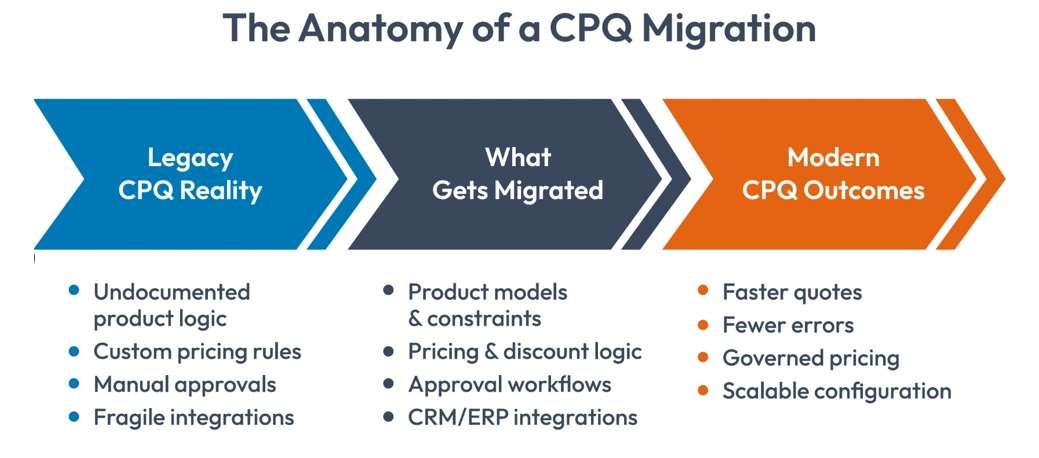
Companies usually consider legacy CPQ to cloud migration when they start facing challenges like:
- Quotes taking too long to generate
- Frequent pricing or configuration errors
- Difficulty supporting complex or custom products
- Limited integration with CRM or ERP systems
- High maintenance costs and slow updates
Modern CPQ platforms are built to support automated CPQ deployment, frequent updates, and better collaboration between sales, engineering, and finance.

Still Stuck in the Past? Here’s What’s Holding You Back!
This infographic breaks down why Visual CPQ is the smarter, faster, and a more engaging way to configure and quote products.
Most Common CPQ Migration Challenges
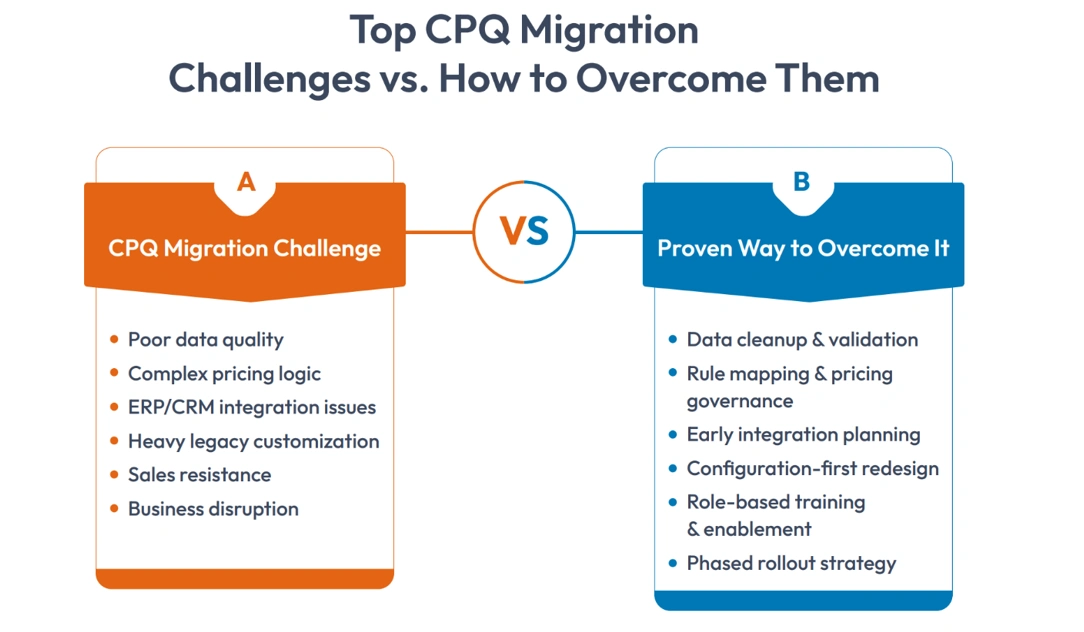
1. Poor Data Quality and Incomplete Product Models
One of the biggest issues during CPQ migration is data quality. Over time, legacy systems accumulate outdated products, inconsistent attributes, and configuration rules.
When this data is migrated as-is, it leads to problems like:
- invalid configurations
- incorrect pricing
- constant quote rework and approval delays.
Often organizations only realize how messy their product data is once migration begins. This is why data preparation is often more time-consuming than the actual CPQ implementation.
2. Complex Pricing and Discount Structures
Pricing rarely follows simple rules. Most organizations rely on a mix of customer-specific pricing, volume discounts, regional adjustments, and special approvals. In legacy CPQ systems, these rules are often buried in custom logic.
During CPQ implementation, translating that complexity into a new pricing engine takes careful planning. If pricing rules aren’t mapped correctly, companies risk margin erosion or non-compliant quotes, both of which directly impact revenue.
3. Integration Issues with ERP and CRM Systems
CPQ doesn’t work in silos. It depends on CRM for customer and opportunity data, and ERP for pricing, inventory, and order processing.
Integration challenges are common when:
- Legacy systems use outdated APIs
- Data structures don’t match across platforms
- Integration requirements are identified late in the project
When integrations aren’t prioritized early, CPQ migration can stall, even if the CPQ system itself is ready.
4. Customization vs. Configuration Limitations
Legacy CPQ systems often rely heavily on custom code. While this can solve short-term needs, it creates long-term problems during migration.
Modern CPQ platforms are designed to be configured rather than customized. Trying to recreate every legacy customization usually leads to longer timelines, higher costs, and less flexibility after go-live.
Migration is often the right moment to rethink, not just replicate how quoting should work.
5. User Adoption and Sales Team Resistance
Even a technically successful CPQ migration can fail if sales teams don’t use the new system. Sales teams may resist change if the new CPQ feels complex or disrupts familiar workflows.
Common adoption issues include:
- Minimal or generic training
- Poor alignment with real sales workflows
- Lack of clear communication
Without strong user adoption, CPQ never delivers its promised ROI.
6. Business Disruption During Migration
CPQ migration directly affects ongoing deals. If not managed carefully, it can disrupt quoting, approvals, and order processing.
Many organizations struggle to balance:
- Running daily sales operations
- Testing the new CPQ environment
- Training users at the same time
This is where planning and rollout strategy matter most.
How to Overcome CPQ Migration Challenges
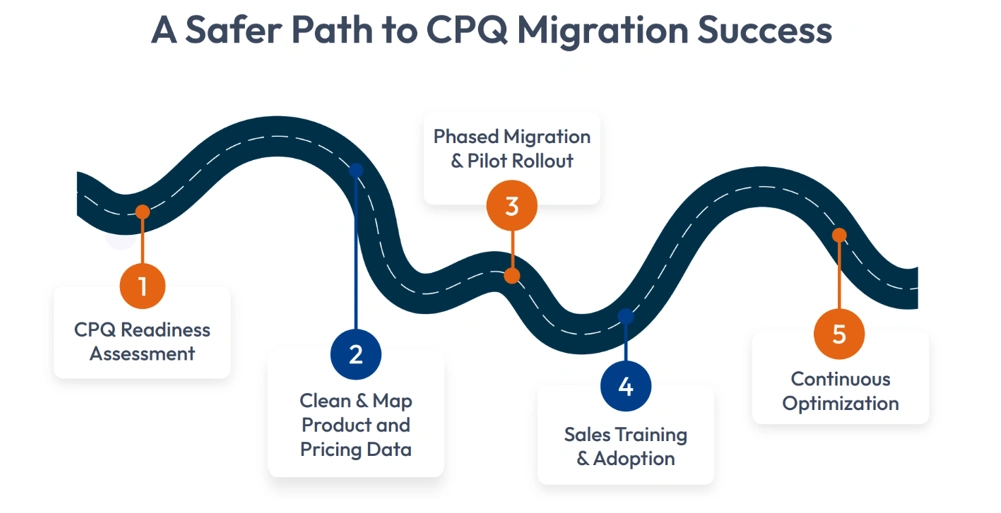
1. Conducting a CPQ Readiness Assessment
Before starting CPQ migration, companies should assess how ready they really are. A CPQ readiness assessment looks at product complexity, pricing models, data quality, and integration needs.
It helps answer key questions like:
- What data should be migrated and what shouldn’t?
- Which rules need to redesign?
- What integrations are critical for go-live?
This step prevents costly mistakes later.
2. Cleaning and Mapping Product and Pricing Data
Data cleanup essential. A strong CPQ data migration strategy includes removing obsolete products, standardizing attributes, and validating pricing rules with stakeholders.
Clean data improves performance, reduces errors, and makes future updates much easier.
3. Prioritizing Integrations Early
ERP and CRM integrations should be planned from the start of the CPQ migration project. Early alignment avoids rework and ensures smooth data flow once CPQ goes live.
Key questions include:
- Where does pricing originate?
- How are quotes converted to orders?
- What data must sync in real time?
4. Phased Migration and Pilot Rollouts
A phased approach reduces risk. Instead of switching everything at once, many companies roll CPQ out by product line, region, or sales team.
This allows teams to:
- Test real-world scenarios
- Gather feedback early
- Fix issues before full deployment
5. Training Sales Teams for Faster Adoption
Training should focus on real quoting scenarios and not just system features. Sales teams adopt CPQ faster when they clearly see how it helps them close deals faster and with fewer errors.
Ongoing support after go-live is just as important as initial training.
See how Helmer Scientific successfully transformed its quoting process with Cincom CPQ
Best Practices for a Successful CPQ Migration
- Set clear business goals
- Involve sales, IT, and operations early
- Avoid copying legacy inefficiencies
- Test pricing and configurations thoroughly
- Plan for continuous optimization after launch
Choosing the Right CPQ Partner
CPQ migration is as much about experience as technology. The right partner understands complex sales processes, integration challenges, and real-world constraints.
Look for a partner that offers:
- Proven CPQ migration frameworks
- Flexible deployment options
- Long-term optimization support
Final Thoughts
CPQ migration isn’t easy, but it’s worth it. Companies that approach CPQ migration strategically often achieve faster sales cycles, better pricing control, and stronger alignment across teams.
When planned correctly, legacy CPQ to cloud migration becomes more than a system change. It becomes a foundation for scalable, efficient growth.
Planning a CPQ migration? Cincom CPQ helps manufacturers migrate complex product logic, pricing, and integrations with confidence, without disrupting ongoing sales.
FAQs
1. What is CPQ migration?
CPQ migration is the process of moving product, pricing, and quoting logic from an existing CPQ or legacy system to a modern CPQ platform.
2. Why do CPQ migrations fail?
Common reasons include poor data quality, underestimated complexity, integration issues, and low user adoption.
3. How long does a CPQ migration take?
Timelines vary based on complexity but typically range from 3 to 9 months.
4. What data needs to be migrated to a CPQ system?
Product models, configuration rules, pricing logic, discount structures, and sometimes historical quotes.
5. How do you minimize risk during CPQ migration?
By conducting readiness assessments, cleaning data, prioritizing integrations, and using phased rollouts.
6. Can CPQ be integrated with ERP and CRM during migration?
Yes. Modern CPQ platforms support ERP and CRM integration during and after migration.