


Most revenue conversations start and end with sales. Quotas, pipeline coverage, win rates are sales metrics, and sales owns them. But the systems that actually make selling possible belong to IT. And increasingly, the health of those systems determines whether revenue targets get hit or missed.
CPQ sits right in the middle of that equation. It’s not a flashy tool. Most customers never see it. But every quote that leaves a sales team’s hands passes through it, and the quality of that quote depends entirely on how well the CPQ solution is built, integrated, and maintained.
Research from Forrester shows that CPQ has evolved into a core system for managing how products are configured, priced, and sold across complex revenue environments, moving it from a sales tool to a foundational part of revenue operations.
This blog gets into the specifics: how a CPQ increases revenue, where IT’s fingerprints are all over that outcome, and what the research actually shows about the business impact.
Why IT Is Becoming a Revenue Driver?
There’s a useful bit of organizational history here. The group we now call IT has been called the Tabulation Department, Data Processing, Management Information Systems, each name reflecting the priorities of its era. For most of that history, the mandate was the same regardless of the label: manage information, control costs, and keep things running.
The cost-center era is winding down. Enterprises now expect IT to contribute to revenue generation directly, not just support it from the back office. The reason is structural: the entire revenue production system runs on technology that IT owns. When those systems work well together, sales moves faster and margins hold. When they don’t, deals stall and errors compound.
IT’s core mission hasn’t changed which is to get the right information to the right people, in the right form, as fast as possible. What’s changed is that this mission now has a direct line to the income statement.
The Enterprise Revenue Production System
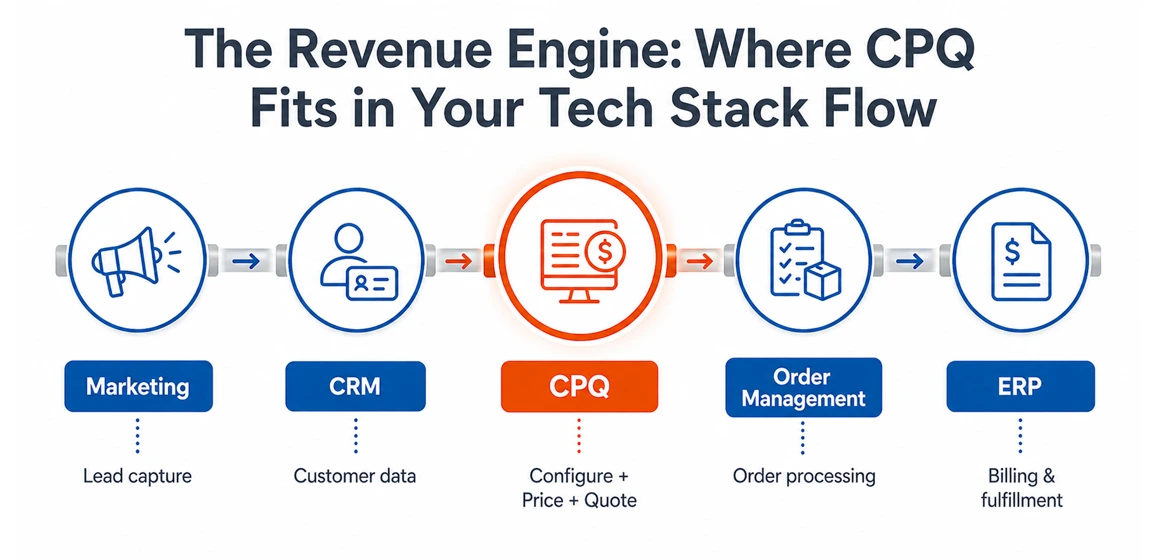
Sales don’t happen in isolation. It’s the end result of a chain of systems, each responsible for a distinct phase of the revenue cycle. Break any link and the whole chain slows down.
The typical enterprise stack runs roughly like this: Marketing Automation captures intent and feeds qualified leads into CRM. CRM tracks customer relationships, contact data, and deal history. Sales automation software manages pipeline activity and keeps reps organized. CPQ translates customer requirements into accurate, approved quotes. Order Management converts those quotes into fulfillment instructions. ERP handles inventory, billing, and production scheduling downstream.
IT is responsible for making sure these systems actually integrate with each other; that data flows from one to the next without manual re-entry, reconciliation, or guesswork. In a well-integrated stack, revenue moves predictably. In a fragmented one, it leaks at every seam.
Why CPQ Is the Core of Revenue Operations Automation
Every buying transaction comes down to three questions:
- What exactly is the customer getting?
- What will it cost?
- Can we actually deliver it?
CPQ exists to answer all three automatically, accurately, and fast enough that deals don’t lose momentum while someone chases down approvals.
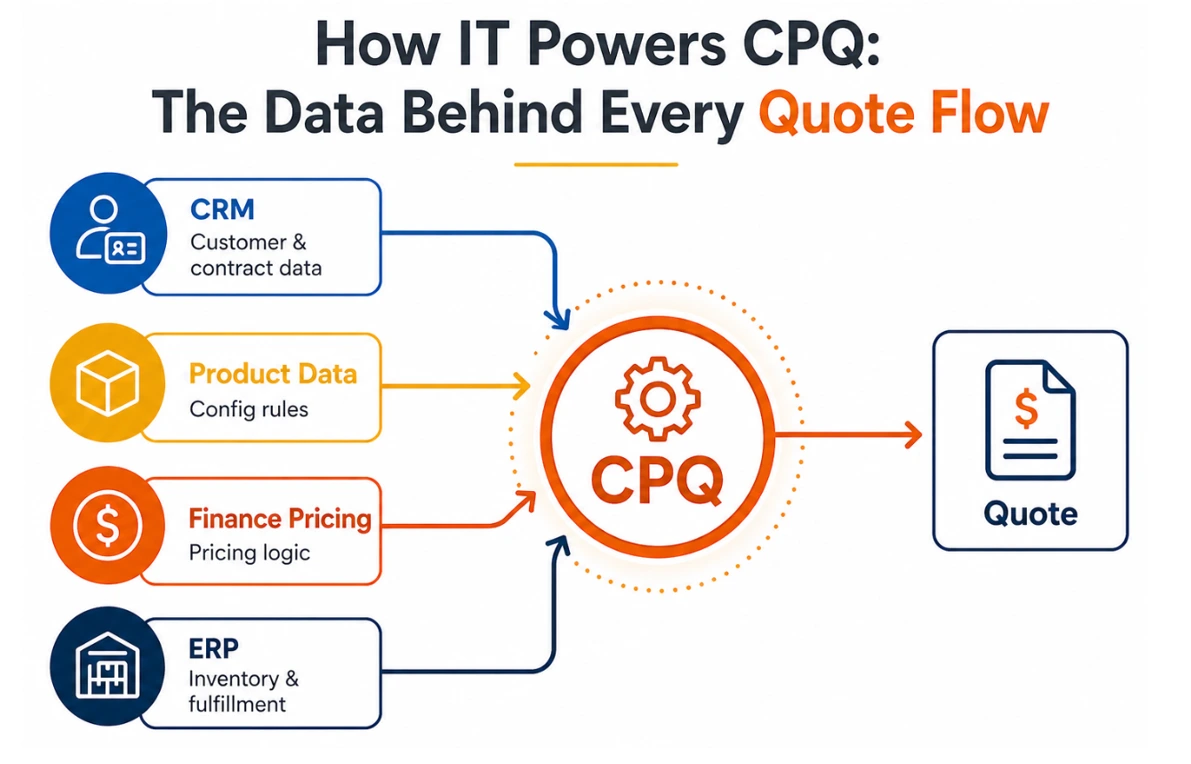
The reason CPQ functions as the core of the revenue stack is data convergence. A properly integrated CPQ solution draws simultaneously from product management (specifications, configuration rules, compatibility limits), finance (approved pricing, discount structures, contract-specific terms), and CRM (customer history, existing agreements, contact details). When that data is clean and current, CPQ produces quotes that reflect reality. When it isn’t, the errors are immediate and expensive.
For quote-to-cash automation specifically, CPQ is the point where manual handoffs get eliminated. Reps stop cross-referencing pricing spreadsheets. Approvals happen within the system. The quote that comes out the other end is both faster and more reliable than anything a manual process can produce.
How Does a CPQ Increase Revenue?
1. Faster Quote Generation
Sales cycles die in the waiting. A rep who needs three days to pull together a complex quote is giving competitors time to move and giving the buyer time to reconsider. CPQ cuts that time dramatically, in some cases from days to minutes.

Helmer Scientific reduced quote generation time by 88% and scaled sales operations without adding headcounts with Cincom CPQ.
2. Accurate Pricing and Margin Protection
Every manually produced quote carries pricing risk. Reps apply the wrong discount tier, miss a contract-specific rate, or quote a configuration that doesn’t exist. CPQ encodes pricing logic directly into the system, approved tiers, bundle rules, promotional rates, so that the output is always within guardrails.
This matters especially for organizations managing subscriptions and recurring revenue. The best CPQ process for revenue recognition automation maintains pricing integrity from initial quote through renewal, which keeps billing clean and revenue recognition straightforward.
3. Integrated Sales Processes
Disconnected systems create friction that’s easy to underestimate until you try to measure it. When CRM data doesn’t flow into CPQ, reps re-enter customer details manually. When CPQ doesn’t connect to ERP, order management teams have to re-key quote data to create orders. Each of these gaps is a delay, a potential error, and an unnecessary cost. Revenue operations automation works because it eliminates these gaps.
4. Higher Deal Values Through Guided Selling
CPQ doesn’t just process what reps ask for. It can prompt them to offer more. Guided selling features surface relevant product combinations, complementary add-ons, and upgrade paths based on what the customer has already configured. These prompts aren’t guesses; they’re driven by rules that reflect actual product relationships and purchasing patterns.
For CPQ providers managing subscription and recurring revenue, guided selling also surfaces renewal and expansion opportunities that might otherwise go unnoticed. The practical result is a meaningful lift in average deal size without requiring reps to know the entire product catalog by heart.
The Role of IT in CPQ Success
A CPQ solution performs exactly as well as the data flowing into it. This is where IT’s role becomes decisive. Not just as the team that installs and maintains the software, but as the function responsible for the integrations that make the whole system coherent.
In practice, IT manages four primary data streams feeding into CPQ:
- Customer data from CRM: Account details, existing contracts, purchasing history, and contact information must be accurate and current for CPQ to generate quotes that reflect real customer relationships.
- Product data from product management: Specifications, configuration rules, and compatibility constraints determine what can and can’t be quoted. Stale or incomplete product data produces quotes that can’t be fulfilled.
- Pricing data from finance: Approved pricing structures, volume discounts, promotional rates, and contract-specific terms need to be maintained and pushed to CPQ in real time. A pricing table that’s three weeks out of date is a liability.
- Manufacturing data for BOM and production planning: Bills of material and production schedules ensure that what gets quoted can actually be delivered on the timeline the customer expects.
When these integrations work, CPQ becomes a genuine revenue engine rather than an expensive quoting tool. When they don’t, sales teams end up verifying information manually anyway and the CPQ investment delivers a fraction of its potential.
IT also handles CPQ integration with legacy systems, which is one of the more underappreciated challenges in enterprise revenue operations. Modern CPQ platforms are built to connect with existing ERP and CRM environments, so IT doesn’t have to choose between transformation and stability. The integration work is demanding, but it’s the thing that unlocks everything else.
Business Benefits of CPQ for Revenue Growth
When CPQ is implemented well and integrated properly, the business outcomes show up across multiple areas, not just in sales velocity.
- Quote-to-order cycles shorten because the manual steps disappear.
- Pricing consistency improves because every quote runs through the same rules.
- Cross-department collaboration gets easier because sales, finance, and operations are all working from the same data rather than emailing spreadsheets back and forth.
- Sales decisions become more data-driven because CPQ reporting surfaces which configurations close, which pricing structures win, and where deals stall.
For organizations selling through subscription or recurring revenue models, CPQ also creates a structured framework for renewals and expansions, two revenue streams that are systematically undermanaged when handled manually. The revenue growth CPQ delivers in these contexts is often as much about retention and expansion as it is about new business.
Conclusion
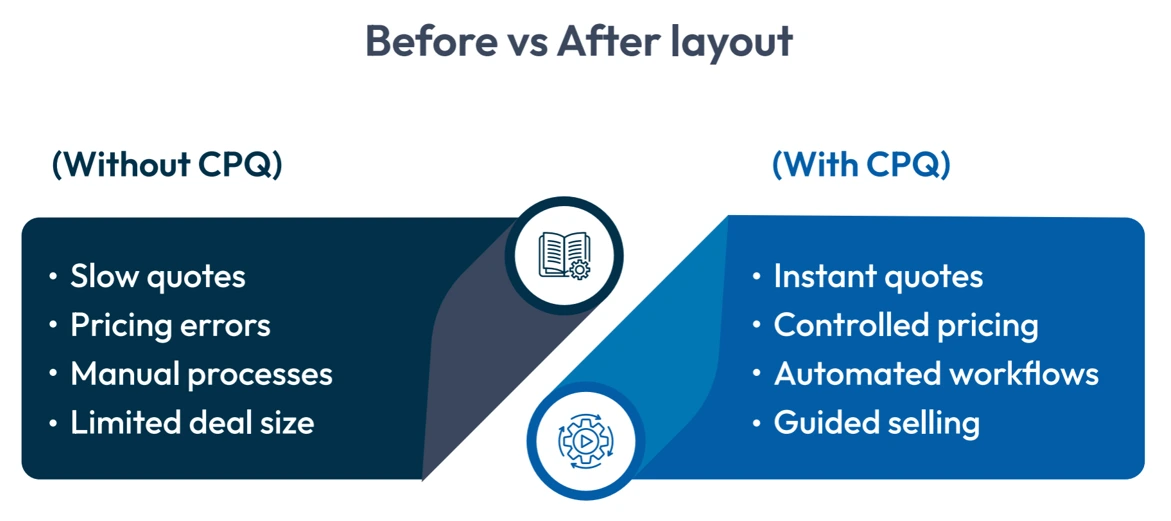
CPQ may look like a quoting tool, but it directly shapes how revenue moves through the business.
When systems are disconnected, quoting slows down, pricing errors creep in, and deals slip. When CPQ is properly integrated, those gaps disappear: quotes go out faster, pricing stays consistent, and sales teams focus on closing, not fixing.
The impact isn’t just efficiency. It’s predictable, scalable revenue and that’s where IT makes the difference.
FAQs
1. How does CPQ increase revenue?
CPQ accelerates the quoting process, enforces accurate pricing, and surfaces cross-sell and upsell opportunities at the point of sale. Faster quotes move more deals forward; accurate pricing protects margins; guided selling increases average deal size. Each mechanism works independently, and they compound when all three are operating together.
2. What role does IT play in CPQ implementation?
IT manages the integrations that make CPQ effective, connecting CRM, product management, finance, and ERP so the CPQ solution always runs on accurate, current data. IT also handles ongoing maintenance, data governance, and system upgrades. Without strong IT involvement, even well-designed CPQ implementations underdeliver.
3. Why is CPQ important in the quote-to-cash process?
CPQ is the point in the quote-to-cash process where customer requirements, product configurations, and pricing rules converge. Without it, this step is manual, slow, and error prone. With it, the quote-to-cash cycle becomes faster, more accurate, and scalable without adding headcounts.
4. How does CPQ integrate with CRM and ERP systems?
CPQ platforms use APIs and middleware connectors to exchange data with CRM and ERP systems. CRM provides customer and contract data; ERP provides inventory, pricing, and order management. These integrations ensure that quotes are accurate, deliverable, and properly documented across systems.
5. What industries benefit most from CPQ software?
CPQ delivers the strongest results in industries with complex product configurations, multi-tier pricing, or high quoting volume, manufacturing, technology, financial services, telecommunications, and industrial equipment. Any organization with more than a handful of product combinations stands to benefit.


