Why CPQ Use Cases Matter More Than Ever
In earlier days, CPQ wasn’t about “digital transformation.” It was about survival. Sales teams were drowning in product complexity, pricing lived in spreadsheets no one trusted, and engineering was the final gatekeeper for every serious deal. Sound familiar? That’s because not much has changed, except for the stakes.
Today’s B2B sales teams face even more pressure like:
- shorter buying cycles
- tighter margins
- global selling models
- zero tolerance for errors
That’s why understanding CPQ use cases matters more than just understanding CPQ features. CPQ only delivers value when it’s applied to the right sales problems, in the right order.
Let’s break down the CPQ use cases that consistently deliver results, based on what work across industries and implementations.
What Is CPQ and How Does It Actually Work in Practice?
On paper, CPQ helps you configure products, price them correctly, and generate quotes.
In reality, CPQ is a control system for sales complexity.
A well-implemented CPQ solution embeds product rules, pricing logic, and approval policies directly into the sales workflow. It removes interpretation from the process. Reps don’t “decide” what’s allowed; they’re guided toward valid outcomes.
The CPQ use cases below aren’t theoretical. These are the patterns that reduce errors, accelerate deals, and restore trust between sales and the rest of the organization.
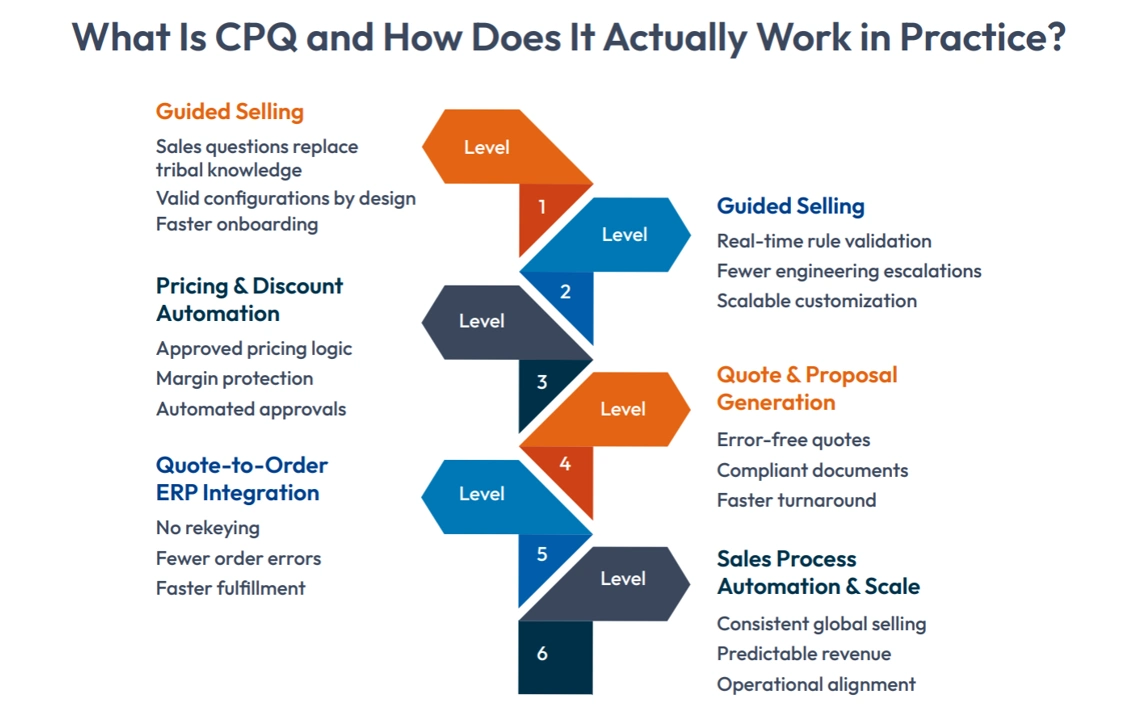
CPQ Use Case #1 – Guided Selling for Complex Products
Guided selling is where CPQ proves its worth fastest and where poor implementations fail just as quickly.
When done right, guided selling replaces tribal knowledge with structured logic. Instead of expecting sales reps to understand every product dependency, CPQ asks the right questions in the right sequence.
Reducing Sales Errors and Training Time
In most organizations, sales errors weren’t caused by incompetence; they were caused by unscalable knowledge.
Guided selling in CPQ:
- Encodes expert knowledge into rules
- Prevents invalid configurations by design
- Reduces dependence on engineering and product specialists
The result is fewer re-quotes, faster onboarding, and dramatically less internal friction.
Improving Buyer Experience
From the buyer’s perspective, guided selling shortens the conversation. Fewer revisions. Fewer “let me check.” More confidence that the quote they receive is viable.
That confidence closes deals.

CPQ Use Case #2 – Automated Product Configuration
Product configuration is where most sales processes quietly break.
Organizations lose weeks correcting orders because configuration validation happened after the quote was approved. CPQ flips that model.
This CPQ use case ensures configurations are validated in real time, during the sales conversation and not after it.
When configuration logic is centralized in CPQ:
- Invalid combinations are eliminated upfront
- Engineering firefighting drops significantly
- Custom solutions become scalable, not risky
This is non-negotiable in configure-to-order environments.
CPQ Use Case #3 – Pricing and Discount Automation
If you want to understand a company’s real sales maturity, look at how it handles pricing.
Manual pricing leads to inconsistency, margin leakage, and approval chaos. CPQ brings discipline without slowing sales down.
With pricing and discount automation, CPQ:
- Applies approved pricing logic consistently
- Enforces discount thresholds automatically
- Escalates only true exceptions
Sales moves faster because approvals are embedded and not bolted on.
CPQ Use Case #4 – Quote and Proposal Generation
Teams often lose deals over quote errors that should never have happened.
CPQ eliminates this class of failure by automating quotes and proposal generation. Once configuration and pricing are locked, everything else becomes easy to determine.
This CPQ use case delivers:
- Accurate, compliant quotes every time
- Consistent branding and legal language
- Faster turnaround without cutting corners
When quotes stop being a risk factor, sales gains momentum.
CPQ Use Case #5 – Quote-to-Order and ERP Integration
This CPQ use case connects CPQ directly to ERP systems, ensuring what’s sold is exactly what gets built, delivered, and billed.
The benefits are operational, not theoretical:
- No manual rekeying
- Fewer order corrections
- Faster fulfillment cycles
This is where CPQ stops being a sales tool and becomes an operational asset.
CPQ Use Case #6 – Sales Process Automation and Scalability
Growth exposes weak sales processes fast.
As companies expand across regions or channels, inconsistency creeps in. CPQ creates guardrails without micromanagement.
With CPQ-driven sales automation:
- Best practices become standard practice
- New teams sell the right way by default
- Revenue becomes predictable instead of reactive
That’s what scalable selling looks like.
Industry-Specific CPQ Use Cases
CPQ delivers the strongest ROI in industries where complexity is structural, not optional.
1. Manufacturing and Industrial Equipment
Here, CPQ enforces engineering rules, aligns sales with production realities, and prevents costly downstream errors.
2. Specialty Vehicles and Custom Products
CPQ enables mass customization without operational chaos, something manual processes simply can’t sustain.
3. High-Tech and B2B Services
In these environments, CPQ supports solution bundling, recurring pricing models, and consistent global execution.
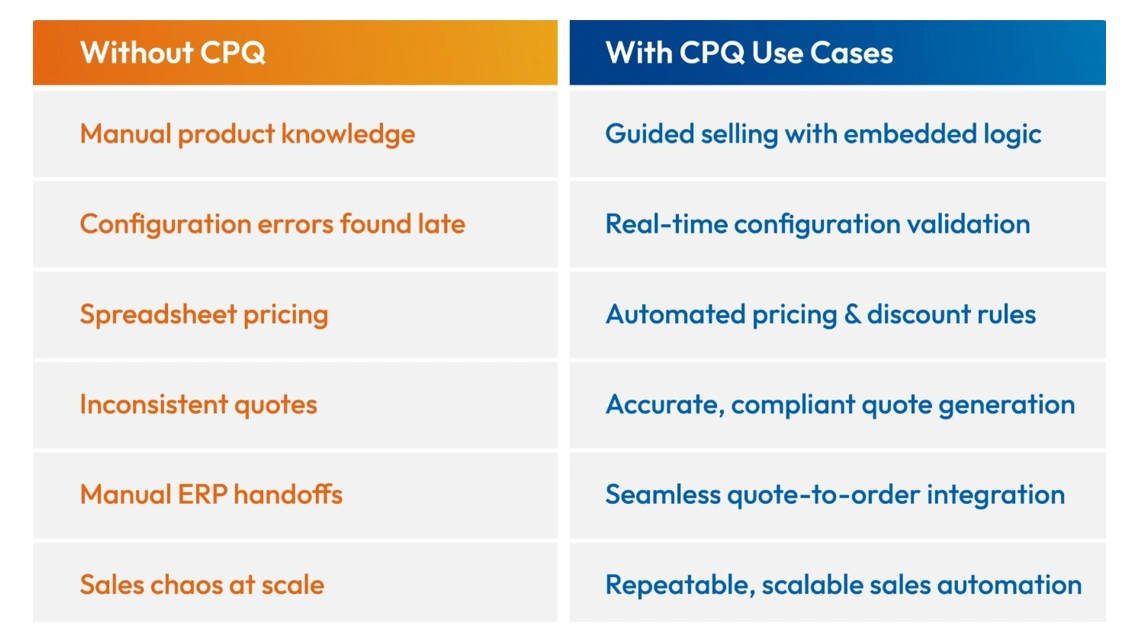
Turning CPQ Use Cases into Sustainable Growth
CPQ doesn’t just fix the bad sales strategy, but it amplifies the good ones.
When applied to the right use cases, guided selling, configuration accuracy, pricing control, and sales automation, CPQ becomes a growth engine, not just a quoting tool.
The organizations that win with CPQ aren’t chasing features. They’re solving real sales problems, systematically.
If you are struggling with your sales strategy and planning to implement changes in it, Cincom CPQ is the best option for you.
FAQs
1. What are the most common CPQ use cases?
Common CPQ use cases include guided selling, automated product configuration, pricing and discount automation, quote generation, and quote-to-order integration.
2. How does guided selling work in CPQ?
Guided selling uses rules and logic to lead sales reps through a structured process, recommending the right products and configurations based on customer needs.
3. Can CPQ automate pricing and discounts?
Yes. CPQ automates pricing and discounting based on predefined rules, approval thresholds, and margin controls.
4. How does CPQ integrate with CRM and ERP systems?
CPQ integrates with CRM to streamline sales workflows and with ERP to support seamless quote-to-order and fulfillment processes.
5. Which industries benefit most from CPQ software?
Manufacturing, industrial equipment, specialty vehicles, high-tech, and B2B services benefit significantly from CPQ due to complex products and pricing models.