Introduction
Many organizations today are asking a reasonable question: Why should they consider investing in a new customer communications solution when correspondence and documents are already being created and delivered successfully?
For years, the ability to generate accurate documents and ensure they reach customers on time has been viewed as a fundamental operational requirement. For many organizations, existing systems continue to meet that basic need. However, as the ways organizations interact with customers continue to evolve, documents and correspondence play a more visible role in shaping how those interactions are perceived, which places greater importance on how communications are created, managed, and delivered across the business. As a result, evaluating a customer communications solution has become less about whether documents can be produced and more about whether those communications support the expectations and engagement standards customers now expect from every interaction.
The Traditional Approach: Getting Documents Out the Door
Earlier, customer communications were evaluated primarily through an operational lens, with the main objective being to produce and deliver documents accurately, efficiently, and at the lowest possible cost. In this context, documents such as letters, statements, and notices were treated as a necessary output of core business processes, and the systems used to create them were selected based on their ability to support established workflows rather than their flexibility or impact on the customer. Early forms of document automation for enterprise environments were therefore focused primarily on operational efficiency rather than strategic communication value.
Success in this area was defined by a small set of practical considerations, including:
- The accuracy and completeness of the information contained in each document.
- The ability to generate communications in a timely and reliable manner.
- The overall cost associated with document creation, printing, and delivery.
- The use of core administrative systems and standard word-processing tools to support document production.
This approach allowed organizations to meet regulatory requirements and maintain consistent operations, and for a long time, it provided an acceptable foundation for managing customer correspondence at scale.

Modern CCM vs. Legacy Systems: The Cost of Standing Still
Legacy communication systems increase compliance risk and operational strain across insurance and financial services organizations. This guide explains how modern customer communications management strengthens governance and supports scalable, personalized engagement.
What Changed: Expectations Around Customer Communications
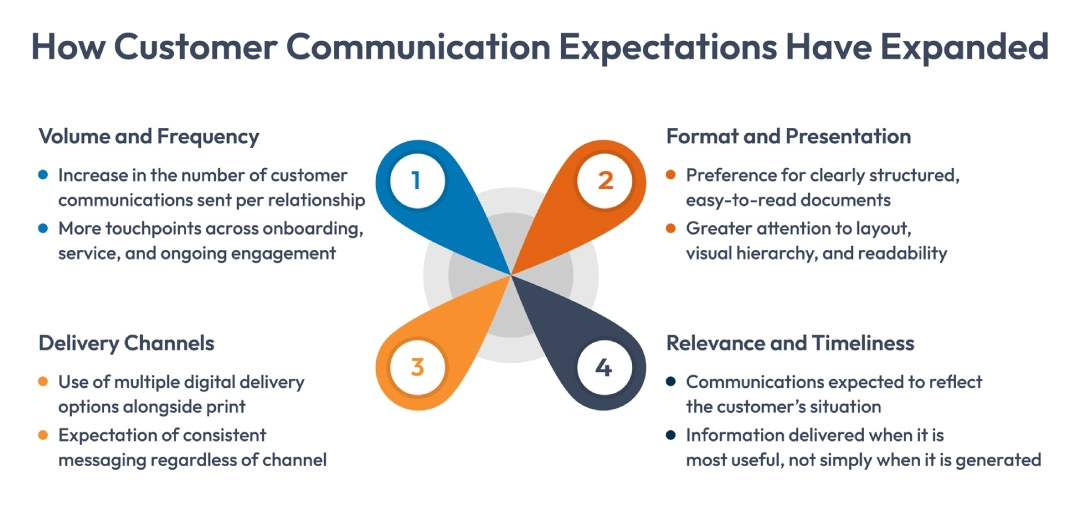
Customer expectations around communications have evolved as digital interactions have become a routine part of everyday life, influencing how information is consumed and how organizations are judged through each interaction. Customers now encounter communications from many sources on a daily basis, which has shaped their expectations for clarity, relevance, and convenience when receiving information from the organizations they do business with.
This shift has increased the demand for personalized customer communications that reflect individual preferences, behaviors, and needs. As a result, communications that once served a purely informational purpose are now viewed as an extension of the overall relationship, making the structure, presentation, and delivery of documents increasingly important.
The Expanding Role of Documents and Correspondence
As organizations increase the number and variety of interactions they have with customers, documents and correspondence play a more central role in supporting those relationships across their full duration. To manage this growing complexity, many organizations rely on a comprehensive customer communications solution supported by document automation for enterprise capabilities and modern digital correspondence solutions. What were once occasional touchpoints are now recurring interactions that inform, guide, and update customers at different stages, which increases the importance of how consistently and effectively those communications are managed.
Documents now support a broad range of customer interactions, including:
- Statements, invoices, and formal notices that incorporate customer-specific data and transaction details
- Policies, agreements, and disclosures that reflect applicable terms, conditions, and customer attributes
- Service updates and notifications that respond to customer activity or changes in status
- Proactive communications related to reminders, offers, or service-related outreach
In addition to their role in customer engagement, documents and correspondence are often reviewed by internal teams and external auditors, which places added importance on accuracy, consistency, and compliance. During audits and regulatory reviews, these communications are commonly treated as official records, requiring organizations to demonstrate that content is controlled, approved, and delivered according to defined standards. This dual responsibility further elevates the role of documents, as they must simultaneously support personalized customer communication and meet regulatory and governance expectations.
Where Traditional Communication Systems Begin to Struggle
Limited support for personalization at scale
Without a modern customer communications solution, personalization is often handled through manual processes or disconnected tools, which increases the risk of inconsistencies and errors as volumes rise. This limitation becomes more pronounced when communications must be updated frequently or tailored across different lines of business, making scalable, personalized customer communications difficult to sustain.
Fragmented tools and processes across the organization
In many environments, document creation and delivery are spread across multiple systems, teams, and workflows. This fragmentation makes it difficult to maintain consistent structure, language, and branding across communications, even when the underlying information is accurate. Over time, these disconnected processes add complexity and reduce visibility into how communications are created and managed, highlighting the need for integrated digital correspondence solutions.
Difficulty maintaining consistency across delivery channels
Existing systems were often designed with print as the primary delivery method, which can limit their ability to support digital channels in a consistent way. Managing the same content across print, email, text messaging, and online portals frequently requires separate templates or processes. This approach increases maintenance effort and makes it harder to ensure that customers receive a consistent experience regardless of how communications are delivered—a challenge that modern digital correspondence solutions are designed to address.
Limited flexibility as communication volume increases
Legacy systems can struggle to accommodate frequent changes that an organization faces while scaling without additional customization or workarounds, which slows response times and places added strain on operational teams. Over time, this lack of flexibility can limit an organization’s ability to adapt communications to changing business needs, particularly without scalable document automation for enterprise capabilities.
Challenges supporting regulatory and compliance requirements
Customer documents are often treated as official records during audits and regulatory reviews, requiring clear control over content, approvals, and delivery. Legacy systems frequently rely on manual processes to manage these requirements, making it difficult to demonstrate consistency, traceability, and version control. As regulations evolve, these limitations create additional risk and increase the effort required to remain compliant without a centralized customer communications solution.
Constraints on maintaining a consistent brand and message
When communications are produced using a mix of systems and tools, maintaining a consistent brand presentation becomes increasingly difficult. Variations in formatting, language, and structure can emerge across departments and document types, even when teams are following established guidelines. Over time, these inconsistencies can affect how customers perceive the organization’s professionalism and reliability, especially in the absence of coordinated personalized customer communications supported by unified enterprise systems.
Questions to Help Determine Whether It Is Time to Invest in a Customer Communications Solution
Organizations evaluating a customer communications solution often begin by asking focused, practical questions about how communications are currently created, delivered, and governed. These considerations help determine whether existing processes can continue to support growing expectations around document automation for enterprise environments, digital correspondence solutions, and personalized customer communications.
- How many systems are involved in creating and delivering customer documents?
When document creation spans multiple disconnected systems, maintaining oversight and consistency becomes increasingly difficult. - How easily can document templates be updated across the organization?
If updates require manual changes in several locations, document automation for enterprise use may be limited in scale and efficiency. - Are communications consistently branded across all departments and channels?
Variations in layout or messaging may indicate the absence of a centralized framework for managing personalized customer communications. - Can customer-specific data be incorporated into documents in a controlled and repeatable manner?
Sustainable personalized customer communications depend on structured data integration rather than manual adjustments. - How efficiently can new communication requirements be introduced?
Lengthy implementation cycles may signal that existing digital correspondence solutions lack flexibility. - Is digital delivery managed within the same environment as print communications?
Separate processes for different channels often increase operational complexity and reduce efficiency. - Can document approval histories and content changes be easily traced?
Clear traceability supports governance and strengthens confidence in regulatory compliance. - How much manual intervention is required before documents are distributed?
High levels of manual processing can limit the effectiveness of document automation for enterprise communication needs. - Are compliance and legal teams confident in document controls?
A structured customer communications solution can provide clearer oversight and reduce uncertainty during audits. - How quickly can regulatory updates be reflected across all affected communications?
Timely updates across document libraries are essential to maintaining compliance standards. - Does communication volume continue to increase as the organization grows?
Rising document output often requires more scalable digital correspondence solutions. - Are internal teams spending significant time resolving document-related inconsistencies?
Recurring corrections may indicate gaps in centralized communication management. - Can performance metrics be captured across communication channels?
Visibility into distribution and engagement data supports better decision-making. - Is there a coordinated strategy for managing personalized customer communications across the business?
A unified approach reduces duplication and promotes consistency. - Does the current infrastructure support long-term scalability and governance?
As communication complexity increases, a structured customer communications solution may provide a more sustainable foundation.
Final Thoughts
Customer communications have evolved from a routine operational output to a structured capability that supports personalization, digital engagement, and regulatory accountability. As documents assume a broader role across the customer lifecycle, the systems that create and manage them must support increasing complexity with consistency and control. The indicators outlined above provide a practical framework for determining whether existing processes remain sufficient. For organizations experiencing operational strain, governance challenges, or growing communication demands, investing in a customer communications solution becomes a strategic step toward sustaining reliability, scalability, and long-term oversight.
Schedule a demo to see how Cincom Eloquence can help your organization manage customer communications with greater consistency, control, and scalability.
FAQs
1. How long does it typically take to implement a customer communications solution?
Implementation timelines vary based on document volume, integration requirements, and governance complexity, but many organizations begin with a phased approach that prioritizes high-impact communications.
2. Does investing in document automation for enterprise environments require replacing core systems?
In many cases, a customer communications solution integrates with existing core systems rather than replacing them, enabling organizations to enhance communication management while preserving established infrastructure.
3. How does a centralized solution improve collaboration between business and compliance teams?
A structured environment can provide clearer approval workflows, version control, and audit visibility, which supports coordination between operational, legal, and regulatory stakeholders.
4. Can digital correspondence solutions support both print and electronic delivery simultaneously?
Modern platforms are designed to manage multi-channel distribution within a unified framework, helping organizations maintain consistency across delivery formats.
5. What is the business impact of improving personalized customer communications?
Greater accuracy and relevance in communications can strengthen customer trust, reduce clarification requests, and support more efficient ongoing engagement.