A Bill of Materials (BoM) serves as a foundational document for manufacturers before they start the complex and long manufacturing process. It lists raw materials, intermediate components, end parts, part numbers and descriptions, and other required essentials.
For simple or less complex products, creating and managing a bill of materials can be a straightforward task. However, for organizations handling complex products, such as configure-to-order products, it can be intricate, posing significant challenges to the sales and manufacturing teams.
With a modern approach, driven by a Configure Price Quote (CPQ) solution, manufacturers can solve this operational problem seamlessly. Want to know how? This article dives into the challenges of bills of materials and how CPQ solutions can help solve them.
Why Bill of Materials Management Is Difficult for Complex Products
Quoting custom products is an unforgiving task. There’s a very slight margin for error as customers today demand tailored solutions and getting them right means data has to move cleanly and accurately between sales, engineering, and production departments. However, when it comes to reality, this handoff is rarely clean. A few things make it particularly hard.
Disconnected Systems and Siloed Data
The primary challenge is that the tools don’t talk to each other. Sales teams often use CRM platforms to track customer requests, while engineering teams rely on CAD and ERP systems to manage product data. Without a native connection between them, someone has to manually bridge the gap, copying data from one platform and entering it into another. That’s where components get missed, and custom requirements get lost in translation.
Excessive Dependency on Engineering
When sales representatives lack the required technical knowledge, product information, and data to build an accurate quote for a custom product, they must rely heavily on engineering support. This dependency forces engineers to spend their time validating sales configurations and manually drafting BOMs instead of focusing on new product innovation.
Frequent Design Changes
Complex products rarely follow a straight path from initial quote to final production. Customers change their minds – they want different dimensions, different materials, different performance specs. Updating a manual BOM for each of those iterations eats up valuable engineering time and makes version control errors almost inevitable.

How CPQ Automates Bill of Materials
Manufacturing quoting software automates and streamlines the quoting process. By deploying a robust CPQ solution, manufacturers can drastically reduce response times and eliminate configuration errors. Here is how a bill of materials CPQ integration specifically automates the documentation process.
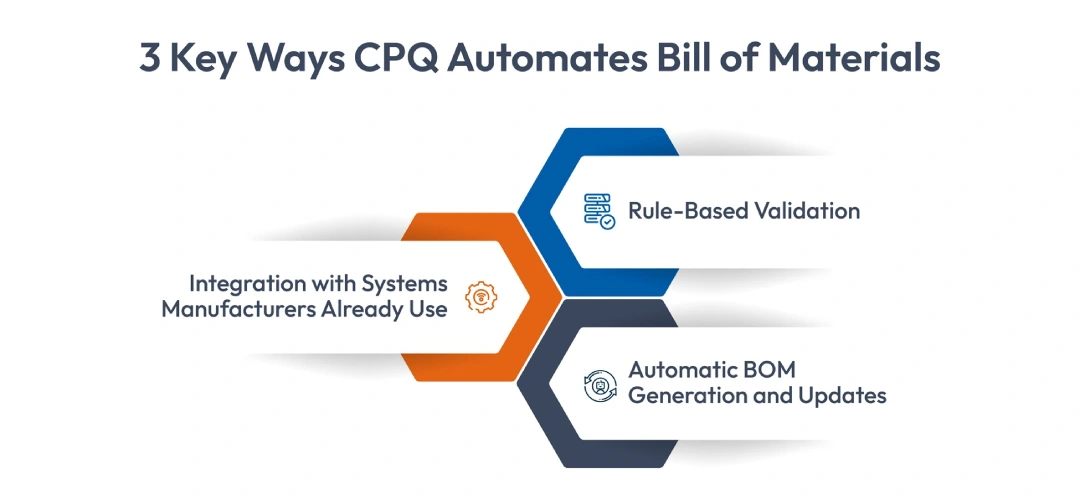
Rules-Based Validation
CPQ software provides rule-based configuration that uses pre-programmed product rules and constraints, allowing only configurations that are viable and can be produced. When a sales representative selects a specific feature, the CPQ system automatically prevents the salesperson from selecting incompatible components.
By the time the rep hits submit, a complete and accurate BOM already exists. No engineering review needed to catch basic errors. No back-and-forth to confirm whether a particular component is compatible with the rest of the configuration.
Automatic BOM Generation and Update
Manufacturers dealing in custom or configured products know the problem with static BOMs: they become outdated the moment something changes. A last moment change leads reps to track down the right version of the document and make sure it’s been updated everywhere. CPQ eliminates that problem through the real-time generation of BOM. It also updates it dynamically based on configuration changes. The result? There’s no version to update manually, no risk of production running off an old document, and the BOM reflects the order, every time, automatically.
Integrates with Systems Manufacturers Already Use
A bill of materials that lives only inside a quoting tool isn’t useful to a production team. CPQ connects the BOM directly to your existing ERP and CAD systems. What makes the integration valuable for manufacturers is that the generated BOM flows directly into the ERP system, without anyone having to re-key it.
Why Cincom CPQ Stands Out for BOM Automation
Cincom CPQ is built for manufacturers who can’t afford BOM errors. As users make selections, Cincom CPQ dynamically updates the bill of materials in real time, no documentation lag, and no manual reconciliation required. Configurations are validated against engineering logic before the quote goes out, so you never propose a product that can’t actually be built.
Sounds interesting? Learn more about how Cincom CPQ helps manufacturers sell complex products effortlessly.
Best Practices for Implementing CPQ
Here are a few key bills of materials automation best practices that organizations should follow from the start.
Standardize your product data before you start – Audit existing part numbers, descriptions, and pricing models to make sure everything is accurate and consistently formatted.
Align sales and engineering on configuration rules – Automation is only as good as the logic behind it. Both teams need to collaborate on defining the exact rules, constraints, and dependencies that will govern the system.
Integrate with your core systems – A CPQ platform that operates in isolation won’t deliver its full value. It needs to connect with your CRM for customer data and your ERP for downstream manufacturing.
Test extensively before rollout – Before handing the system over to the broader sales team, run it through your most complex product variations. Verify that the BOM output is accurate before it matters.
Simplify Your Manufacturing Workflows
In manufacturing, fast response times win deals. Relying on manual processes to generate BOMs in manufacturing complex products puts a hard ceiling on how efficiently you can scale, and how well you can serve customers who expect quick, accurate quotes. CPQ software removes the disconnect between sales and engineering. When BOM generation is automated, every quote is technically viable, accurately priced, and ready for production, the moment the customer says yes. If your team is still spending days on what could take minutes, it’s worth taking a close look at your current configuration workflows — and whether a dedicated CPQ solution might change the equation.
FAQs
1. What is a bill of materials?
A bill of materials (BOM) is the complete list of every part, sub-assembly, and raw material needed to build a product.
2. Can CPQ handle BOMs for products that are heavily configured to order?
This is actually where bill of materials CPQ automation delivers the most value. For configured-to-order manufacturers where every job is different, the rules-based configuration engine generates an accurate BOM for even the most complex orders without pulling engineering into every quote.
3. How long does it typically take to implement CPQ BOM automation?
A straightforward deployment generally takes less time, while more complex environments with deep ERP and CAD integration can take longer. The biggest factor is usually data readiness — organizations with inconsistent part numbers or poorly structured BOMs in manufacturing tend to spend more time on cleanup than on the software itself.
4. Will CPQ replace the role of engineering in the quoting process?
Implementing a CPQ solution in the quoting process does not replace engineering; it supports it and streamlines the overall process. With CPQ in place, engineers are no longer pulled into every quote to manually validate whether a configuration is buildable. This frees them to focus on actual product development, which is where their time is better spent.