Organizations today are engaging customers across more channels than ever before. Email, SMS, secure portals, mobile apps, and more, and that’s just what’s standard now. Each channel generates data. Each brings its own regulatory obligations. And each introduces a potential point of failure if your compliance infrastructure isn’t built to handle the volume.
Here’s the thing: for most compliance, legal, and operations leaders, the problem isn’t awareness. The real struggle is execution. Now the question arises? How can you keep your company moving forward while controlling legal and regulatory risk?
This article takes a closer look at the challenge of risk management compliance and discusses how CCM helps organizations in bringing greater control, visibility, and consistency to customer communications.
What Risk Management Compliance Actually Means
At its core, risk management compliance is about three things: identifying the legal and regulatory risks your organization faces, assessing how exposed you actually are, and putting processes in place to keep things within bounds. However, it doesn’t stop at just knowing the rules. You also have to be able to show that you followed them.
For customer communication teams, this becomes complicated very quickly. Every outgoing message needs to be accurate, legally sound, and documented in a way that holds up to scrutiny. That means applying the right disclosures to financial documents, handling personally identifiable information in line with frameworks like GDPR and HIPAA, and keeping verifiable records of customer consent.
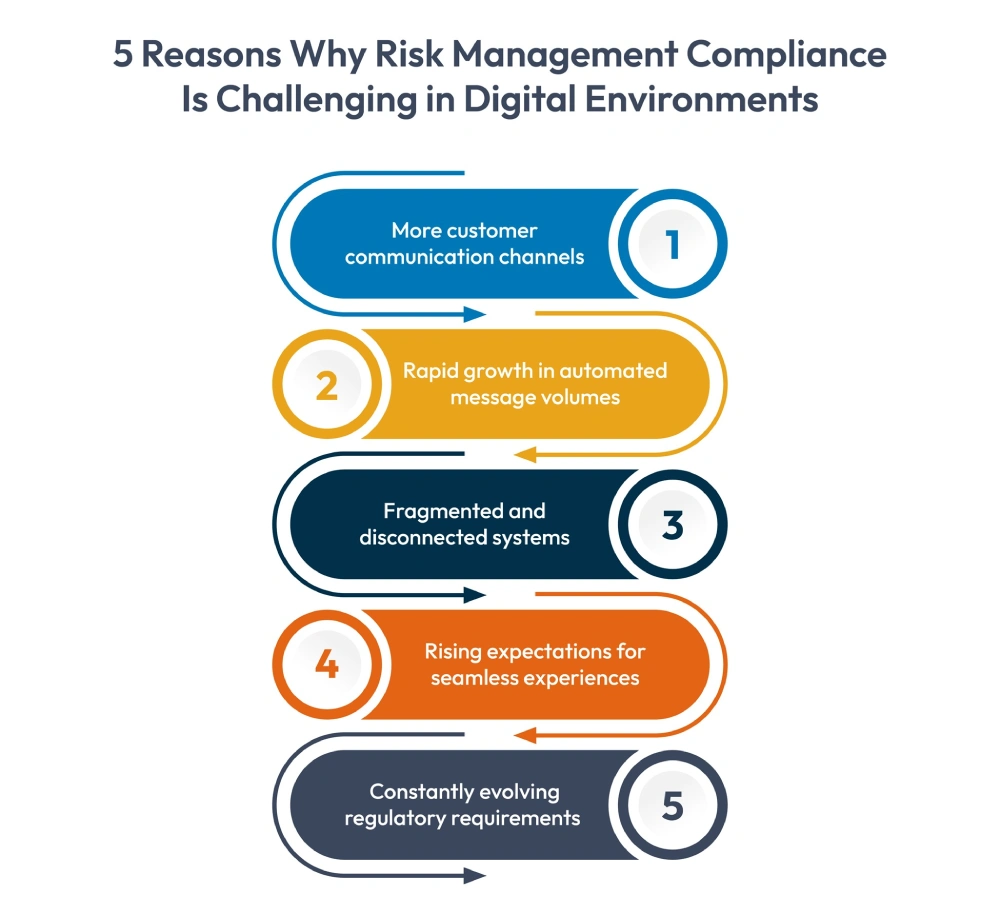
Why Digital Environments Amplify Risk Management Compliance
Not long ago, communication was simpler, there were fewer channels, and a well-organized team could stay on top of it. That operating environment no longer exists. Organizations now send millions of automated digital messages every day. They are available at almost every channel, including print and digital, to reach their customers. This has led to the risk management compliance burden to scale massively, as most organizations still rely on fragmented and disconnected systems.
These systems often lead to delays, inconsistent communication, and extra manual effort. At the same time, customers expect a smooth and seamless experience across every channel.
Regulations are constantly shifting, too. Regulatory authorities change them sometimes because of new technology, a new law, or when regulators have decided to prioritize something differently. Missing a single change can mean financial penalties, and in the highly regulated industries, the reputational damage that follows is often worse than the fine itself.

Safeguard Your Client Relationships: Mitigate Risks with a Modern Customer Communication Compliance Solution
How a CCM Platform Addresses These Challenges
A Customer Communication Management (CCM) platform is built around a central idea: bring all your customer communications into one place and manage them with consistency.
Centralized governance over communication content
When your communication workflows run through a single hub, a compliance officer can update legal language once and trust that it will flow automatically to every template across every channel. No version drifts. No forgotten SMS template. No overlooked document that went out without the right disclosures.
Regulatory Compliance Automation
CCM platforms also let organizations build logic directly into their templates. If a particular regulation applies to customers in certain states, or to specific account types, the system handles it automatically by inserting the required legal text without anyone having to remember to do it manually. The guesswork disappears magically.
A complete auditable record
Documentation requests are stressful when records are scattered. The CCM platform fixes that by maintaining a timestamped archive of every communication sent automatically, without any manual effort. When a regulator or auditor asks for records, your team isn’t digging through multiple systems. Everything is in one place, and producing a full interaction history takes far less time than it would otherwise.
How can Cincom Eloquence help you? For enterprises looking to navigate the challenges of compliance and risk management, Cincom Eloquence proves to be a robust solution that delivers centralized control and auditability for complex communication processes. It is built to support high volume communication for regulated industries such as finance, banking, and insurance.
With built-in templates, embedded rules, and conditional logic workflows, Cincom Eloquence gives enterprises the power to eliminate inconsistencies and be audit ready.
The Path Forward
Digital communication isn’t slowing down. With more channels, higher volumes, and regulatory requirements that keep shifting, it’s a combination that makes risk mitigation harder to manage every year. Fragmented systems and manual oversight worked when the stakes were lower. They don’t work anymore.
CCM platforms offer a more sustainable path. One place for templates, compliance rules built directly into workflows, and a complete audit record that’s always current. Organizations that adopt this model don’t just reduce risk, they build the kind of operational consistency that holds up under scrutiny.
For enterprises in regulated industries, the honest question is whether the current setup can actually hold up. If templates are scattered, updates require manual effort, or audit trails are difficult to produce, those gaps represent real compliance risks. A centralized CCM platform closes them and does it in a way that scales with the business rather than against it.
FAQs
1. What is risk management compliance?
Risk management compliance is the process of identifying, assessing, and controlling the legal and regulatory risks that arise from how a business operates — and being able to demonstrate that those risks are being managed.
2. Why has risk management compliance become more complex in digital environments?
Digital communication has expanded the number of channels, increased message volumes, and introduced automated workflows. This scale makes it harder for organizations to maintain consistent compliance.
3. What risks do fragmented communication systems create for compliance teams?
Fragmented systems tend to produce inconsistent messaging, outdated regulatory language, and limited visibility into what’s actually going out to customers, each of which creates gaps in compliance management that can be costly to the organization.
4. How does a CCM platform support risk management compliance?
A CCM platform centralizes communication templates, applies rule-based compliance controls, and maintains a complete record of customer communications.
5. Why are audit trails important for compliance risk management?
Audit trails provide verifiable records of what communications were sent, when they were delivered, and what information they contained. These records allow organizations to quickly demonstrate compliance during regulatory reviews or internal audits.