When an Outdated CPQ Quietly Becomes a Revenue Constraint
Most organizations don’t wake up one day and decide that their system is broken. Instead, their outdated CPQ slowly falls behind evolving product complexity, pricing strategies, integration needs, and sales expectations. What once worked well becomes rigid. What once felt innovative becomes operational friction.
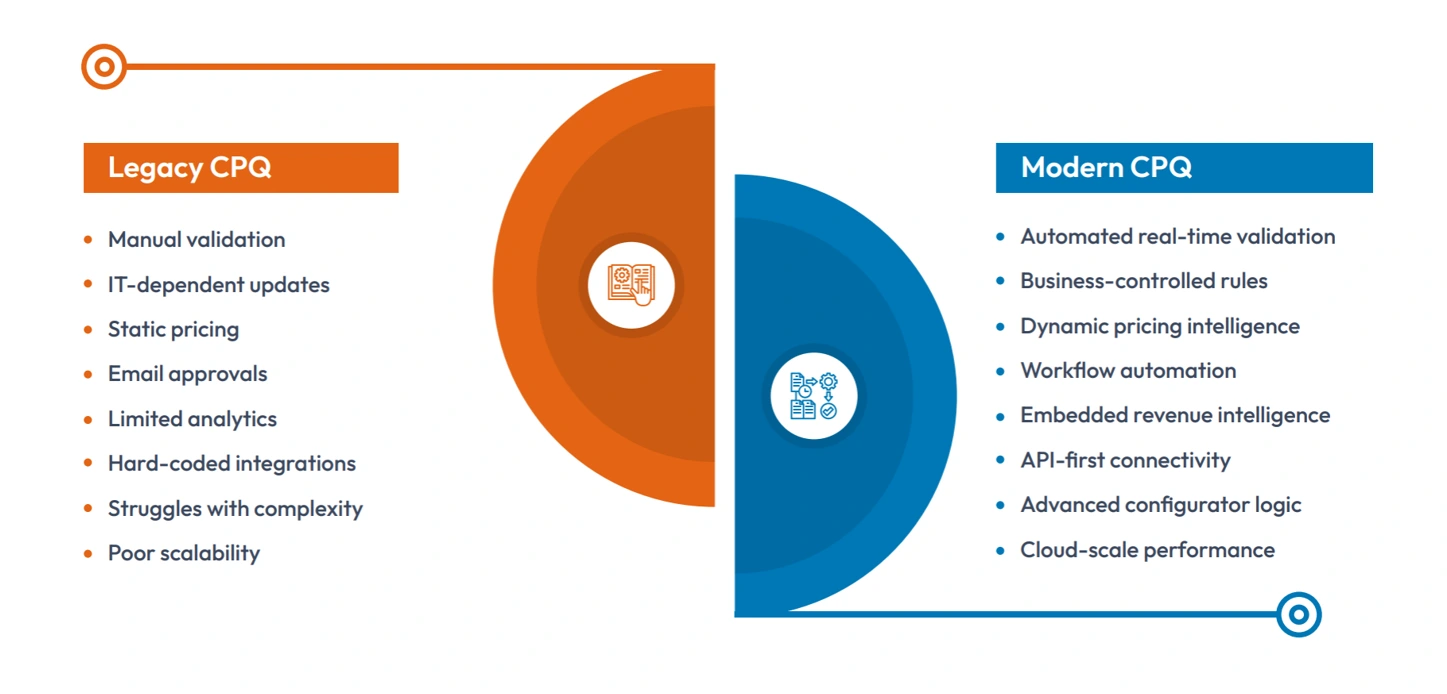
Legacy CPQ systems were not built for the present API-driven ecosystems, global pricing complexity, subscription models, and configure-to-order environments. When the system can’t evolve, sales teams compensate. That compensation like manual workarounds, spreadsheets, shadow tools, costs revenue.
In a recent B2B manufacturing survey, 88% of companies reported losing deals due to manual sales and quoting processes, with outdated or manual methods driving an average of 5% total annual revenue leakage, losses that modern CPQ systems are specifically designed to prevent.
Here are the 10 warning signs that come up when a CPQ platform has outlived its strategic value.
Sign #1 – Quotes Take Too Long to Create
In every sales organization, speed correlates directly with win rate.
If quotes require multiple handoffs, manual validations, or engineering intervention for standard deals, your outdated CPQ is likely slowing revenue. In modern sales cycles, buyers expect responsiveness measured in hours, not days.
Legacy CPQ engines often struggle under complex rule sets. Performance degrades. Configuration logic becomes heavy. What should be guided selling becomes manual troubleshooting.
CPQ modernization restores velocity through optimized rule architecture, streamlined user interfaces, and real-time validation.
Sign #2 – Frequent Pricing and Configuration Errors
Pricing errors are rarely a sales discipline issue. They’re usually a system design issue.
Organizations lose margin quietly for years because their legacy CPQ relied on outdated pricing tables, disconnected discount logic, or excessive overrides. When pricing governance lives outside the system, accuracy collapses.
Modern CPQ platforms centralize pricing logic and enforce validation automatically. If your team frequently corrects quotes or issues revised proposals, your outdated CPQ is introducing preventable risk.

Visual CPQ vs. Manual CPQ
Are you ready to leave outdated CPQ behind and close deals faster?
Sign #3 – IT Owns Every Change
One of the clearest signs of an outdated CPQ is excessive IT dependency.
If adding a product, adjusting pricing rules, or modifying an approval flow requires development cycles, your system lacks business agility. In the contemporary markets, pricing and packaging strategies evolve quickly. Your technology must keep pace.
True CPQ scalability means empowering sales operations and pricing teams with structured, governed control without sacrificing system integrity.
When IT becomes the bottleneck, responsiveness suffers.
Sign #4 – CRM and ERP Integrations Feel Fragile
A legacy CPQ often predates modern integration standards. The result is brittle data flows between CRM, ERP, and downstream systems. Sales reps re-enter data. Orders require reconciliation. Finance questions quote accuracy.
Modern CPQ modernization embraces API-first architecture and seamless integration frameworks. If your integration landscape feels fragile or heavily customized, it’s a structural limitation and not a temporary issue.
Sign #5 – The System Can’t Handle Growing Product Complexity
Businesses evolve. Product portfolios expand. Bundles become dynamic. Regional variations multiply.
But many outdated CPQ systems were implemented when the product catalog was far simpler.
When I see spreadsheets reappear or engineering manually reviewing routine configurations, I know the system is straining. Complex product environments require advanced rule engines and multi-dimensional pricing logic.
If your CPQ cannot comfortably support configure-to-order or engineer-to-order scenarios, scalability is compromised.
Sign #6 – Sales Adoption Is Low
If sales teams avoid the system, the system is a problem.
Low adoption often signals poor usability, slow performance, or inflexible workflows. When reps build their own quoting spreadsheets, they’re trying to regain control and speed.
Modern CPQ systems prioritize guided selling, intuitive configuration flows, and real-time feedback. Adoption improves when the system genuinely makes selling easier.
An outdated CPQ creates resistance. A modern one creates momentum.
Sign #7 – No Real-Time Margin Visibility
Many legacy CPQ platforms were designed primarily to generate quotes, not optimize profitability.
Without real-time margin visibility, discount guardrails, and automated pricing thresholds, sales teams operate without financial context. That leads to inconsistent discounting and margin erosion.
Modern CPQ integrates pricing intelligence directly into the sales workflow. Reps see impact immediately. Approvals trigger only when necessary. Governance becomes proactive rather than reactive.
Sign #8 – Approval Workflows Are Rigid or Manual
In many legacy CPQ systems, approval processes are linear and inflexible. Every exception triggers the same chain.
Modern organizations require dynamic workflows, routing based on margin thresholds, risk level, region, or product category.
When approvals rely on email threads or manual escalation, deal velocity suffers. Intelligent automation is a hallmark of modern CPQ scalability.
Sign #9 – Limited Analytics and Quote Intelligence
In today’s revenue operations landscape, visibility is non-negotiable.
Outdated CPQ platforms often provide limited reporting. Leadership cannot easily track discount trends, approval bottlenecks, win/loss drivers, or quote turnaround times.
Modern CPQ solutions embed analytics into the quoting lifecycle, enabling data-driven pricing strategy and continuous optimization.
Without visibility, improvement becomes guesswork.
Sign #10 – The System Cannot Scale with Growth
The final and most decisive indicator is scalability.
As companies expand into new regions, add channels, introduce subscription pricing, or increase transaction volumes, legacy CPQ systems begin to show performance strain.
Organizations postponing modernization for years only face urgent replacement when growth overwhelms the platform.
CPQ scalability is not about handling today’s volume. It’s about supporting tomorrow’s strategy.
Download the Brother Industries success story to see how Salesforce and SAP integration transformed quoting speed and accuracy with Cincom CPQ.
What to Do If Your Outdated CPQ Is Limiting Growth
If your outdated CPQ is limiting your growth, here’s a structured approach to follow:
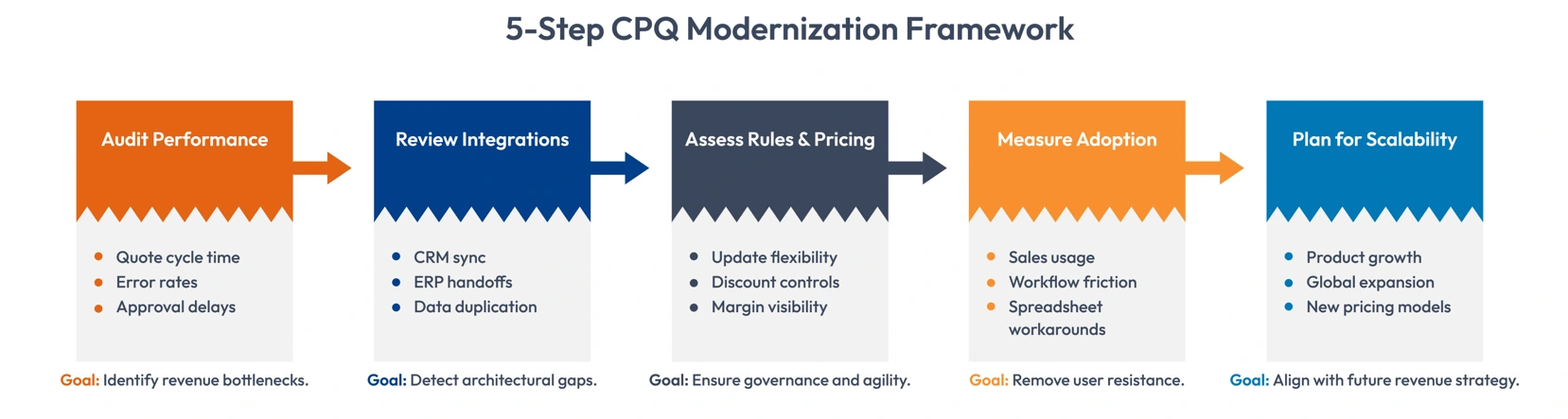
- Audit current performance, error rates, and quote cycle time
- Evaluate integration architecture with CRM and ERP
- Assess rule maintainability and pricing governance
- Measure sales adoption and workflow friction
- Define future scalability requirements
CPQ modernization should not be reactive. It should align with long-term revenue architecture strategy.
A well-planned transition reduces risk and avoids revenue disruption.
Modern CPQ Is a Revenue Infrastructure Decision
An outdated CPQ rarely fails dramatically. It erodes efficiency gradually through slow quotes, manual workarounds, pricing inconsistencies, and integration gaps.
Over time, these issues compound and restrict revenue potential.
Organizations that treat CPQ as strategic revenue infrastructure outperform those that treat it as a quoting tool.
Legacy CPQ systems serve their purpose. But modern revenue environments demand agility, integration, intelligence, and scalability.
If your system reflects multiple signs above, it may not just be outdated; it may be limiting your growth trajectory.
If you suspect multiple warning signs, conduct a structured CPQ modernization assessment focused on scalability, integration health, pricing governance, and adoption. Early evaluation prevents reactive migration later. Want to know how?
FAQs
1. How do you know if your CPQ system is outdated?
If it causes slow quoting, pricing errors, heavy IT dependency, poor integration, low adoption, or limited scalability, it is likely an outdated CPQ system.
2. When should a company replace its CPQ software?
Replacement should be considered when the system limits growth, struggles with complexity, or creates operational bottlenecks that affect revenue.
3. What are the risks of using a legacy CPQ system?
Risks include margin leakage, configuration errors, integration instability, slow sales cycles, and limited scalability.
4. How does modern CPQ improve sales efficiency?
Modern CPQ improves efficiency through guided selling, automated validation, integrated pricing intelligence, seamless system connectivity, and scalable architecture.
5. How long does CPQ modernization take?
Timelines vary based on complexity and integrations, but structured modernization programs can be phased to minimize disruption and maintain revenue continuity.