Configure-price-quote software is often positioned as a sales enablement tool. But CPQ for complex manufacturing goes far beyond accelerating quotes. It connects sales, engineering, production, supply chain, and finance into a unified system that reduces errors, protects margins, and enables scalable growth.
For manufacturers managing product complexity, regional pricing, dealer networks, and custom configurations, CPQ is not optional but foundational.
CPQ for Complex Manufacturing: More Than a Sales Tool
Traditional sales tools focus only on generating proposals. But manufacturers operate in a much more complex environment:
- Engineer-to-order and configure-to-order models
- Multi-level product options and variants
- Global pricing structures
- Dealer and distributor ecosystems
- ERP-driven production planning
This is where CPQ for complex manufacturing becomes strategic. It ensures that what sales promises can actually be built, delivered, and billed profitably.
Improving Configuration and Pricing Accuracy Across the Enterprise
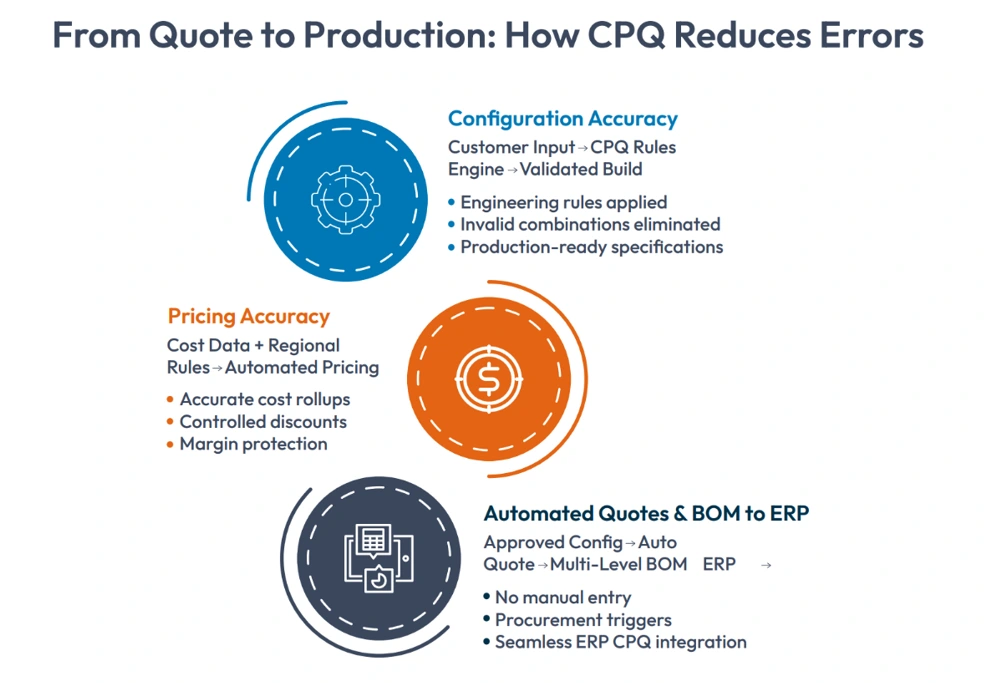
1. Improved Configuration Accuracy
Sales teams benefit from accurate product configuration, but so are engineering and production teams.
With CPQ:
- Products are configured using predefined engineering rules
- Invalid combinations are eliminated
- Production receives build-ready specifications
This prevents downstream errors in planning, scheduling, and assembly.
2. Pricing Accuracy That Protects Margins
Nothing protects profitability like accurate pricing.
CPQ ensures:
- Cost components are included automatically
- Regional and channel pricing is applied correctly
- Discounts follow governance rules
For manufacturers selling configurable products, configurable product pricing software ensures every quote protects margin while remaining competitive.
3. Automated Quotes and Accurate Bills of Material
When quotes are generated automatically, they eliminate manual entry errors and inconsistencies.
More importantly, CPQ can generate accurate, multi-level bills of material (BOMs) that:
- Feed directly into ERP
- Drive production sequencing
- Trigger procurement requirements
This tight alignment is critical for successful ERP CPQ integration for manufacturers.

Enabling Product and Market Diversity
Manufacturing today is defined by complexity:
- Shorter product lifecycles
- Higher customization expectations
- Global markets
- Dealer-specific variations
- Service add-ons
Managing this diversity manually is not sustainable.
Supporting Dealer and Distributor Networks
Many manufacturers extend CPQ to external sales channels.
When deployed effectively, CPQ to dealers and distributors enables consistent configuration, pricing, and quoting across partner networks.
This ensures:
- Channel pricing consistency
- Reduced quoting errors
- Faster response times
- Controlled discounting
How CPQ Drives Manufacturing Sales Process Optimization
The impact of CPQ extends well beyond quoting speed. It enables true manufacturing sales process optimization by aligning commercial activity with operational execution.
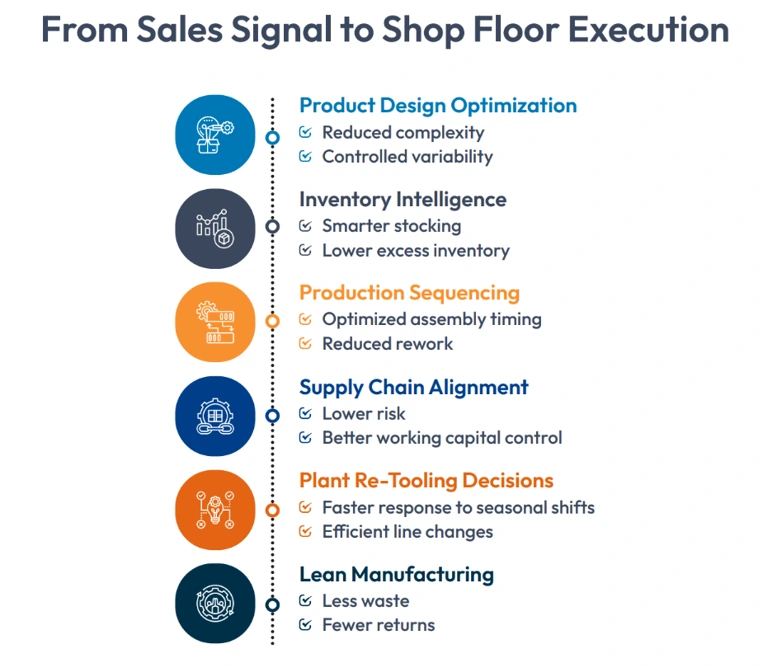
1. Product Design Optimization
CPQ supports modular product strategies:
- Core platform components defined early
- Options and add-ons applied later
- Logical build sequences embedded into configuration rules
This reduces complexity while increasing variability.
2. Superior Inventory Control
CPQ captures real-time demand signals from:
- Prospect inquiries
- Configuration patterns
- Option popularity trends
Over time, this data supports:
- Demand forecasting
- Smarter part stocking
- Reduced excess inventory
3. Intelligent Production Sequencing
CPQ configurations generate structured build sequences that:
- Optimize assembly timing
- Improve part availability coordination
- Reduce production rework
When integrated with ERP, the transition from quote to shop floor becomes seamless.
4. Enhanced Supply Chain Management
CPQ provides early visibility into demand trends before orders are finalized.
This enables:
- Proactive supplier communication
- Reduced procurement risk
- Improved working capital management
With effective ERP CPQ integration for manufacturers, these signals flow automatically into procurement and planning systems.
5. Efficient Plant Re-Tooling and Demand Shifts
Seasonal demand and market changes impact production planning.
CPQ data helps manufacturers:
- Identify configuration trends early
- Adjust production capacity
- Sequence re-tooling decisions
- Align inventory with seasonal demand
The earlier demand is visible, the better planning becomes.
6. Lean, Low-Waste Manufacturing
Lean manufacturing eliminates waste, anything that does not add customer value.
CPQ ensures:
- Only required features are included
- Configurations match customer needs
- Pricing reflects delivered value
This reduces overproduction, rework, and returns.
Why ERP CPQ Integration for Manufacturers Is Critical
CPQ alone improves quoting.
CPQ integrated with ERP transforms operations.
Benefits of ERP integration include:
- Automated BOM transfer
- Real-time pricing updates
- Production-ready order handoff
- Accurate revenue and cost tracking
- Reduced manual order entry
This alignment eliminates the traditional gap between sales and engineering — one of the most persistent pain points in manufacturing organizations.
Conclusion
If you sell configurable products, CPQ improves quoting.
If you build complex products, CPQ transforms your manufacturing operations.
CPQ for complex manufacturing bridges the gap between what is sold and what is built, improving accuracy, protecting profitability, and enabling scalable growth across global markets.
FAQs
1. What is CPQ for complex manufacturing?
CPQ for complex manufacturing is a system that enables accurate configuration, pricing, and quoting of highly customizable products while integrating directly with ERP and production systems.
2. How does ERP CPQ integration benefit manufacturers?
ERP CPQ integration automates the transfer of configuration data, pricing, and BOMs into production systems, reducing manual entry errors and accelerating order fulfillment.
3. Can CPQ support dealer and distributor networks?
Yes. CPQ can be extended to external sales channels to ensure consistent pricing, validated configurations, and controlled discounting across partner ecosystems.
4. How does CPQ improve manufacturing sales process optimization?
CPQ streamlines quoting, reduces errors, enforces pricing governance, and ensures production-ready orders, improving efficiency across the entire sales-to-production lifecycle.
5. Is CPQ only useful for sales teams?
No. While sales benefits from faster quoting, CPQ also supports engineering accuracy, inventory planning, supply chain management, and lean manufacturing initiatives.