Selecting the right CPQ solution vendor is a strategic decision that directly impacts revenue performance, operational efficiency, and long-term scalability.
While the selection process may resemble other enterprise software purchases, CPQ is not just another tool. It touches sales, finance, operations, supply chain and customer support. Treating CPQ as a simple point solution for sales often leads to underutilization and implementation failure.
A structured, cross-functional approach is essential when evaluating the best CPQ solutions for your organization.
Why CPQ Is More Than a Sales Tool
Many organizations initially view Configure Price Quote software as a quoting accelerator for sales teams. In reality, CPQ influences:
- Financial systems and pricing governance
- Order management workflows
- Supply chain and inventory visibility
- Production scheduling
- Distribution and after-sales support
As CPQ connects so many functional areas, your enterprise CPQ selection guide must extend beyond feature checklists and focus on long-term business alignment.
Selecting the Right CPQ Implementation Partner
Choosing a CPQ solution vendor requires a structured evaluation framework. Your process should include the following elements:
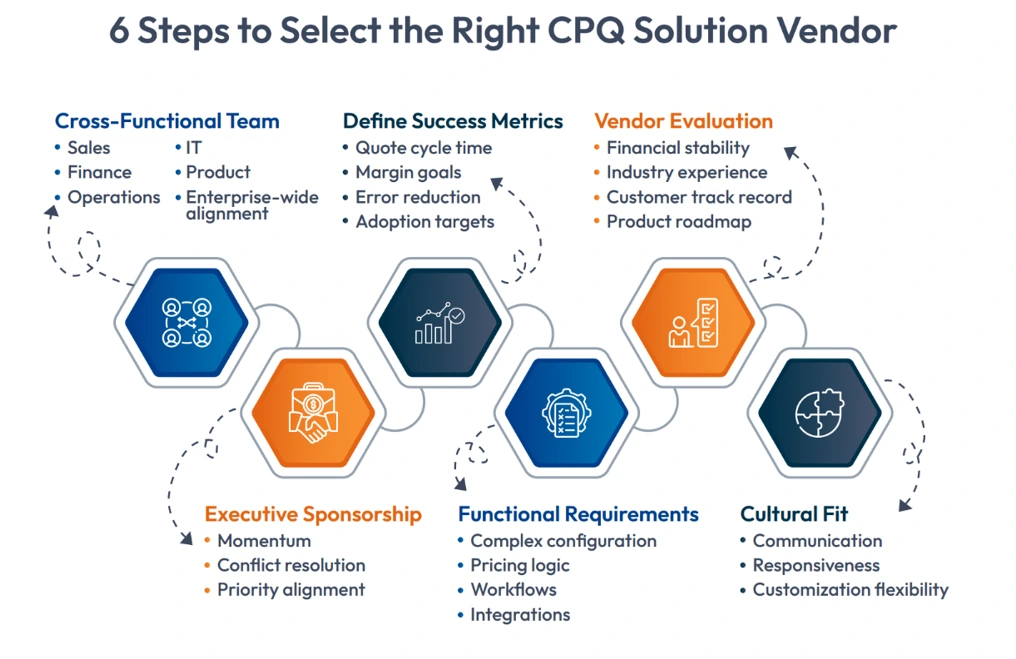
1. Build a Cross-Functional Selection Team
Include stakeholders from:
- Sales
- Finance
- Operations
- IT
- Product management
CPQ impacts all of them. Broad representation ensures better requirement gathering and stronger adoption later.
2. Secure Executive Sponsorship
Enterprise systems frequently face internal resistance. An executive champion helps:
- Maintain momentum
- Resolve conflicts
- Align cross-functional priorities
3. Define a Clear Vision of Success
Before beginning any Configure Price Quote software comparison, define:
- Target quote cycle time
- Margin improvement goals
- Error reduction benchmarks
- Adoption expectations
Without measurable goals, vendor evaluation becomes subjective.
4. Establish Functional Requirements
Document required capabilities such as:
- Complex product configuration
- Guided selling
- Advanced pricing logic
- Multi-currency support
- Approval workflows
- Integration capabilities
These form the foundation of your CPQ software evaluation criteria.
5. Evaluate the Vendor, Not Just the Product
Your CPQ partner should be assessed on:
- Financial stability
- Product ownership vs. reseller model
- Industry experience
- Customer success track record
- Long-term roadmap
A CPQ implementation is a multi-year relationship. Vendor strength matters as much as functionality.
6. Assess Cultural and Operational Fit
Implementation success often depends on:
- Communication style
- Responsiveness
- Willingness to customize
- Problem-solving approach
You are choosing a partner, not just purchasing software.
Technical Requirements Unique to CPQ Software
Beyond general software evaluation, CPQ brings technical considerations that significantly impact performance and scalability.
1. Standalone CPQ vs. Suite-Based CPQ
Some vendors offer CPQ as part of a larger ERP or CRM suite. Others specialize in standalone CPQ platforms that integrate into diverse ecosystems.
When evaluating your CPQ solution vendor, consider:
- Flexibility of integration
- Vendor lock-in risk
- Customization capabilities
- Long-term scalability
Both models can work in alignment with your enterprise architecture is what matters.
2. SaaS vs. On-Premises Deployment
Deployment model impacts:
- Infrastructure investment
- Security management
- Upgrade control
- Customization depth
Cloud-based CPQ may accelerate rollout. Licensed, on-prem solutions may offer deeper control. The right decision depends on your IT strategy and governance policies.
3. Industry Specialization
Vertical expertise matters.
For example:
- High-tech manufacturers require margin-sensitive pricing controls
- Aerospace & defense organizations need long-cycle revenue recognition and compliance capabilities
- Industrial manufacturers require highly complex configuration logic
Industry experience should be part of your CPQ software evaluation criteria.
4. Scalability and Functional Breadth
Ask critical questions:
- Can the system handle complex configuration rules?
- Does it support multi-business-unit deployment?
- Can it scale globally with multi-language and multi-currency capabilities?
- Does it support subscription, services, and hybrid pricing models?
Your chosen CPQ solution vendor should support both current needs and future expansion plans.
5. Implementation, Training and Long-Term Support
Beware of “turnkey” promises.
Installation is not implementation.
Successful rollout requires:
- Sales workflow alignment
- Change management
- User training programs
- Ongoing rule maintenance
- IT governance support
Your enterprise CPQ selection guide must account for total lifecycle management, not just go-live.
Don’t Forget the Obvious
During your Configure Price Quote software comparison, do not overlook fundamental due diligence:
- Request customer references
- Conduct peer interviews
- Assess financial health
- Evaluate product longevity
- Consider M&A risk exposure
Also assess geographic coverage. Does the vendor operate where you do, both geographically and vertically?
Most importantly, evaluate trust. CPQ implementations can involve tension, iteration, and unexpected challenges. You need a vendor that remains engaged during difficult phases.

Ready to Build Your CPQ Vendor Shortlist?
Evaluate your requirements with a structured framework and choose a CPQ solution vendor that aligns with your long-term growth strategy.
FAQs
1. What is the most important factor when selecting a CPQ solution vendor?
The most important factor is alignment with your long-term business goals. Functionality, scalability, integration flexibility and vendor stability should all support your enterprise strategy.
2. How do I define effective CPQ software evaluation criteria?
Start with measurable business objectives, then map required features such as configuration complexity, pricing rules, workflow automation, and integration needs.
3. Should I choose a standalone CPQ or one bundled within ERP or CRM?
It depends on your ecosystem. Suite-based CPQ may simplify integration, while standalone solutions often provide greater flexibility and specialization.
4. How long does CPQ implementation typically take?
Implementation timelines vary based on configuration complexity, integration scope, and organizational readiness. Enterprise deployments often require phased rollouts.
5. Why is industry specialization important in CPQ selection?
Industry-specific experience reduces implementation risk because the vendor understands regulatory requirements, pricing models, and configuration complexity unique to your market.