Most organizations recognize that their legacy CPQ systems need modernization. The challenge in legacy CPQ replacement isn’t about awareness but the timing. Enterprises mostly hesitate due to the upfront investment and competing priorities that push modernization down the list. Meanwhile, aging systems quietly drain resources in ways that rarely surface in quarterly reports.
What many organizations underestimate is how quickly these hidden costs accumulate and become noticeable. By the time the impact becomes visible in financials and performance, the organization has already spent more on sustaining outdated solutions than it would have invested in replacing it.
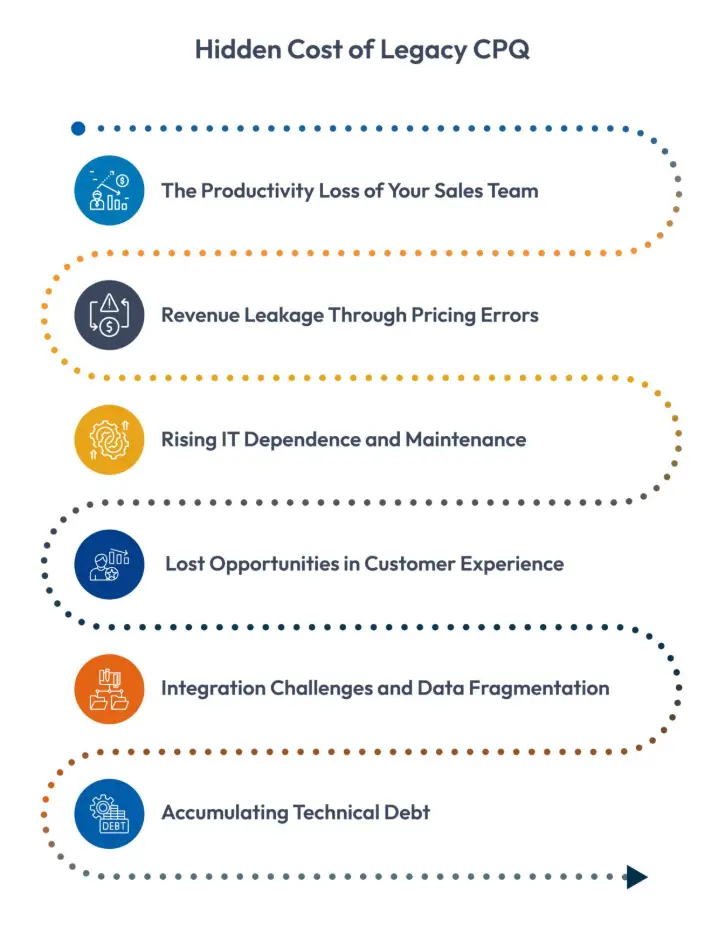
The Productivity
Sales teams were not hired to manage systems all the time. Yet legacy CPQ platforms frequently force them into exactly that role. They navigate through complicated interfaces that may stop working during critical moments. Pages load slowly while prospects wait. Simple configurations require multiple manual steps that modern platforms execute automatically.
Consider the impact on a larger scale. If each sales representative loses just 30 minutes per day to system inefficiencies, a 50-person team loses more than 500 productive hours per month. That equates to multiple full-time roles, producing no revenue contribution.
Many top performers often develop workarounds. They either create spreadsheets, notes, or memorize workflows and create shortcuts to avoid system failures. While all this keeps the sales cycle moving, it comes at a cost. Every hour spent managing system limitations is an hour not spent generating leads.
Revenue Leakage Through Pricing Errors
This is where financial impact becomes material. When legacy CPQ systems cannot support pricing complexity, sales teams rely on spreadsheets, reference outdated pricing documents, and make judgment-based decisions on bundles and discounts that may not align with current margin targets.
The outcomes are consistent:
- Discounts bypass approval thresholds
- Bundled pricing reflects outdated assumptions
- Margin erosion occurs incrementally and invisibly
- Pricing consistency becomes impossible to enforce
Even minor pricing inaccuracies create a significant financial impact at scale. Margin leakage of just 1–3% can lead to millions in lost revenue for mid-market and enterprise organizations—not due to sales performance, but due to structural limitations in pricing governance.
Rising IT Dependence and Maintenance
Legacy CPQ platforms consume increasing IT effort simply to remain functional. They keep generating patches and custom scripts to support new products, pricing models, and integrations. Over time, all this accumulates to add complexity to the system. Routine updates require extensive testing. Small enhancements take weeks because system behavior is unpredictable. IT teams spend more time maintaining existing functionality than enabling new capabilities.
Technical debt compounds quietly. Old customizations remain because removing them feels risky. Even minor updates become risky as they demand pre-planning and downtime.
Maintenance costs rise while value declines. IT resources stay locked into supporting outdated architecture instead of driving initiatives that improve sales execution, data visibility, or customer experience.
The longer the delay in legacy CPQ replacement, the more complex and costly modernization becomes. Every workaround must be unraveled. Every exception must be re-evaluated. Delay does not preserve stability—it increases long-term disruption.
Lost Opportunities in Customer Experience
Modern customers expect speed and transparency when it comes to the buying process. They expect digital configuration, rapid pricing, and fast quote delivery. These expectations exist in B2B as much as in consumer environments.
Legacy CPQ platforms struggle to support this reality:
- Quote cycles extend unnecessarily
- Mobile access remains limited
- Partner self-service is constrained
- Complex products require specialist intervention
These gaps rarely show up as explicit deal losses. Prospects do not provide feedback stating that quoting friction influenced their decision. Opportunities simply stall or disappear. Pipeline erosion occurs without visible attribution.
Integration Challenges and Data Fragmentation
Enterprise operations depend on connected data. Marketing, sales, finance, product, and service functions require shared visibility. Legacy CPQ platforms often struggle to integrate cleanly with modern CRM, ERP, and analytics environments.
In many organizations, custom connections bridge these gaps, requiring specialized knowledge to maintain and troubleshoot. However, such a complicated system introduces integration risk and inconsistency in data management, making everything less reliable. The impact –
- Marketing campaigns run without configuration insight
- Finance forecasts lack real-time pricing and quote accuracy
- Product decisions rely on anecdotal sales input rather than structured data
- Customer service lacks full quote and configuration visibility
These are not isolated inefficiencies. They represent systemic barriers to operating as a data-informed organization.
Accumulating Technical Debt
Temporary fixes are rarely temporary in legacy CPQ environments. What starts as a quick workaround to keep deals moving often becomes a permanent process embedded in daily operations. Manual documentation fills the gaps left by the system and gradually turns into an operational dependency rather than a reference. Over time, this technical debt compounds and shows up across the organization. More importantly, it makes modernization increasingly complex. Each workaround adds another layer that must be untangled. As a result, the costs, efforts, and disruption associated with legacy CPQ replacement rise as the longer action is delayed.
What does Legacy CPQ Replacement Enable?
Modern CPQ platforms operate on fundamentally different architectures. They integrate intelligence, automation, and analytics into core workflows rather than layering them on top of legacy logic.
Their capabilities include:
- Guided configuration that reduces errors
- Predictive insights for deal prioritization
- Automated approval workflows
- Real-time pricing logic
- Continuous platform updates without disruption
Organizations adopting platforms such as Cincom CPQ benefit not simply from faster quoting, but from structurally improved sales operations—better governance, stronger pricing control, cleaner integrations, and scalable architecture that supports long-term growth.

Discover how Cincom CPQ simplifies the quoting process and automates complex configurations
How to Build a Business Case for Legacy CPQ to Cloud-Native Transition
A strong business case for legacy CPQ replacement starts by reframing the discussion. The question in legacy CPQ to cloud-native transition is not whether the current system still works, but whether it still supports the business at its current level of complexity.
When replacing legacy ERP-based CPQ software, begin by documenting direct costs. These include support renewals, infrastructure expenses, and the internal IT effort required to maintain an aging CPQ platform. In many organizations, these costs increase each year even as system value declines.
Next, account for indirect costs. Productivity losses across sales teams, pricing inconsistencies, delayed quote cycles, and revenue leakage from manual processes often outweigh visible IT expenses. These impacts rarely appear in a single report, but together they represent a meaningful drag on growth.
For organizations running ERP-based CPQ, the limitations are often more pronounced. Tight coupling with core systems makes change slow and risky. Upgrades become disruptive. Over time, the cost of maintaining the status quo exceeds the investment required for CPQ modernization.
Finally, include opportunity costs. Cloud-native platforms enable faster quoting, improved pricing control, better analytics, and easier integration with modern CRM and E-commerce tools. A legacy CPQ replacement is not just a technology upgrade—it is an enabler for scalable growth.
When evaluated over a three- to five-year horizon, the financial and operational case for replacing a legacy CPQ platform often becomes difficult to ignore.
Conclusion: CPQ Modernization as a Strategic Investment
Delaying a legacy CPQ replacement may feel pragmatic, but the costs add up quietly. Productivity declines, pricing errors increase, technical debt grows, and risk exposure rises—all while the system continues to appear “functional.”
Replacing legacy ERP-Based CPQ is not a technology refreshment. It is a business decision that enables faster selling, better pricing control, and greater operational resilience. A phased legacy CPQ to cloud-native transition allows organizations to modernize deliberately rather than react under pressure.
The longer the action is delayed, the more complex and costly the transition becomes. The advantage lies with organizations that choose to move before legacy systems become a constraint on growth.
FAQs
1. What is a legacy CPQ system?
A legacy CPQ system is typically an older, on-prem, or heavily customized platform that was designed for earlier sales models.
2. Why do organizations delay legacy CPQ replacement?
Most delays are driven by cost concerns, competing priorities, and the perception that the current system is still “working.” However, the hidden costs are often underestimated until they significantly impact revenue and operations.
3. When is the right time to move from legacy CPQ to a cloud-native platform?
The right time is before the system becomes a bottleneck. Warning signs include increasing reliance on spreadsheets, long quote cycles, frequent pricing exceptions, and growing IT maintenance effort. A planned legacy CPQ to cloud-native transition is far less disruptive than a forced replacement.
4. How does CPQ modernization improve sales performance?
CPQ modernization reduces manual effort, improves pricing accuracy, and accelerates quote turnaround times.