Why Quote-to-Order Needs Modernization
The two cornerstones of success in the contemporary industrial sector are speed and accuracy. However, a lot of businesses continue to use a disconnected quote-to-order procedure. While ERP systems like SAP handle pricing, inventory, and order fulfillment independently, sales teams must balance disparate quotation tools, spreadsheets, and email threads. As a result, the entire process becomes fragmented.
Slow quotation turnaround times, inconsistent pricing, configuration mistakes, and eventually unhappy clients are the results of this lack of connectivity. Manual quotation procedures may cost businesses up to 5% of yearly sales, and 88% of manufacturers report losing agreements as a result of inefficiencies in quoting and approvals, according to recent study.
By integrating Cincom CPQ with SAP ERP, manufacturers may update their quote-to-order software system. Sales teams can use real-time SAP data to produce accurate quotations, configure complex products with confidence, and convert approved quotes straight into SAP sales orders.
What Happens When CPQ Integrates with SAP ERP?
When CPQ SAP integration is implemented correctly, it connects the front-end sales experience with back-end operational systems. Cincom CPQ acts as the intelligence layer for configuration and pricing, while SAP ERP remains the system of record for materials, costing, inventory, and fulfillment.
Instead of working in silos:
- Sales teams configure products using guided rules
- Pricing is validated against SAP data
- Approved quotes are automatically converted into SAP sales orders
- Bills of materials (BOMs) and order details flow directly into production
This tight integration transforms the quote to order CPQ process from a manual handoff into a continuous, error-free workflow.

Enhance Sales Efficiency with Cincom CPQ: A Powerful Solution to Master Data Management in SAP® Environments
Real-Time Data Sync: Pricing, Inventory & Configurations
One of the most powerful benefits of integrating Cincom CPQ with SAP ERP is real-time data synchronization.
Pricing Accuracy
Cincom CPQ pulls pricing logic, discounts, and cost structures from SAP, ensuring every quote aligns with approved pricing rules. This prevents margin erosion caused by outdated price lists or unauthorized discounts.
Inventory & Availability
By syncing inventory and availability data, sales teams gain visibility into what can be delivered and when before committing to a quote. This reduces order revisions and missed delivery promises.
Configuration Rules
Complex configuration rules managed in Cincom CPQ ensure only valid, manufacturable products are quoted. These configurations align with SAP material masters and BOM structures, eliminating downstream corrections.
Together, these capabilities ensure your quote to order software reflects real-world operational constraints.
How Cincom CPQ Enhances SAP ERP Workflows
SAP ERP excels at transaction processing and enterprise data management, but it isn’t designed for dynamic product configuration or fast quoting.
Cincom CPQ fills this gap by extending SAP workflows into the sales process:
- Guided selling simplifies complex product selection
- Automated approvals enforce pricing and compliance rules
- One-click order creation pushes approved quotes directly into SAP
- Structured BOM output supports manufacturing and procurement
Rather than replacing SAP, Cincom CPQ enhances it, making SAP more accessible and usable for sales teams without compromising control or data integrity.
Benefits for Manufacturers & Complex Product Sellers
For manufacturers selling configurable, engineer-to-order, or multi-option products, the benefits of quote to order CPQ integration are significant.
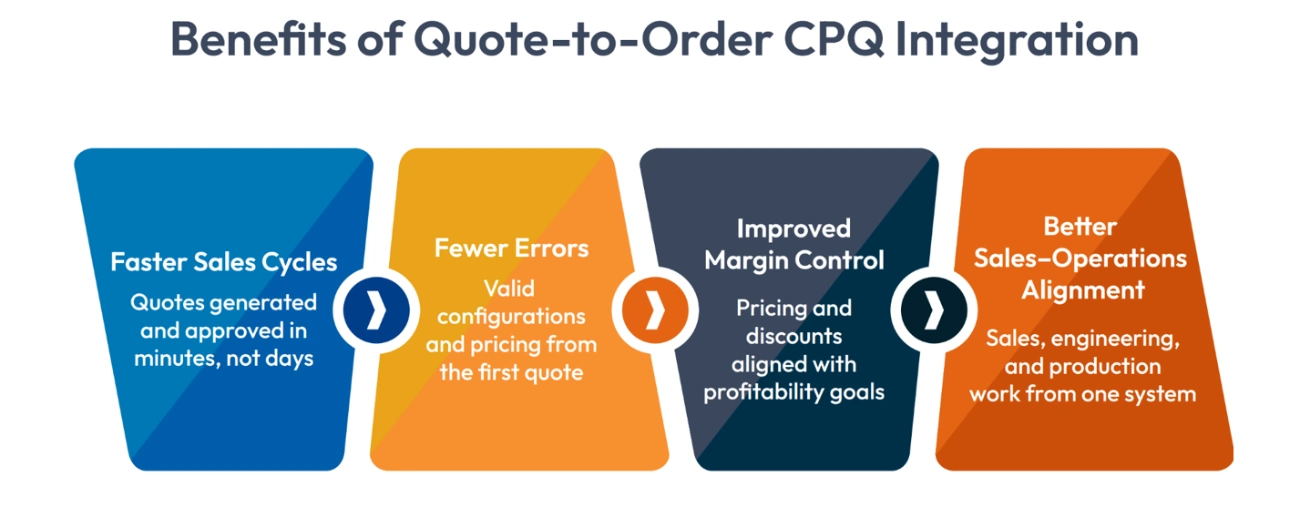
1. Faster Sales Cycles
Automated quoting and order creation reduce turnaround times from days to minutes.
2. Fewer Errors
Validated configurations and real-time data eliminate common quoting and order entry mistakes.
3. Improved Margin Control
Pricing governance ensures discounts and costs align with profitability targets.
4. Better Sales–Operations Alignment
Sales, engineering, and production work from a single source of truth.
These advantages are especially critical for businesses operating at scale or across multiple regions.
Fassi Gru achieved 100% configuration accuracy and streamlined global production with Cincom CPQ
Download the success story to learn how seamless CPQ–ERP integration accelerated quoting and order processing.
Use Case Examples
| Industry | How Cincom CPQ + SAP ERP Supports Quote to Order |
| Industrial Equipment Manufacturing | Enables accurate configuration of complex machinery and sends production-ready BOMs to SAP, reducing rework and engineering change orders. |
| Medical Equipment & Device Manufacturing | Enforces compliance rules during quoting while SAP supports traceability and controlled fulfillment. |
| Specialty Vehicles | Ensures consistent dealer pricing and approved configurations, enabling faster quoting and smoother order processing. |
| HVAC Manufacturing | Guides accurate product sizing and configuration while SAP manages materials and order execution to shorten quote cycles. |
| Electrical & Electronics Manufacturing | Controls complex product variations at the quote stage and aligns pricing, inventory, and fulfillment in SAP. |
| Power Generation Equipment Manufacturing | Supports engineered configurations and commercial terms, with SAP managing costing, planning, and execution. |
| Pumps & Valves Manufacturing | Validates technical requirements during quoting and sends clean order and BOM data to SAP for faster production. |
Key Integration Capabilities You Should Look For
Not all CPQ–ERP integrations are created same. When evaluating CPQ SAP integration, look for:
- Bi-directional data sync (pricing, materials, customers)
- Support for complex and multi-level BOMs
- Flexible integration architecture (APIs, middleware, IDocs)
- Real-time or near-real-time updates
- Minimal SAP customization requirements
Cincom CPQ is designed with flexibility in mind, enabling integration with SAP ECC and SAP S/4HANA without disrupting core ERP processes.
Steps to Achieve Seamless Quote-to-Order with Cincom CPQ
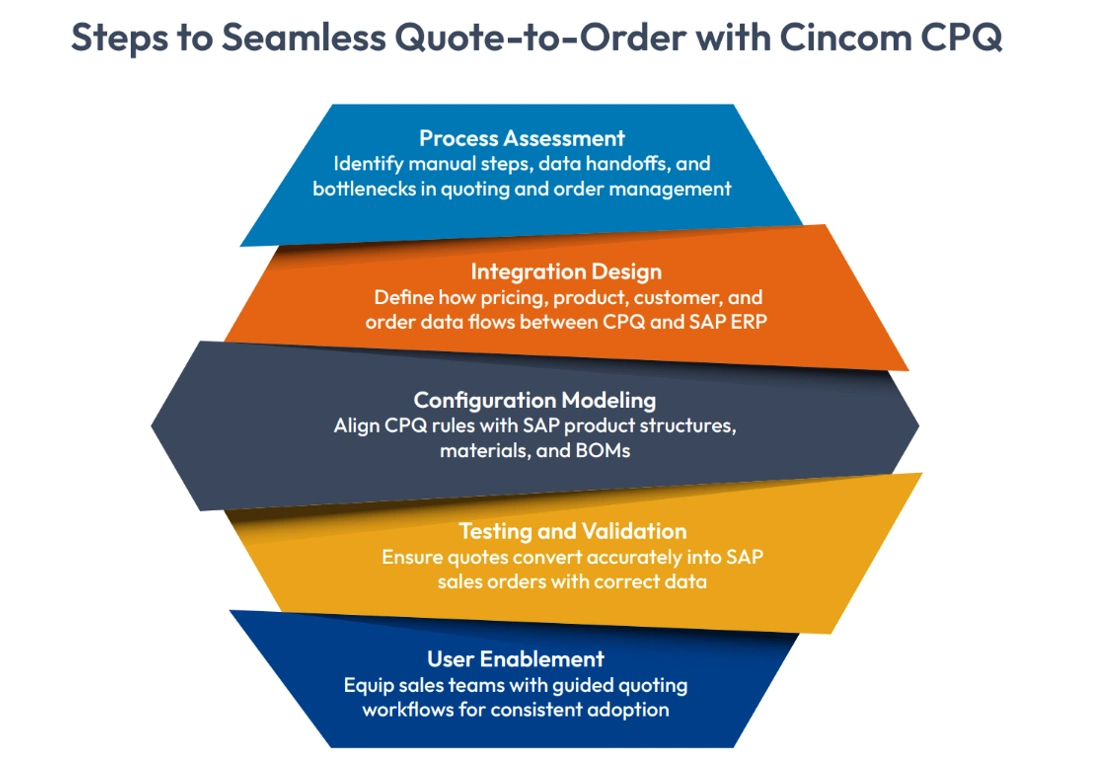
Implementing a seamless quote to order CPQ process requires a structured approach that aligns sales workflows with SAP ERP systems. Key steps include:
- Process Assessment: Determine data handoffs, manual procedures, and bottlenecks that currently exist throughout the order management and quotation processes.
- Integration Design: Describe the data flows, including price, product, customer, and order information, between Cincom CPQ and SAP ERP.
- Configuration Modeling: To guarantee uniformity, match SAP product structures, materials, and BOMs with CPQ configuration and price guidelines.
- Testing and Validation: Verify that quotations with proper pricing, configurations, and BOM data are converted into SAP sales orders.
- User Enablement: Train sales teams guided quotation techniques to ensure adoption and consistent usage.
With Cincom’s flexible integration framework, these steps can be executed efficiently, reducing implementation time, minimizing risk, and accelerating time to value.
ROI: Faster Sales Cycles & Fewer Order Errors
The return on investment from CPQ SAP integration is measurable and fast.
Organizations typically see:
- Shorter quote turnaround times
- Reduced order rework and credit notes
- Higher win rates due to faster responses
- Improved customer satisfaction
By automating the handoff between quoting and order management, Cincom CPQ helps manufacturers protect margins while scaling sales operations.
Conclusion
Faster quoting is not the only requirement for a contemporary quote-to-order process; connection, accuracy, and system alignment are also necessary.
Manufacturers can create an integrated sales-to-production framework where data flows smoothly, mistakes are reduced, and teams can concentrate on growth rather than manual adjustments by integrating Cincom CPQ with SAP ERP.
This connection serves as a strategic basis for scalable, profitable sales for companies that provide complex and configurable products.
Planning to integrate CPQ with SAP ERP?
See how manufacturers streamline quotes to order with Cincom CPQ.
FAQs
1. What is a quote to order process?
The quote to order process covers product configuration, pricing, quoting, and converting approved quotes into sales orders. It helps manufacturers sell complex products faster and accurately.
2. How does Cincom CPQ integrate with SAP ERP?
Cincom CPQ connects with SAP ERP to sync pricing, product data, and orders, allowing quotes to convert directly into SAP sales orders without manual entry.
3. Does Cincom CPQ support SAP S/4HANA?
Yes. Cincom CPQ integrates with both SAP ECC and SAP S/4HANA while minimizing ERP customization.
4. What data syncs between CPQ and SAP?
Pricing, product and material data, customers, inventory, BOMs, and sales orders sync between Cincom CPQ and SAP ERP.
5. How does CPQ reduce quoting errors?
CPQ validates configurations and pricing in real time, preventing invalid product options and incorrect quotes.