Introduction
Manufacturers operate in increasingly complex supply chains where inventory availability, supplier performance, production schedules, and customer demand must remain aligned. Yet many organizations still struggle with fragmented data spread across CRM, ERP, PLM, and inventory management systems. Without real-time visibility, supply chain disruptions, delayed deliveries, and forecasting inaccuracies are difficult to avoid.
This challenge becomes even greater for manufacturers selling configurable, engineer-to-order (ETO) or configure-to-order (CTO) products. Every customer configuration can affect materials, production schedules, supplier requirements, and delivery commitments.
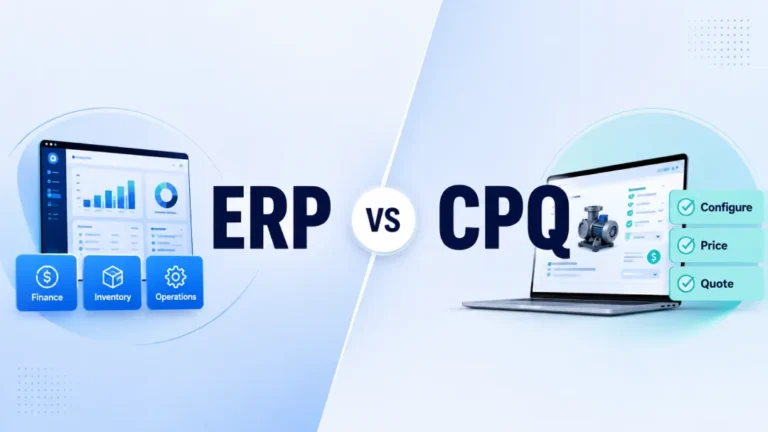
Configure-Price-Quote (CPQ) software helps bridge these gaps by connecting critical business systems and providing visibility into product demand, inventory requirements, and production planning. As manufacturers focus on resilience, agility, and operational efficiency in 2026, CPQ is becoming an essential tool for improving supply chain visibility and decision-making.
What Is Supply Chain Visibility?
Supply chain visibility is the ability to monitor inventory, suppliers, orders, production schedules and customer demand across the entire supply chain in real time. It enables manufacturers to make faster decisions, reduce disruptions, improve forecasting accuracy, and optimize operational performance.
True supply chain visibility extends beyond a manufacturer’s internal operations. It includes visibility into:
- Inventory availability
- Supplier capacity and performance
- Customer demand trends
- Production schedules
- Procurement activities
- Order and shipment status
When supply chain data visibility is available across departments and business partners, organizations can respond more effectively to changing market conditions and customer requirements.

Learn how manufacturers use CPQ to improve quote accuracy, reduce delays, and gain greater visibility across complex sales processes and supply chain operations.
Why Supply Chain Visibility Matters More in 2026
Supply chain visibility has always been important, but the contemporary manufacturing scenario has made it a strategic necessity.
1. Global Supply Chain Volatility
Recent years have demonstrated how quickly supply chains can be disrupted. Material shortages, transportation bottlenecks, geopolitical events and supplier instability can create significant production challenges.
Manufacturers need immediate access to accurate data to identify risks early and adjust plans before disruptions impact customers.
2. Customer Demand Fluctuations
Customer expectations continue to evolve. Buyers expect highly customized products, shorter lead times, and greater transparency throughout the purchasing process.
Without visibility into demand patterns and product requirements, manufacturers struggle to align resources effectively.
3. Increasing Product Complexity
Many manufacturers now offer thousands of product combinations and configuration options. Managing these variations requires accurate product, pricing and supply chain data.
The more complex the product portfolio becomes, the greater the need for connected systems and visibility.
4. Pressure to Reduce Lead Times
Customers no longer tolerate lengthy quoting, ordering, and production cycles.
Manufacturers must respond quickly while maintaining accuracy. This requires seamless coordination between sales, engineering, procurement, and production teams.
These growing supply chain challenges make CPQ an increasingly valuable technology for modern manufacturers.
How CPQ Creates Supply Chain Visibility
Many organizations view CPQ primarily as a sales tool. While CPQ certainly accelerates quoting and proposal generation, its impact extends far beyond the sales department.
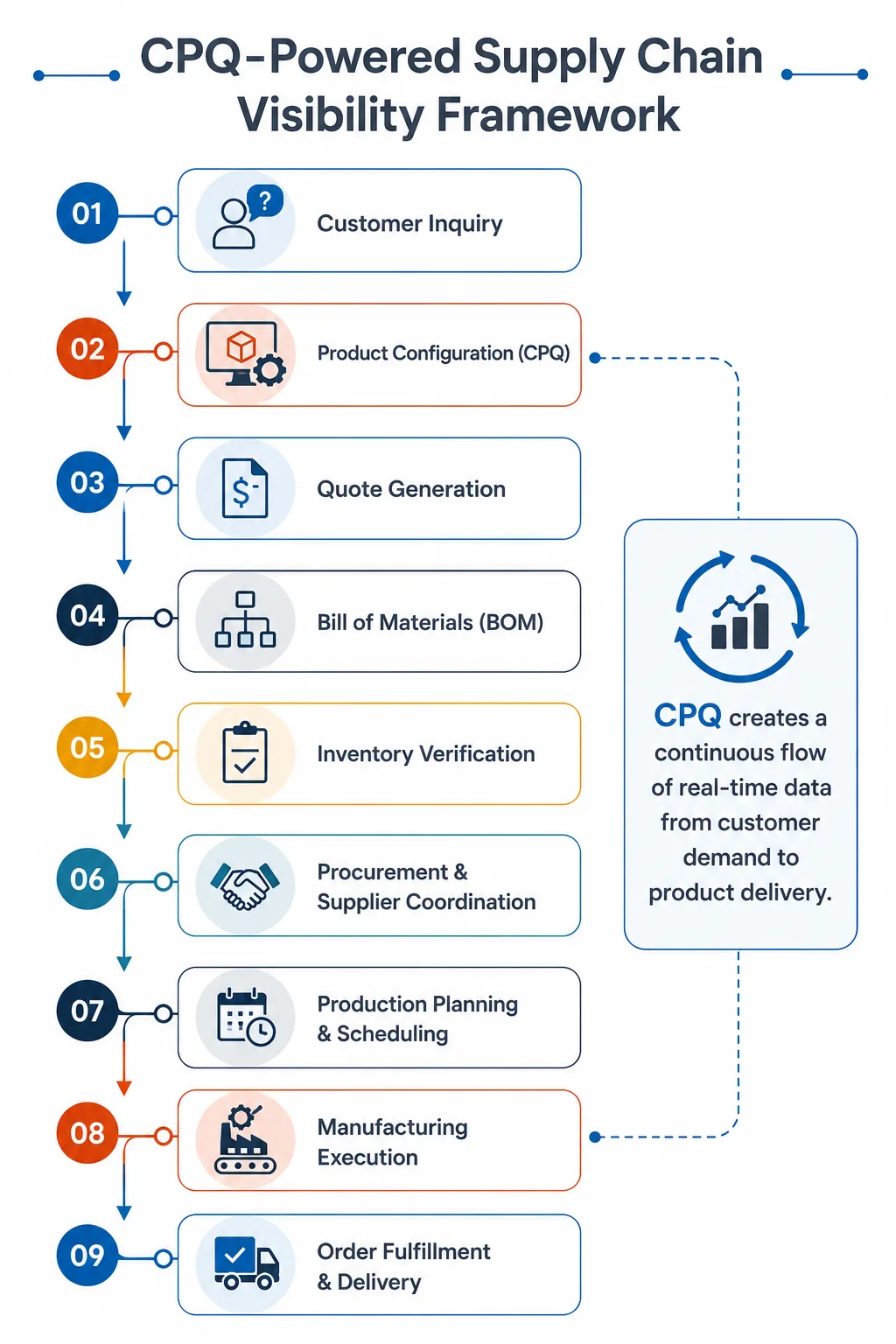
A modern CPQ supply chain strategy helps manufacturers create visibility across the entire revenue and production lifecycle.
1. Connecting CRM, ERP, PLM and Inventory Systems
Manufacturers generate enormous amounts of data across multiple business systems.
These systems often include:
- CRM platforms
- ERP solutions
- Product Lifecycle Management (PLM) systems
- Inventory management systems
- Procurement applications
- Production scheduling tools
Without integration, critical information remains trapped in departmental silos.
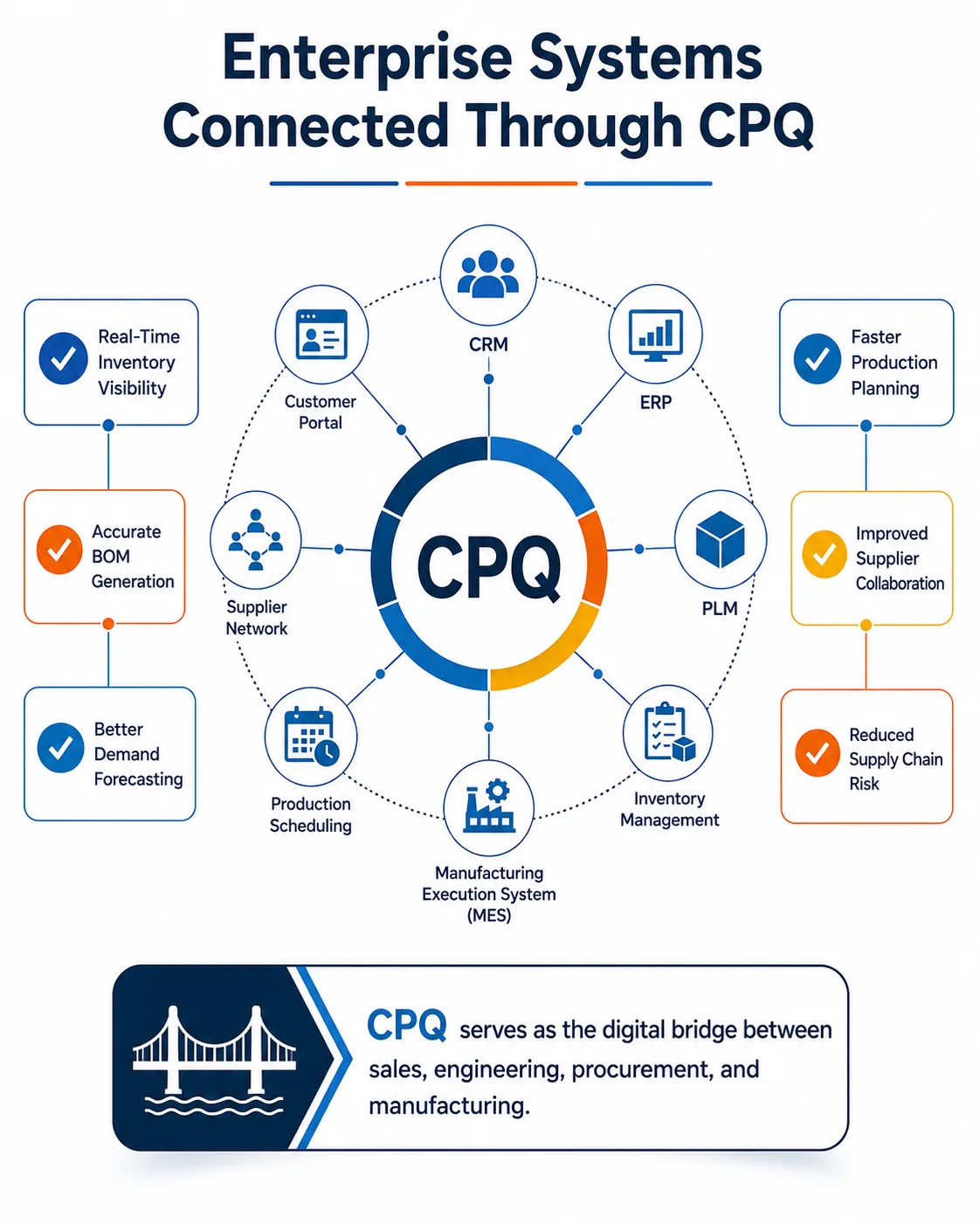
CPQ acts as a centralized hub that brings together data from these systems, creating a unified view of customer demand, product requirements, and operational capacity.
2. Providing Early Demand Signals
Every quote generated by CPQ represents potential future demand.
When customers configure products and request pricing, valuable information becomes available before an order is placed.
Manufacturers can analyze:
- Popular configurations
- Emerging product trends
- Regional demand patterns
- Component requirements
These early demand signals help procurement and production teams prepare for future requirements.
3. Creating Accurate Bills of Materials
For configurable products, inaccuracies in product configurations can create costly downstream problems.
CPQ automatically generates validated configurations and accurate bills of materials (BOMs), ensuring production teams receive complete and reliable information.
This reduces engineering rework, procurement errors, and production delays.
4. Improving Production Planning
When sales, engineering and manufacturing teams operate from the same data, production planning becomes significantly more effective.
CPQ helps manufacturers:
- Prioritize production schedules
- Allocate resources efficiently
- Reduce bottlenecks
- Improve delivery predictability
The result is a more responsive and agile manufacturing operation.
How CPQ Supports Demand Forecasting
Demand forecasting remains one of the most difficult challenges facing manufacturers.
Traditional forecasting methods often rely heavily on historical sales data. However, historical data alone may not accurately reflect future market conditions.
1. Product Configuration Trends
CPQ captures detailed information about customer preferences and product selections.
Manufacturers can identify:
- Frequently selected options
- Growing product categories
- Emerging customer requirements
This information improves forecasting accuracy and helps organizations anticipate future demand.
2. Pipeline Visibility
Sales opportunities represent future production requirements.
CPQ provides visibility into active opportunities, allowing manufacturers to estimate future component and material needs before orders are finalized.
This enables more proactive planning across the supply chain.
3. Capacity Planning
Demand forecasting is not only about materials. Manufacturers must also plan labor, equipment, and production capacity.
CPQ data helps organizations align production resources with anticipated demand, reducing capacity constraints and improving throughput.
CPQ and Real-Time Inventory Awareness
Inventory visibility is one of the most valuable benefits of a connected CPQ environment.
1. Inventory Availability During Quoting
Sales teams often struggle to determine whether products or components are available during the quoting process.
When CPQ integrates with inventory systems, sales representatives gain immediate access to inventory availability.
This helps set realistic customer expectations and prevents orders from being accepted when critical components are unavailable.
2. Alternate Supplier Visibility
Supply disruptions can occur unexpectedly.
A connected CPQ environment can help identify alternative suppliers or substitute components when shortages arise.
This flexibility improves supply chain resilience and reduces the impact of disruptions.
3. Supply Constraint Alerts
CPQ can notify users when inventory shortages, extended lead times, or supplier constraints may affect delivery commitments.
These alerts enable proactive decision-making before issues impact customers.
CPQ’s Role in Supply Chain Resilience
Supply chain resilience has become a major priority for manufacturers worldwide.
Organizations need the ability to respond quickly when disruptions occur.
1. Managing Supplier Risk
Visibility into supplier availability and component dependencies helps manufacturers identify risks earlier.
This allows procurement teams to diversify sourcing strategies and reduce reliance on single suppliers.
2. Faster Response to Disruptions
When disruptions occur, manufacturers must quickly adjust product configurations, sourcing strategies, and production schedules.
CPQ provides the visibility needed to make informed decisions faster.
3. Supporting Production Continuity
Maintaining production continuity during disruptions requires accurate information and coordinated action.
By connecting sales, engineering, procurement and manufacturing data, CPQ helps organizations maintain operational stability even during periods of uncertainty.
CPQ and Industry 4.0 Manufacturing
As manufacturers embrace Industry 4.0 initiatives, connected data becomes increasingly important.
1. Digital Manufacturing
Modern manufacturing relies on digital information flowing seamlessly between departments and systems.
CPQ helps establish this digital thread by connecting customer requirements directly to engineering, procurement and production processes.
2. Connected Enterprise Data
Industry 4.0 depends on integrated systems.
CPQ supports connected enterprise operations by synchronizing data across:
- CRM
- ERP
- PLM
- Inventory management
- Manufacturing systems
3. Automated Production Scheduling
Accurate configuration and BOM data help manufacturers automate production planning and scheduling processes.
This reduces manual effort while improving efficiency.
4. Supporting Smart Factory Initiatives
For organizations pursuing smart factory goals, CPQ provides accurate product and demand information that helps drive automation and operational intelligence.
This makes CPQ for manufacturing an important component of broader digital transformation initiatives.
Benefits of Improved Supply Chain Visibility Through CPQ
Manufacturers that improve supply chain data visibility through CPQ can achieve measurable operational benefits.
| Benefit | How CPQ Improves Supply Chain Visibility |
| Faster Order Fulfillment | Accurate configurations, validated BOMs, and connected processes reduce delays and accelerate production and delivery timelines. |
| Better Forecast Accuracy | Early visibility into customer demand and product configurations helps improve planning, procurement, and capacity management. |
| Reduced Inventory Costs | Real-time inventory awareness enables manufacturers to reduce excess stock while minimizing shortages and stockouts. |
| Improved Customer Satisfaction | Accurate quotes, realistic delivery commitments, and better order visibility lead to a more reliable customer experience. |
| Stronger Supplier Collaboration | Shared visibility into demand and procurement requirements allows suppliers to plan more effectively and respond faster to changing needs. |
What Manufacturers Should Look for in a CPQ Solution
Not all CPQ platforms provide the same level of supply chain support.
When evaluating solutions, manufacturers should prioritize the following capabilities.
1. ERP Integration
The CPQ solution should integrate seamlessly with ERP systems to ensure accurate synchronization of inventory, pricing, and production data.
2. Supply Chain Data Access
Real-time visibility into inventory, procurement and production systems is essential.
3. Advanced Configuration Rules
The platform should prevent invalid product configurations and ensure accurate BOM generation.
4. Scalability for Global Operations
Manufacturers with multiple facilities, product lines, or regions require a CPQ solution capable of supporting enterprise-wide operations.
CPQ Is Becoming a Strategic Supply Chain Tool
Modern manufacturers need more than accurate quotes. They need connected data, real-time visibility, resilient operations and faster decision-making.
CPQ helps bridge the gap between sales, engineering, production and procurement by creating a centralized source of truth for product, pricing and operational data.
As supply chains become more complex and customer expectations continue to rise, CPQ is evolving beyond quoting into a critical technology for supply chain visibility, demand forecasting and manufacturing agility.
Organizations that leverage CPQ as part of their digital manufacturing strategy will be better positioned to improve responsiveness, reduce risk and build more resilient supply chains.
Learn how manufacturers use Cincom CPQ to reduce delays, improve forecasting accuracy, and streamline complex sales and production processes.
FAQs
What is supply chain visibility?
Supply chain visibility is the ability to monitor inventory, suppliers, production activities, shipments, and customer demand across the supply chain in real time.
How does CPQ improve supply chain visibility?
CPQ connects CRM, ERP, PLM, inventory, and manufacturing systems to provide a unified view of product demand, inventory availability, and production requirements.
Can CPQ help with demand forecasting?
Yes. CPQ captures product configuration trends, quote activity, and sales pipeline data, helping manufacturers forecast demand more accurately.
How does CPQ integrate with ERP systems?
CPQ integrates with ERP platforms to synchronize product, inventory, pricing, procurement, and production data, ensuring consistent information across departments.
What are the benefits of supply chain visibility for manufacturers?
Improved forecasting, faster order fulfillment, reduced inventory costs, stronger supplier collaboration, and better customer satisfaction.
How does CPQ improve inventory planning?
CPQ provides real-time inventory awareness during quoting, helping manufacturers align demand forecasts with inventory availability and procurement strategies.