Introduction
Credit unions have always had something that many traditional financial institutions struggle to build: a close and personal relationship with their members. People join them expecting to be understood, which naturally makes communication an important part of this relationship. A member applying for a loan wants timely updates, while someone receiving an account notice expects clear and accurate information.
The problem starts when these expectations are repeatedly left unmet. Delayed updates, irrelevant messages, or conflicting information across channels can create frustration and influence how members view their relationship with the credit union. Understanding these communication gaps can help explain why members leave credit unions and what practical measures can improve credit union member retention rates.
Why Do Credit Union Members Leave Due to Bad Communication
Generic Communications Fail to Reflect Individual Member Needs
Every member has a different financial relationship with their credit union. One may have recently taken out an auto loan, another may be saving for a first home, while someone else may have been with the institution for decades.
For example, a member who has recently taken out an auto loan may continue receiving promotional emails for the same product; this creates a disconnected experience. Personalization should go beyond adding a first name to an email. The communication itself should have some connection with the member’s actual needs and existing relationship with the institution.
Delayed Communication Creates Uncertainty at Important Moments
Waiting for an update is far more stressful when an important financial decision is involved. For instance, if a person who has applied for a home loan hears nothing for several days, they may wonder whether the application is under review, more documents are needed, or something has gone wrong.
Members should not have to repeatedly call just to find out what is happening, particularly during loan applications, new account openings, suspicious transactions, or major account changes. When such things happen, customers create a negative impression of the brand and will leave.
Inconsistent Information Across Channels Weakens Trust
Suppose a member receives an email about a change in loan terms and later receives a printed document containing different information. The member now has two versions of the same information and must contact the credit union to find out which one is correct.
This can happen when different teams manage separate templates or the same change must be manually updated in several places. Whatever the internal reason, members expect information from their financial institution to be reliable.
Complex Financial Communications Leave Members Confused
Financial communications often include information such as interest rates, terms, disclosures, account changes, and instructions that members need to understand before taking action. If someone reads an entire notice and still cannot understand why a change was made or what needs to be done next, communication has failed to serve its purpose.
Credit unions should look at such documents from the members’ point of view and make important details and next steps easier to follow by appending them properly to an official document.
Related: Customer experience in banking
Outdated or Incorrect Information Can Create Compliance Gaps
Credit unions operate within a regulatory environment where member communications are subject to both federal and state requirements. Lending disclosures, privacy notices, consent preferences, and marketing communications are all governed by rules that may vary by product, jurisdiction, or the member’s recorded preferences. Consequently, a single regulatory change or preference update can affect almost every communication across the organization; thus, it often becomes strenuous for credit unions to ensure that every affected version is identified, updated, approved, and delivered consistently. The complexity, therefore, lies in governing communication throughout its lifecycle rather than in drafting the communication itself.

Banking Communication Checklist: Are You Meeting Customer Expectations and Compliance Requirements?
What Do Members Expect from Credit Union Communications Today?
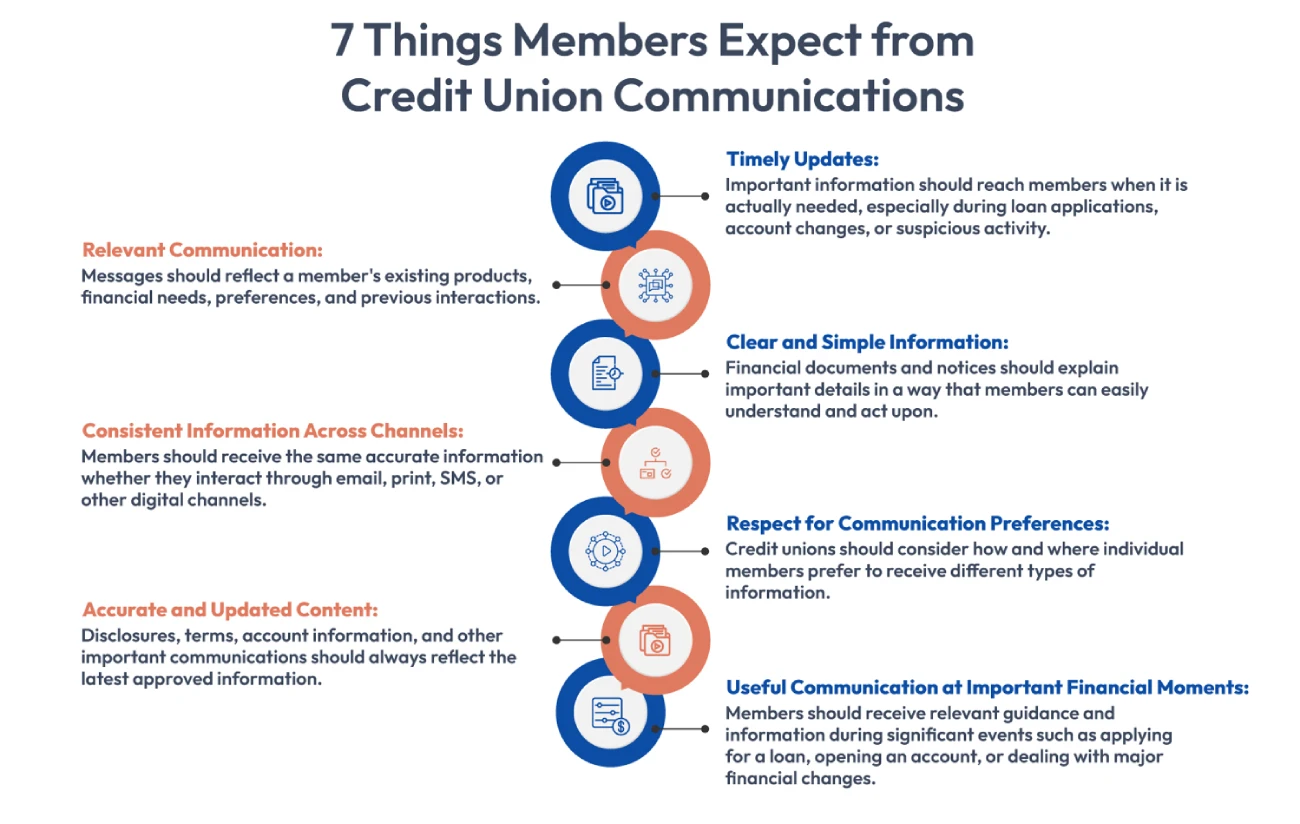
Members interact with digital platforms almost every day, whether they are shopping, making payments, booking services, or managing their finances, and these experiences naturally shape what they expect from their credit union as well. They want communication that reaches them at the right time, reflects their actual needs, and gives them the information required to make a decision or take the next step without unnecessary confusion.
How Can Credit Unions Improve Member Communication and Retention?
To improve member communication, credit unions are required to examine what happens behind every message or document before it reaches the member. Who owns the content? When was it last reviewed? How quickly can a mistake be corrected? And does the team even know how many versions of the same disclosure are currently in use? These operational questions often reveal gaps that affect the credit union member experience and may remain hidden until a member receives the wrong information.
5 Strategies Credit Unions Can Implement Right Away
1. Give Every Important Communication a Clear Owner
A loan department may create one document, compliance may approve the disclosure within it, and another team may eventually deliver it to the member. When several teams are involved, responsibility can easily become blurred. Therefore, every important communication should have a clear owner who knows when it was last reviewed, which teams use it, and who needs to approve a change. Clear ownership should therefore form a basic part of any credit union communication strategy, as it also aligns with the regulatory requirements.
2. Build an Inventory of What Members Actually Receive
Credit unions should know how many active emails, letters, notices, disclosures, and document templates are currently being used. This exercise may uncover duplicate templates created by different departments, old documents that were never formally retired, or several versions of the same communication still sitting in active systems.
Start with one high-volume member journey, such as a loan application, and trace every communication a person receives from the first application confirmation to the final decision. This gives the team a clearer picture of the credit union member experience without trying to audit the entire organization at once, and then you can implement the same approach for other journeys.
3. Put a Review Date on Content That Should Never Run Indefinitely
A template approved three years ago should not remain active simply because nobody has had a reason to open it since then. Disclosures, privacy notices, fee explanations, and other regulated content should have defined review dates based on their nature and the requirements that apply to them.
A proper review cycle becomes even more important when a regulatory change affects the wording of member communications or when privacy preferences need to be reflected correctly across systems and channels. If a document has a clear owner and a scheduled review date, there is less room for outdated information to remain unnoticed for years.
4. Create a Clear Escalation Path for Communication Errors
Suppose several members receive a document containing an incorrect fee, an old disclosure, or a message that fails to reflect an updated privacy preference. Employees should know immediately who needs to be informed, who has the authority to correct the content, which other communications may contain the same error, and how affected members will receive the corrected information.
Without a defined escalation process, the issue can move between compliance, operations, IT, and member service teams while the incorrect version continues to remain active, further deteriorating the trust of your customers.
5. Measure Whether Members Understood the Communication
Open and click rates can tell a credit union whether someone interacted with a message, but they cannot tell whether the person actually understood it. A better source of insight may already exist within the credit union’s own service data.
If members repeatedly call after receiving a certain notice, ask the same question about a loan document, or abandon a process after a specific communication, the document itself deserves closer examination. Such patterns can reveal where the credit union communication strategy is failing to support the member and provide useful insight for improving credit union member retention.
The Technology Layer: Where CCM Fits into Member Communication
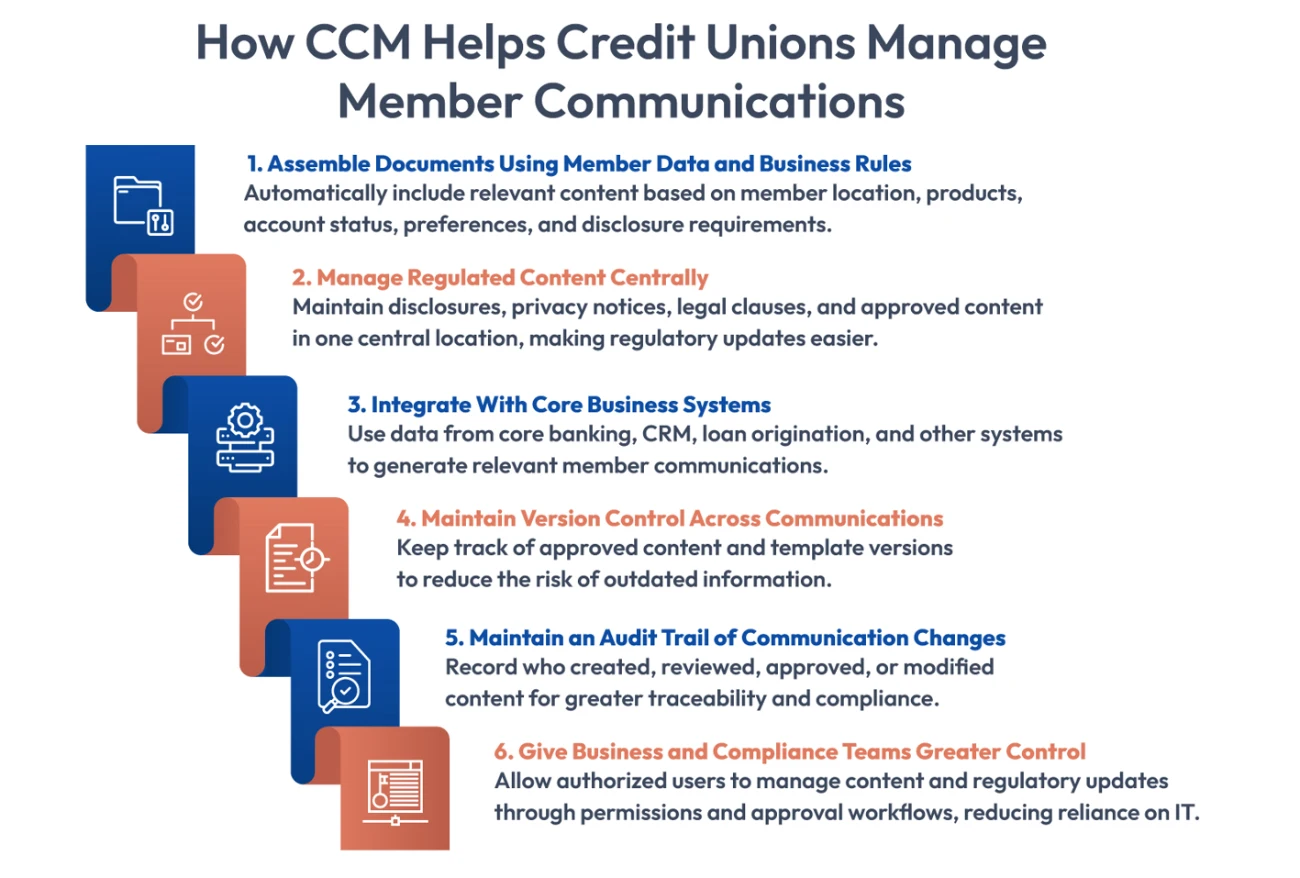
As the number of members, templates, documents, regulatory requirements, and delivery channels grows, managing them through separate systems and manual processes becomes difficult. Customer Communications Management (CCM) provides a structured environment for creating, managing, generating, and delivering communications while connecting approved content with member data and predefined business rules.
For credit unions, the value of CCM also lies in the control it can provide over regulated content. A privacy notice may need to reflect a member’s communication preferences, a lending document may require a specific disclosure, and a regulatory change may affect wording that appears across several templates. Managing these requirements manually increases the chances of an outdated or incorrect version remaining in use, which can directly affect the credit union member experience.
Related: CCM for Credit union
A Quick Self-Assessment of Your Current Communication Setup
Before evaluating whether the current communication infrastructure can support growing member expectations, credit unions should be able to answer a few basic questions about their own processes:
- How many active member communication templates currently exist across the credit union?
- Can the team quickly identify every document where a particular disclosure, privacy notice, or approved clause appears?
- How many routine template and regulatory content changes still depend on IT?
- Can the credit union trace the exact version of a communication that was sent to a particular member?
- If one piece of approved content changes today, how quickly can it be updated everywhere it is currently used?
If these questions are difficult to answer, the issue may lie deeper than the quality of individual messages. Understanding these operational gaps can also shed light on why members leave credit unions, since inaccurate, delayed, or poorly managed communications eventually become part of the member’s communication.
Conclusion
Communication within a credit union is often viewed as an operational necessity, yet its role extends much further. From the perspective of information theory, the purpose of communication is to reduce uncertainty. Every disclosure, account notice, loan document, or policy update exists because a member requires accurate information to make financial decisions with greater confidence. When that information is delayed, inconsistent, or difficult to govern, uncertainty increases rather than decreases, regardless of how well the communication is written.
This makes communication more than a document generation exercise. It becomes a question of information governance. Cincom Eloquence supports this by helping credit unions govern regulated content, document operations, and member communications within a single environment, allowing every communication to deliver information that is not only compliant but also reliable.
FAQs
1. What are the primary reasons members leave credit unions for traditional banks?
There is no single answer to why members leave credit unions. While pricing and product offerings certainly matter, inconsistent communication, delayed responses, and confusing member journeys can gradually weaken the relationship and encourage members to explore other financial institutions.
2. How does bad communication impact credit union retention rates?
Poor communication creates unnecessary friction throughout the member journey. When members repeatedly receive inaccurate, delayed, or unclear information, credit union member retention becomes more difficult because trust and confidence are gradually affected.
3. What communication channels do credit union members prefer most?
The preferred channel often depends on the type of communication. Most members expect a mix of email, SMS, secure mobile notifications, online banking messages, and printed documents when appropriate. The real objective of a good credit union communication strategy is to deliver the right message through the most relevant channel.
4. How can credit unions use automation to improve member experience without losing the personal touch?
Automation works best when it supports personalization rather than replacing it. By using member data, business rules, and preferences, credit unions can deliver timely and relevant communications that improve the overall credit union member experience without making interactions feel generic.
5. What is the average member churn rate for credit unions experiencing poor communication?
There isn’t a universal benchmark that directly links poor communication to a specific churn rate. However, communication quality is widely recognized as one of the factors that influence member satisfaction, loyalty, and long-term retention.
6. How do you fix a broken onboarding communication sequence in digital banking?
Start by mapping the entire onboarding journey from the member’s perspective. Then identify missing messages, duplicate communications, outdated content, or delays that affect the digital banking communication experience and update them accordingly.
7. What role does Customer Communication Management (CCM) software play in preventing member attrition?
CCM software helps credit unions create, govern, generate, and deliver communications from a single environment. By improving consistency, compliance, and personalization, it strengthens the overall credit union communication strategy and supports a better member experience over time.