Manufacturers are entering 2026 with new sets of challenges and complexities. Product complexity is increasing. Customer expectations are soaring. All these factors drive manufacturers to improve their sales process by offering more accuracy, transparency, and customization in every quote.
In this environment, legacy CPQ systems are starting to show their limits. Manufacturers need their CPQ solutions to meet the growth pace and fulfil customer expectations. This is one of the main reasons why they are now looking for leading vendors for CPQ system upgrades as the new year begins.
Upgrading the CPQ solution for manufacturers is not just about improving the quoting process but also to enhance scalability and reach new heights as they plan for the coming years.
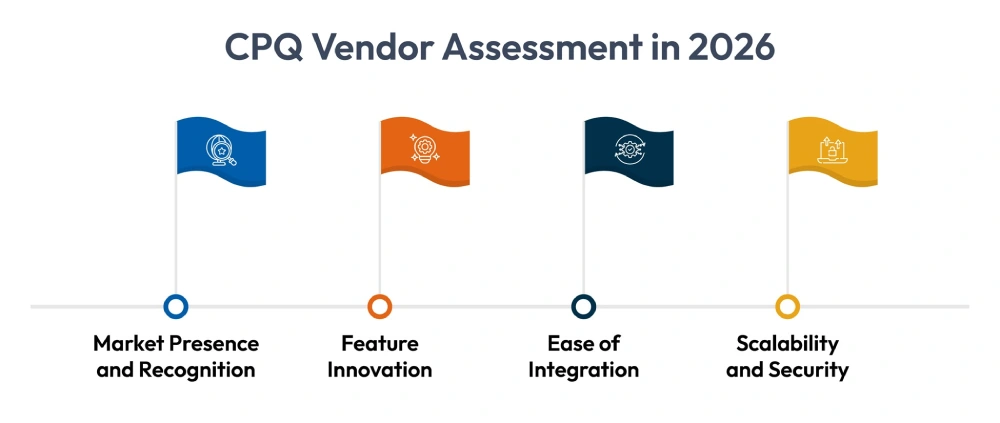
What Makes a CPQ Vendor “Leading” in 2026
A leading CPQ vendor in 2026 is defined less by brand recognition and more by how well the platform supports complex manufacturing realities. The strongest solutions combine product intelligence, automation, integration, and governance in a way that scales with the business.
Market Presence and Recognition
For big manufacturers and enterprises, market presence and recognition mean a lot. It ensures that the CPQ vendors have proven deployments, financial stability, and ongoing investment in product development. It also signals data security, high scalability, and enterprise support.
Furthermore, manufacturers should look beyond reports to understand whether a vendor’s customer base and use cases align with their own product complexity and sales model.
Feature Innovation
CPQ vendors must continue to innovate features and functionalities that further reduce dependencies on manual operations. and improve pricing and configuration processes.
Modern features like guided selling, AI-based recommendations, and accurate 3D visual configuration can help manufacturers improve sales automation and reduce quoting errors to a great extent.
Ease of Integration
CPQ does not operate in isolation. Today, manufacturers rely on a number of tools and enterprise solutions to automate their operations. CPQ solutions must integrate with these tools to create a smooth flow of data between systems. Modern CPQ platforms offer API-driven integrations and prebuilt connectors that reduce implementation effort and support real-time data exchange.
Scalability and Security
As manufacturers grow, CPQ must scale across regions, product lines, and user groups. This includes handling high transaction volumes, complex rule sets, and multi-currency pricing without performance issues.
Security is equally critical. Leading vendors provide enterprise-grade security, role-based access controls, auditability, and compliance support to protect sensitive pricing and customer data.
Top CPQ Vendors to Consider
If you are looking for leading vendors for CPQ system upgrades, here are some of the top-rated quote-to-order solutions you can consider for your enterprise.
Cincom CPQ
Cincom CPQ is purpose-built for manufacturers that deal with complex, configurable, and engineered products. Its strong rules-based configuration engine allows manufacturers to model highly complex product structures with precision. It offers robust integration capabilities with enterprise tools like CRM, ERP, PLM, E-commerce, and more.
Salesforce CPQ
Salesforce CPQ is widely adopted, particularly by organizations already using Salesforce CRM. It offers strong quote automation and contract alignment but can require significant customization for highly engineered or complex manufacturing products.
Oracle CPQ
Oracle CPQ is used by large enterprises with complex pricing models. It integrates well within the Oracle ecosystem but may feel heavy for organizations seeking faster configuration changes or more flexibility for products.
Conga CPQ
Conga CPQ focuses on quote-to-contract workflows and document automation. It works well for organizations prioritizing sales and legal alignment, though complex product modeling may require additional effort.
SAP CPQ
SAP CPQ is commonly selected by manufacturers running SAP ERP. It supports integration and global scale but may involve longer implementation timelines depending on customization needs.
PROS Smart CPQ
PROS Smart CPQ emphasizes AI-driven pricing and analytics. It is often chosen by manufacturers with advanced pricing strategies but may require integration planning for configuration-heavy products.
Tacton CPQ
Tacton CPQ is known for its strength in complex, engineer-to-order and configure-to-order environments. It supports deep product logic and tight integration with engineering systems.
Experlogix CPQ
Experlogix CPQ is flexible and integrates with several ERP platforms. It is often used by mid-sized manufacturers seeking configurable solutions without enterprise-level complexity.
DealHub.io CPQ
DealHub.io CPQ focuses on ease of use and fast deployment. It works well for subscription and recurring revenue models but may be less suitable for highly engineered manufacturing products.
How to Evaluate Leading Vendors for CPQ System Upgrades
Here is a step-by-step process to evaluate leading vendors for CPQ system upgrades:
- Start by looking at your product complexity and how your teams actually sell today. The CPQ should support your configuration model, be it configure-to-order or engineer-to-order.
- Review how the system handles configuration rules and pricing. It should prevent invalid combinations, apply pricing, and manage discounts and approvals accurately.
- Check how CPQ integrates with other enterprise solutions. Smooth integration helps ensure smoother flow of information, faster approvals, and minimized rework.
- Consider how easy the solution can be implemented and managed over time. Sales teams should be able to use it without facing any difficulties.
- Involve sales, engineering, IT, and operations in the evaluation and test the CPQ using real products and pricing scenarios. This quickly reveals whether the solution works in practical, day-to-day conditions.
Why Cincom CPQ Could Be the Best for You
Cincom CPQ is the best CPQ for manufacturing if you handle complex and highly configurable products. It is designed to handle detailed configuration rules, dependencies, and constraints without slowing down your sales teams. This helps ensure that what gets quoted can actually be built.
It also fits well into manufacturing environments where multiple systems are involved. Cincom CPQ connects with ERP, CRM, PLM, and e-commerce platforms, which helps reduce manual handoffs and misalignment between teams.
If your business needs more than basic quoting and pricing, Cincom CPQ is worth considering. It is a practical option for manufacturers that value accuracy, control, and long-term scalability over quick fixes.

Discover How Manufacturer of Specialized Medical Devices Slashed Quote Time by 88%
Conclusion
As manufacturers move toward 2026, CPQ now plays a direct role in accuracy, speed, and customer confidence. Rising product complexity and higher expectations for customization make legacy CPQ systems harder to rely on.
Many CPQ industry leaders stand out by supporting real manufacturing needs. This includes handling complex configurations, integrating with core systems, security, and scaling across regions and product lines.
Today, choosing the best CPQ for manufacturing is about finding a platform that fits how products are designed, priced, and sold. When manufacturers take a structured and cross-functional approach, CPQ upgrades lead to fewer errors, stronger margins, and long-term growth readiness.
FAQs
1. How does CPQ help reduce quoting errors?
CPQ applies rules and constraints during configuration. This prevents invalid product combinations and pricing mistakes before a quote reaches the customer.
2. What makes CPQ vendor “CPQ industry leaders” in 2026?
Leading CPQ vendors support complex configurations and integrate well with enterprise systems. They also scale with business growth and provide strong security. Real manufacturing fit matters more than brand name alone.
3. Is CPQ only useful for large manufacturers?
CPQ is valuable for both large and mid-sized manufacturers. Any company with configurable products can benefit from CPQ. It helps manage complexity and improve sales efficiency.
4. Why might manufacturers consider Cincom CPQ?
Manufacturers often consider Cincom CPQ as the best CPQ for manufacturing when product complexity is high. It is designed to support detailed configuration logic and align sales with engineering and operations.