


Introduction
Manufacturing has always lived at the intersection of what customers want and what production lines can actually deliver. For complex manufacturers, that tension usually comes down to one question: how much of this order can we configure, and how much needs an engineer in the room?
The answer shapes everything: quote turnaround times, engineering workload, deal margins, and ultimately, how fast a business can grow without burning out its best technical people. Get the balance right, and you have a scalable operation. Get it wrong, and you have a backlog that no amount of overtime will clear.
This blog breaks down the structural difference between ETO and CTO workflows, explains why defaulting to either extreme creates problems, and how to balance ETO and CTO workflows for complex products.
What is the Structural Difference Between ETO and CTO in Complex Manufacturing ?
Before you can balance ETO and CTO, you need to understand what separates them structurally, not just philosophically.

Configure-to-Order (CTO) starts with a finished engineering envelope. The product architecture is predetermined. Sales can configure options like voltages, materials, dimensions, finishes, within a defined set of rules, and engineering does not need to touch the order before manufacturing begins. Think of it as structured customization within a guardrail.
Engineer-to-Order (ETO), by contrast, begins with customer requirements and ends with a design. There is no pre-existing product template. Each order demands original engineering work: new drawings, new bills of materials (BOMs), feasibility reviews, and often prototype validation. The engineering team is on the critical path from day one.
The structural difference comes down to where engineering intervention is required. In CTO, engineering has already done the work upfront in defining the configurable product model. In ETO, that work happens per order. Both create real value. Both carry real cost. The problem for complex manufacturers is that most products do not fit neatly into either category.
A custom industrial pump, a large-format printing system, or a bespoke aerospace sub-assembly may have a standard hydraulic core (CTO) that attaches to a customer-specific mounting configuration (ETO). Treating the whole unit as ETO wastes engineering hours. Treating it as pure CTO is technically impossible. The productive answer lies in separating the two workflows at the sub-component level, and that separation requires a system intelligent enough to enforce it.
Why Do both ETO and CTO Manufacturing Models Fail to Balance Speed and Customization?
Most manufacturers, especially those scaling into complex engineer-to-order products, start out with a heavily manual process. Sales takes a requirement, passes it to engineering, engineering produces a quote, the quote goes back to sales, and eventually it reaches the customer days or weeks later.
This model fails for two reasons that compound each other.
The speed problem: Sales representatives take 73% more time to produce a typical quote or proposal when not using CPQ software.
The accuracy problem: When sales reps manually estimate pricing on a complex build, the numbers are rarely grounded in real engineering cost. They rely on prior project memory, rule-of-thumb markups, and rough-order-of-magnitude estimates. The quote looks credible but often it is not. Downstream engineering adjustments, change orders mid-build, and rework on the shop floor silently strip the margin from the deal, often before anyone in finance notices. In an ETO environment, every job carries financial risk. Quoting is harder, scheduling is less predictable, and cost control is more difficult than in traditional make-to-stock environments.
Pure CTO models have their own failure mode. When manufacturers try to standardize everything into a configurator, they eventually hit orders that fall outside the defined rules. Engineers then have to override the system manually, the BOM is modified offline, and the data integrity of the digital model breaks down. The configurator becomes a liability rather than an asset.
The fundamental issue is that neither pure model scales. Pure ETO bottlenecks engineering and invites pricing errors. Pure CTO breaks down at the edges of complexity. What complex manufacturers actually need is a CPQ platform that intelligently routes each order or each sub-component, to the right workflow.
It’s a fact without any doubt that the demand for CPQ is increasing gradually. Recent research shows that the CPQ market is projected to reach USD 7.55 billion by 2031, growing at a CAGR of 15.74%.

Overcoming BOM Complexity: Why Industrial Equipment Manufacturers Need CPQ
How Does CPQ Software Establish the Perfect Balance Between ETO and CTO Workflows?
A manufacturing CPQ platform functions as the decision layer between your product catalog and your engineering team. It does not eliminate ETO. It protects engineering time by ensuring that only orders that genuinely require custom design reach the engineering queue.
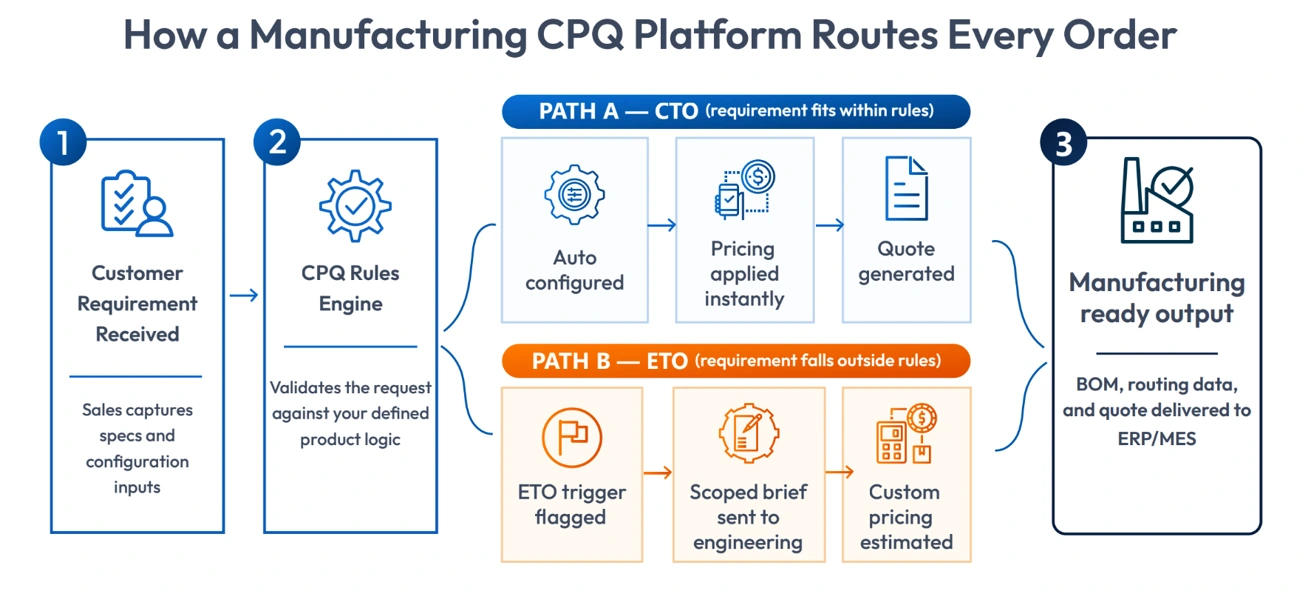
Here is how that works in practice.
Step 1: Rules-based product structure breakdown. CPQ captures the configurable portion of your product like the standard subassemblies, option families, and pricing logic, in a rules engine. When a sales rep configures an order, the platform validates every selection against those rules in real time. Anything within the defined envelope routes as CTO. In-built rules working behind the scenes automatically check for compatibility, adjusting options and pricing to a set of pre-determined rules, ensuring the final configuration is feasible for production.
Step 2: Automated identification of ETO triggers. When a customer requirement falls outside the defined configuration space, the CPQ system flags it, not as a rejected order, but as an ETO trigger. The platform captures what is known (the standard components, the verified pricing on the CTO portion) and passes a structured brief to engineering for only the custom elements. Engineering does not receive the full order; they receive a scoped engineering request.
Step 3: Accurate pricing on the hybrid. As the CTO portion of the quote is rule-governed, its pricing is exact. The ETO portion is flagged with engineering cost estimates and not guesses. Finance knows from quote day which portion of the deal carries margin risk. This changes the conversation from discovering cost surprises after delivery to managing them before the order is confirmed.
Step 4: Manufacturing-ready data handoff. Once the order is confirmed, the CPQ platform generates a structured output like BOMs, routing information, and configuration data, that feeds directly into ERP and MES systems. Automating many manual processes, like data entry and routine documentation, frees up valuable time and resources so teams can focus on higher-level priorities.
When engineering knowledge is captured in rules-based automation, what once required days of manual CAD edits and cross-functional reviews can now run in hours. One documented example: a manufacturer was able to achieve an 80% reduction in proposal lead time for certain product families after implementing rules-based engineering logic.
Three Signs Your ETO Process Needs a CPQ Layer
If you are still unsure whether a CPQ platform applies to your operation, these are the indicators that the manual ETO approach is costing you more than you realize.
- Your engineers are writing quotes, not engineering products. When senior engineers spend meaningful portions of their week generating BOMs for quotes that may not close, that is ETO overhead with no guaranteed return. CPQ removes this burden for the configurable portion of your catalog.
- Your win rate drops as deal complexity increases. If you are competitive on standard orders but lose ground on complex configurations, response speed is likely the differentiator. CPQ reduces sales cycles by 28% and approval wait times by 95%. That speed is felt most acutely on complex deals.
- You discover margin erosion after delivery, not before. This is the clearest indicator of inaccurate ETO quoting. When the cost of engineering changes, rework, and unanticipated material variances consistently exceeds the margin buffer in the original quote, the pricing model is broken, and a manual process cannot fix it.
Building the Hybrid Model: A Practical Starting Point
You do not need to restructure your entire product catalog overnight. The practical entry point for most complex manufacturers is a product structure breakdown exercise: for each major product family, identify what percentage of the design is genuinely standard across orders and what percentage truly varies per customer.
In most cases, manufacturers are surprised to find that 60–70% of a “custom” product is actually configurable. That is your CTO foundation. CPQ captures and automates it. The remaining 30–40%, the genuinely custom elements, continues as ETO, but with far less noise around it.
The competitive pressure to deliver faster, quote more accurately, and scale without proportionally growing headcount is not going away. The manufacturers building durable operations are the ones establishing this hybrid infrastructure now.
Conclusion
The debate between ETO and CTO is often framed as a strategic choice as if a manufacturer must pick a side and commit. In reality, most complex product companies are already running both models simultaneously. The problem is that without the right systems, hybrid operation is invisible, inconsistent, and expensive to manage.
A manufacturing CPQ platform makes the hybrid explicit. It captures what is configurable, automates what is repeatable, and surfaces what genuinely needs engineering attention so that every order moves through the right workflow, at the right speed, with pricing that reflects actual cost.
For manufacturers under pressure to quote faster, deliver accurately, and scale without adding engineering headcount, that infrastructure is not optional. It is what separates the operations that grow profitably from those that grow painfully.
Ready to See How Cincom CPQ Handles ETO and CTO in a Single Platform?
Cincom CPQ is built for manufacturers selling complex, configurable products with support for hybrid ETO-CTO workflows, manufacturing-ready BOMs, and rules engines that scale with your product complexity.
FAQs
1. How does a hybrid ETO-CTO model save engineering hours?
CPQ handles all standard configurations through rules-based automation, so engineers only receive scoped requests for genuinely custom elements, recovering significant engineering time each week.
2. Can a CPQ platform handle manufacturing-ready data handoffs without manual entry?
Yes. Manufacturing CPQ platforms generate structured BOMs and routing data that feed directly into ERP and MES systems, eliminating manual work between the quote and the shop floor.
3. What products are best suited for a hybrid ETO-CTO approach?
Products with a stable engineering core and customer-specific modifications layered on top such as custom machinery or configurable capital equipment, are the best fit.
4. How does CPQ prevent margin erosion on complex orders?
It enforces pricing rules on configurable elements and structures engineering cost estimates on ETO portions, so cost assumptions are visible before the order is confirmed, not discovered after delivery.
5. Is CPQ implementation disruptive to existing ETO workflows?
Not when scoped correctly. Most implementations start with the highest-volume product families, leaving existing ETO processes intact while incrementally encoding more of the catalog into the rules engine.


