How can sales operations boost revenue with a CPQ solution?
For many organizations, adopting CPQ for Sales Operations has become one of the most effective ways to improve consistency, speed, and predictability across the sales process.
We’ve talked about CPQ (configure-price-quote) from the perspectives of IT, Sales Management, Finance and Marketing, but what about sales operations and the sales professionals themselves? From a sales operation lens, CPQ plays a direct role in driving structured sales revenue growth strategies.
In the past, companies haven’t spent much time worrying about enabling sales or making the selling task easier for the person out in the field. The historical mindset was, we do the product; you sell it. As long as you make your numbers, we’re happy; how you get it done is your affair. This approach left little room for scalable Configure Price Quote software benefits that modern sales teams rely on today.
Arthur Miller points this out during the second act requiem for Willy Loman in his brilliant work, Death of a Salesman.
“He’s a man way out there in the blue, riding on a smile and a shoeshine . . . a salesman is got to dream, boy . . .”
Today, companies know they cannot rely on such romantic notions. And sales reps? They know they need more than a smile, a joke, and a shoeshine to get the job done. Modern selling demands structure, accuracy, and technology that support repeatable sales revenue growth strategies.
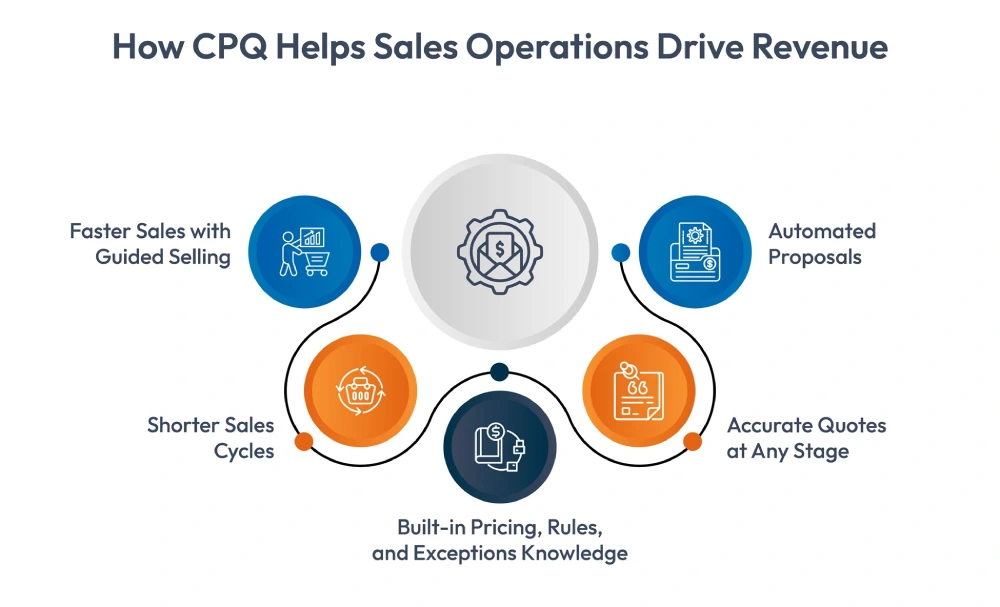
How does CPQ help sales operations deliver more revenue? Let’s look at several immediate benefits.
CPQ Minimizes Training Time for Sales Reps
Products are complex, and their application as a solution to a problem can be quite complicated. Couple that fact with the rapid development and improvement cycle of products today, and you have a significant knowledge deficit working against the person tasked with selling the product. Sales operations teams often struggle to keep training aligned with this pace, which directly affects revenue outcomes.
CPQ removes the obligation to memorize all of the variable pricing, specification data, and configuration and application information from the sales rep. All of that complexity can be built into the interviewing logic that drives the configuration process.
The sales rep and the customer walk through a guided-selling-based interview. The customer’s answers drive the options presented on the selection menus, and ultimately the product is configured based on the customer’s input. This structured approach helps sales operations enforce consistency while supporting sales revenue growth strategies.
Sales teams need to understand and articulate the high-level benefits and messaging related to the solution, but CPQ handles the details. This means new sales reps can become productive more quickly, and modified products go straight into the sales cycle without extensive retraining of the sales force. For organizations investing in CPQ for sales operations, faster ramp-ups directly translate into earlier revenue contribution.

Built-in Guided Selling Scripts Answer Buyers’ Questions
The sales rep’s role is largely that of a problem resolver and information source. When prospects come up with that one question, that exception no one has thought of, the sales rep steps up and gets the answer for them. This means finding the right expert in Finance, Product Management, Engineering, or elsewhere to noodle the question and provide a credible answer.
That quest for information means long delays in the decision-making process while the prospect waits for their answer. It also means the sales rep will lose productive time making a lot of phone calls and burning through lots of shoe leather running down the right expert and obtaining the right answer.
CPQ steps up to help Sales and keep the selling cycle on schedule. All of the esoteric expert knowledge is built into the interviewing guided question-and-answer facility within CPQ. Finance, Engineering, Product Management and the rest all provide input into the interactive interview script. These embedded rules are a key Configure Price Quote software benefit for sales operations teams seeking predictability.
The obscure and exceptional questions all have answers “built in” and included in the interview when needed.
Sales do not have to “come back next week” with an answer; the answer is there when needed. This immediacy strengthens buyer confidence and supports scalable CPQ for sales operations.
Deliver Accurate Quotes Anytime During the Sales Cycle
Talking about money and asking for the order are two inevitable elements of almost any sales cycle. Early on, prospects that see benefits in your product will start asking for pricing information. They may not want a final price, but they want to have “some idea about cost,” or perhaps they will ask for a “ballpark” quote. Prospects ask for this because they don’t want to waste time talking about a solution that is beyond their pricing limits. It’s understandable, but it also creates problems.
Sales reps know there is danger in quoting any price too early in the sales cycle. First, any price, no matter how large or small, sets an expectation and negotiating limit that is tough to overcome later in the cycle. Secondly, quoting a price before all of the requirements are understood is simply foolish. This is where CPQ for sales operations plays a critical role in governance.
CPQ provides the ability for the rep to deliver a quotation at any time during the selling cycle―a quotation that is time and date stamped and accompanied by an itemized listing of the specifics being quoted. This transparency is one of the most practical Configure Price Quote software benefits for revenue protection. This also means later on in the selling cycle, when those additional requirements do surface, the higher price is much easier to justify and account for.
The sales rep is not stuck with having to “honor” an invalid price that was quoted weeks or months before, margin is preserved and additional functionality is sold as required.
CPQ Automates Sales Proposals
Getting the order is both a blessing and a curse for the sales professional. Sure, getting the order is the whole point of the exercise, but it also means time in the office putting together a professional proposal to seal the deal. This is time spent keyboarding proposal documents, gathering up collateral and user stories and putting it all together in a format that’s reflective of your corporate standards. All of that time would be better spent nurturing other opportunities.
CPQ takes that burden off of the sales rep’s shoulders and automates the proposal-generation process. The ability to deliver automated sales proposals is one of the most visible wins for sales operations.
Proposals are generated based on marketing standards and visual branding rules. User stories and references are included that are current, valid, and applicable to the buyer’s own situation.
Best of all, the sales rep can continue selling instead of running around the office putting the proposal together. This shift allows sales teams to focus on execution while sales operations scales CPQ for sales operations.
What does CPQ do for Sales Operations?
Sales operations will derive great benefit from CPQ. In fact, many organizations adopt CPQ for sales operations specifically to create repeatable, measurable sales revenue growth strategies.
- Errors are eliminated.
- The endless memorization of trivial, yet critical, detail is no longer required.
- The panic quest for information from experts is minimized and quotations.
- Sales proposals are available with the click of a mouse.
Willy Loman would be thrilled!
FAQs
1. What is CPQ and why is it important for sales operations?
CPQ is software that helps sales teams accurately configure products, apply correct pricing, and generate quotes. It brings structure and consistency to the sales process, reduces errors, and ensures every quote follows approved rules and pricing policies.
2. How does CPQ help increase sales revenue?
CPQ helps increase sales revenue by shortening sales cycles, reducing pricing mistakes, and enabling sales reps to respond faster to buyer questions.
3. Can CPQ reduce training time for new sales reps?
Yes. CPQ reduces training time by embedding product rules, pricing logic, and configuration knowledge into the system.
4. How does CPQ support accurate pricing during the sales cycle?
CPQ allows sales reps to generate time-stamped, itemized quotes at any stage of the sales cycle. This ensures pricing is based on current requirements and approved rules.
5. Does CPQ help automate sales proposals?
Yes. CPQ automates sales proposal creation by generating branded, compliant proposals that include the correct product details, pricing, and supporting content.