If your sales cycle feels too long, quotes require multiple revisions, or reps rely heavily on engineering team, it may be time to evaluate CPQ. Speed, accuracy, and consistency are absolutely non-negotiable in the contemporary B2B market.
This CPQ implementation checklist helps you assess readiness, define requirements, and apply proven CPQ software evaluation criteria so you can confidently move from interest to execution.
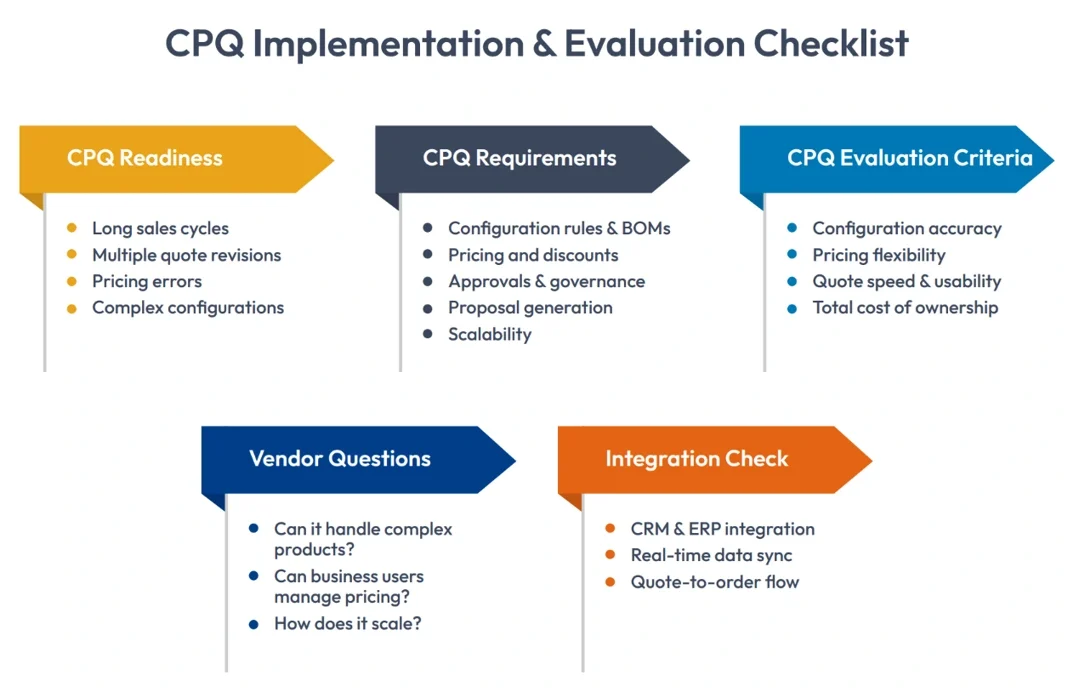
Assessing Your Current Sales Process and Business Requirements
Before selecting technology, you need clarity on where your current process breaks down. Use this checklist to evaluate your opportunity-to-order workflow:
- Quotes take too long to generate or require manual calculations
- High dependency on sales engineering or product experts
- Frequent pricing errors or margin leakage
- Inconsistent proposals across regions or reps
- Difficulty managing complex configurations, bundles, or custom products
- Limited visibility into deal approval status
If several of these apply, you already have a strong CPQ requirements list forming.
Checklist: Define your CPQ requirements
- Product configuration complexity (rules-based, guided selling, BOM-level)
- Pricing models (tiered, volume-based, contract pricing, discounts)
- Approval workflows and governance
- Proposal and document generation needs
- Scalability for future product and market expansion
Critical Criteria for Evaluating CPQ Software Providers
Not all CPQ platforms are built for long-term growth. When selecting a CPQ vendor, evaluate solutions beyond surface-level features.
CPQ software evaluation criteria to prioritize:
- Configuration accuracy: Can the system prevent invalid or non-compliant configurations?
- Pricing flexibility: Does it support your real-world pricing logic without custom code?
- Quote speed and usability: Can sales reps generate accurate quotes quickly?
- Best-practice enforcement: Does CPQ replicate top-performer behavior across the team?
- Total cost of ownership: Consider implementation, maintenance, and scalability costs
Ask vendors to demonstrate how their CPQ handles your most complex quoting scenario.
Questions to Ask CPQ Providers Before You Commit
Use these questions to ask CPQ providers during demos and evaluations:
- How does your CPQ support complex, multi-level product configurations?
- Can pricing rules be managed by business users without IT involvement?
- How do you ensure consistently accurate quotes across channels?
- What does implementation typically look like for companies like ours?
- How does the platform scale as product complexity and quote volume increase?
The answers will quickly reveal whether a solution is tactical or strategic.
Ensuring Seamless Integration with ERP and CRM Systems
A CPQ platform should not operate in isolation. Seamless integration ensures data accuracy and end-to-end visibility.
Integration checklist:
- Native or flexible integration with CRM and ERP
- Real-time product, pricing, and customer data sync
- Clean handoff from quote to order
- Minimal custom code for future upgrades
Strong integration is often the difference between CPQ adoption and abandonment.

Ready to Choose the Right CPQ?
Download the guide to find out the critical factors that Sales Leaders should consider while choosing a CPQ solution.
This in-depth resource helps you go beyond basics and make a confident, future-ready CPQ decision.
FAQs
1. What is a CPQ implementation checklist?
A CPQ implementation checklist outlines the business, technical, and process requirements needed to successfully deploy CPQ software.
2. How do I evaluate CPQ software providers?
Focus on configuration accuracy, pricing flexibility, usability, scalability, and integration—not just features.
3. What questions should I ask CPQ vendors?
Ask about real-world complexity handling, pricing governance, implementation approach, and long-term scalability.
4. Is CPQ only for large enterprises?
No. CPQ benefits mid-sized and growing organizations dealing with product complexity and long sales cycles.
5. How long does CPQ implementation take?
Timelines vary, but platforms designed for flexibility and integration deploy faster and scale more efficiently.