Introduction
Insurers operate in a world of extremes. On one side are meticulously structured, high-volume policy documents; on the other, dynamic, ad hoc correspondence triggered by claims, inquiries, or policy changes. Meeting these demands reveals the core of personalized insurance correspondence challenges, as traditional systems often fail to deliver messaging that feels individual and contextually aware.
The difficulties are not merely technical. They arise from organizational silos, fragmented data, and legacy systems that cannot adapt quickly to each policyholder’s unique situation. These factors combine to make personalized correspondence one of the most elusive objectives in modern insurance operations.
This article explores why personalization remains challenging and how insurers can overcome these obstacles by addressing both organizational and technological barriers.
The Root Causes of Poor Personalization in Insurance Correspondence
Personalized correspondence in insurance is deceptively complex. Even insurers with vast customer data repositories and advanced systems struggle to produce communications that feel truly individual. Understanding these challenges is critical for modernizing insurance communications and addressing personalized insurance correspondence challenges.
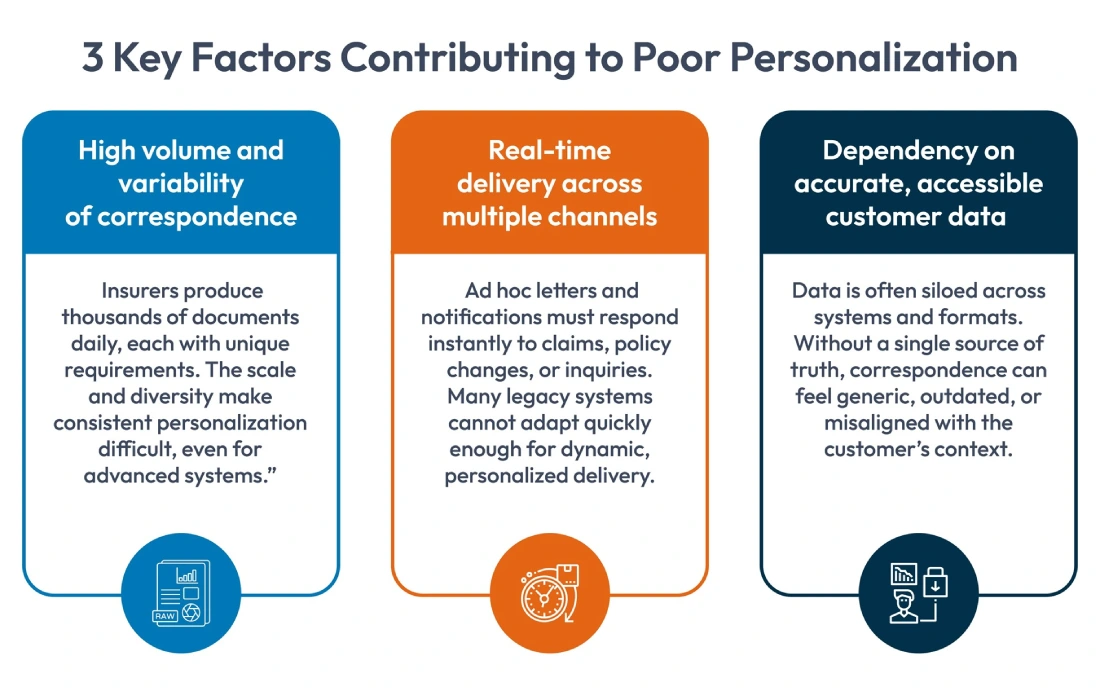
These root causes illuminate why personalized correspondence remains one of the most persistent hurdles for insurers. Overcoming them requires an approach that combines system integration, data governance, and workflow modernization. Tackling these issues effectively is central to modernizing insurance communications and creating correspondence that resonates with each policyholder.

Make Personalized Document Generation Effortless
Transform your insurance communications with real-time, personalized letters.
Learn how to simplify workflows, enhance customer experiences, and boost efficiency.
Navigating Organizational Silos in Insurance Document Management
Siloed departments remain one of the most persistent obstacles to personalized correspondence. When teams operate independently, inconsistencies emerge in tone, style, and personalization levels, undermining customer experience and limiting the impact of insurance letter personalization.
Key organizational challenges include:
-
Different departments use different tools
Underwriting, Claims, Distribution, and other units often maintain separate systems for correspondence. Some rely on legacy software, others on in-house platforms, making it difficult to implement a uniform approach or enforce standards across the enterprise.
-
Challenges in governance, brand consistency, and compliance
Siloed operations make it difficult to maintain uniform governance and ensure all correspondence adheres to regulatory requirements. Inconsistencies can erode customer trust and increase compliance risk.
-
Migration challenges to a unified platform
Moving from multiple departmental tools to a single, enterprise-wide system is complex. Every customer-facing document must be carefully tested and migrated, which requires detailed planning and extensive validation.
Successful consolidation of all these systems and workflows requires senior leadership support. Executive sponsorship ensures departments are aligned, resources are allocated, and teams adopt new processes, creating the foundation for scalable insurance document automation and more effective personalized correspondence.
Moving Beyond Legacy Modules for Modern Insurance Communication
Legacy correspondence modules in core insurance systems present significant barriers to effective personalization. Many insurers continue to rely on these tools, yet they were designed primarily for IT operations, not for the nuanced demands of personalized insurance correspondence challenges.
| Features | Legacy Core Modules | Modern CCM Solutions |
| User Focus | IT-centric; business users require support | Designed for business users with minimal IT intervention |
| Personalization | Limited variable data, static templates | Real-time dynamic content, tailored to individual customers |
| Channel Support | Primarily batch printing/email | Omnichannel: print, email, SMS, portals, mobile apps |
| Scalability | Difficult to scale across departments | Enterprise-wide deployment with centralized control |
| Automation | Minimal automation, high manual effort | Full insurance document automation, triggers, and workflow management |
| Compliance & Governance | Hard to enforce standards | Centralized compliance, brand consistency, audit-ready reporting |
The table highlights the contrast clearly and visually reinforces why insurers must move toward modern platforms to overcome personalized insurance correspondence challenges and achieve modernized insurance communications.
Transitioning to modern CCM solutions enables insurers to:
- Reduce manual intervention and IT dependency
- Deliver real-time, personalized correspondence across multiple channels
- Streamline workflows through insurance document automation while maintaining compliance
- Ensure brand consistency and messaging uniformity across all departments
- Leverage centralized data for more accurate and context-rich personalization
- Scale easily to accommodate growing volumes and new communication channels
- Improve regulatory compliance with audit-ready reporting and governance
- Enhance customer satisfaction through timely, relevant, and engaging communications
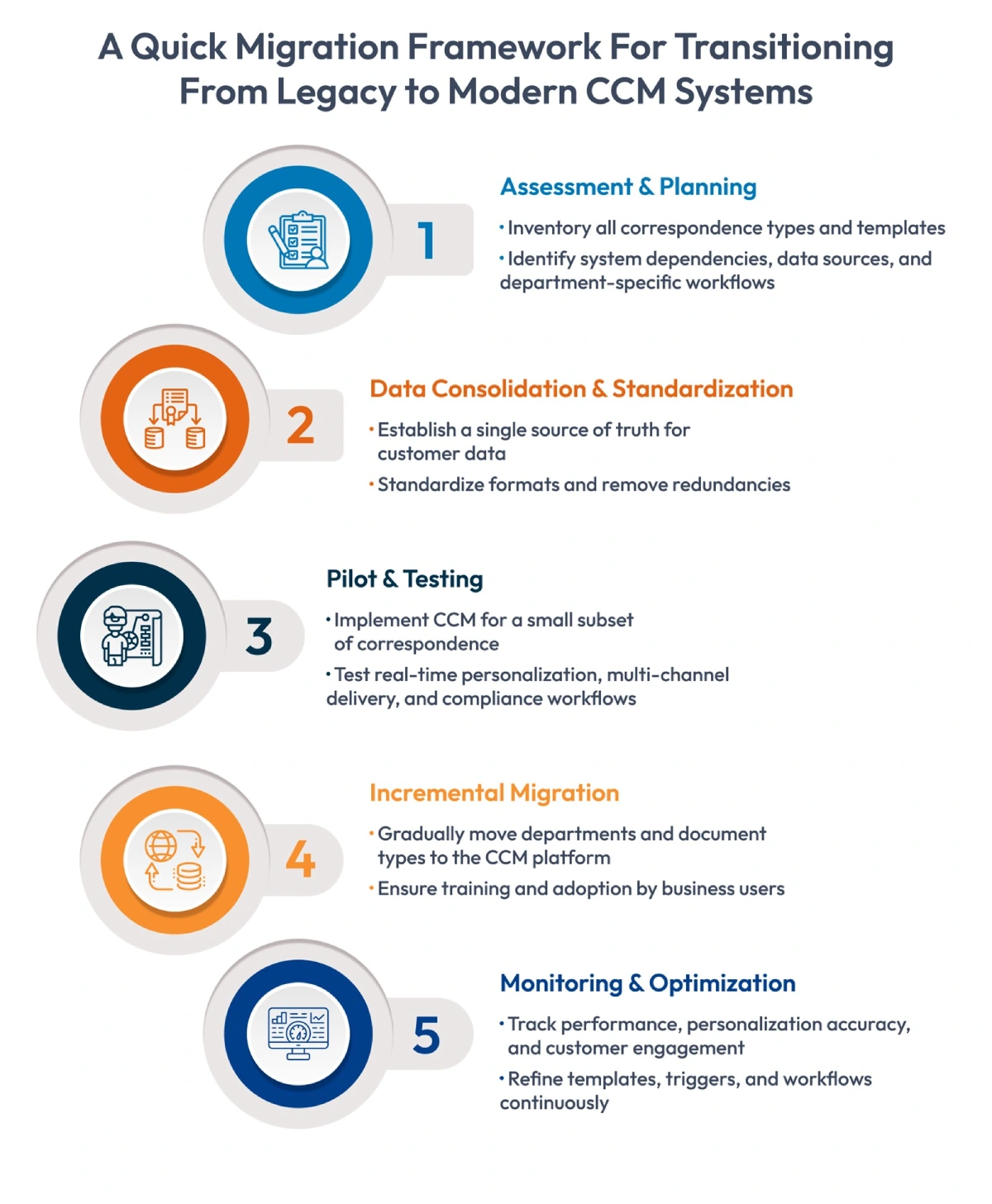
To complement this, insurers can adopt a structured migration framework to move from legacy modules to a modern CCM platform:
Solving Integration Gaps Between Core Systems and CCM Platforms
Integration is the backbone of effective personalized correspondence. Without seamless access to multiple data sources, even the most sophisticated CCM platform cannot deliver truly personalized communications. Legacy systems often operate in isolation, creating significant barriers to insurance letter personalization and limiting the benefits of insurance document automation.
Key Challenges Include:
Legacy systems often integrate only within the core stack
Most policy, billing, and claims systems were designed to operate internally. While they can generate standard documents, they are rarely equipped to share data beyond their own ecosystem, creating silos that hinder personalization.
Difficulty accessing multiple data sources in real time
Personalized correspondence relies on accurate, up-to-the-minute information from multiple systems. Legacy modules often cannot pull data simultaneously from policy, billing, and claims platforms, which results in generic or outdated messages.
Best-Practice Approach for Integration
To overcome these gaps, insurers should adopt a single CCM platform capable of supporting both batch and on-demand correspondence while integrating with all core systems:
-
Single CCM platform supporting batch + on-demand correspondence
Enables insurers to handle high-volume statements as well as dynamic, real-time letters triggered by claims, inquiries, or policy changes.
-
Integration with policy, billing, claims, and customer data systems
Consolidates data streams to create a single source of truth, improving accuracy, relevance, and personalization.
-
Real-time data access to drive personalized messaging
Supports dynamic content generation for insurance letter personalization, ensuring communications reflect current policyholder information and context.
-
Enhanced automation and governance
With centralized workflows, insurers can achieve insurance document automation, enforce compliance, maintain brand consistency, and monitor performance metrics across all correspondence.
-
Foundation for modernizing insurance communications
Full integration allows insurers to deliver a seamless, multi-channel customer experience, reduce manual interventions, and scale personalization efforts efficiently.
The Role of Insurance-Focused CCM Providers
Choosing a CCM provider with deep insurance expertise is critical for overcoming personalized correspondence challenges. Insurer-focused providers bring:
- Proven integrations with common insurance core systems – Ensuring seamless access to policy, billing, and claims data for accurate and timely communications.
- Regulatory and compliance awareness – Reducing risk while maintaining consistent messaging across all correspondence.
- Support for operational efficiency and customer experience – Enabling insurance document automation while delivering insurance letter personalization that resonates with policyholders.
Working with a specialized provider accelerates modernizing insurance communications and ensures that both compliance and personalization goals are met effectively.
The Way Forward: The Future of Personalized Insurance Correspondence
The next frontier in insurance communications is truly intelligent, predictive personalization. Insurers that move beyond legacy systems and fragmented workflows will be able to anticipate customer needs, craft messages in real time, and deliver interactions that feel not just personal, but proactive.
By embracing modern CCM platforms like Cincom Eloquence, insurers can harness centralized data, automate correspondence at scale, and personalize content across channels with unprecedented precision. This is more than efficiency; it is the foundation for a customer experience that evolves alongside expectations, turning each interaction into an opportunity to build trust and loyalty.
The future of insurance is one where personalized correspondence is not a challenge to overcome, but a strategic advantage. Insurers that integrate technology, data, and insight will redefine how policyholders experience communication by making every letter, notification, and policy update meaningful, timely, and engaging.
See Cincom Eloquence in Action
Schedule your personalized demo today and transform your insurance correspondence.
FAQs
1. How does a CCM platform enhance insurance letter personalization?
A CCM platform centralizes data, automates workflows, and enables dynamic, real-time content generation, making personalized correspondence faster, more accurate, and consistent across channels.
2. How can insurers measure the effectiveness of personalized correspondence?
Metrics like open rates, response times, claims resolution satisfaction, and customer retention can help gauge whether letters and communications are truly resonating.
3. Are there risks associated with automating insurance correspondence?
Key risks include data inaccuracies, compliance lapses, and tone inconsistency. Mitigation involves strong governance, centralized templates, and real-time data validation.
4. How can insurers ensure personalization across multiple channels?
Using a unified CCM platform with omnichannel delivery capabilities ensures that email, print, portal notifications, and SMS are consistent, accurate, and timely.
5. Can personalized correspondence improve customer loyalty?
Absolutely. Tailored, timely, and relevant communications strengthen trust and engagement, turning routine policy updates into meaningful interactions.