Over the years, working with businesses across finance and insurance, we’ve seen teams go all-in on digital transformation in business. New tools roll out, systems get a facelift, and leadership expects smoother operations. However, a few months in, teams are still chasing emails, customer messages are scattered, and important documents keep slipping through the cracks.
Digital transformation in business is supposed to close that gap. More often than not, it doesn’t.
Before we get into why these efforts fall apart, let’s take a quick look at what digital transformation really means and why so many companies are betting big on it.
What Is Digital Transformation in Business?
Digital transformation in business means using modern technology to change how a company works, serves customers, and runs day to day. Digital transformation is not a one-off, time-bound initiative. It’s a long-term shift that continues to run; it revolutionizes how teams work, make decisions, and deliver results. This usually involves updating tools, systems, and processes to remove bottlenecks and make work easier. It also means rethinking how people across departments collaborate and communicate.
At its core, digital transformation helps businesses stay relevant, competitive, and ready to grow.
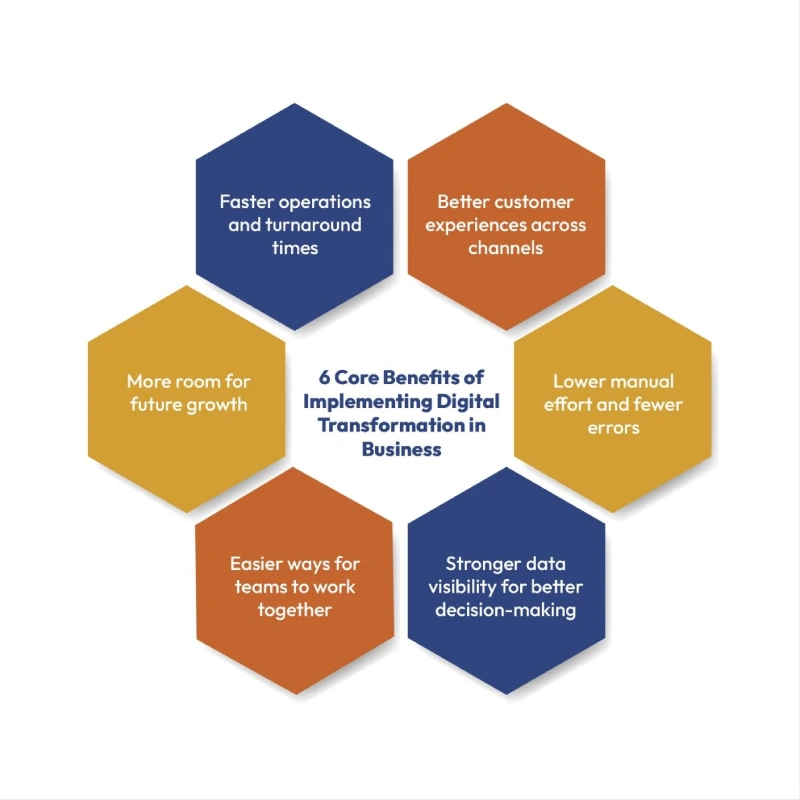
Benefits of Digital Transformation in Business
Below, we have listed key benefits companies aim for when they commit to digital transformation in business:
The Importance of Digital Transformation in Business
Here’s why companies can’t afford to treat digital transformation as a side project:
- It impacts full processes, not just isolated tasks.
Fixing one step in a process isn’t enough. End-to-end changes create real value. - It helps businesses move with speed.
When teams can access the right tools and data, they get more done with less back-and-forth. - It supports long-term change, not just short-term gains.
Companies need to build for scale, not patch short-term problems. - It brings tech and people together.
Real transformation happens when teams across the business are connected and supported. - It keeps the company in the game.
Markets shift quickly. Falling behind on digital capabilities can cost more than just revenue—it can cost relevance.

Omnichannel Communication at Scale: A Guide for CX Leaders
Learn how to build a smarter, more resilient omnichannel communication system.
7 Real Reasons Why Digital Transformation Fails in Business
It’s rarely just about the tech. These are the real, on-the-ground reasons digital transformation efforts fall apart, rooted in what happens inside organizations.
#1. No Clear Direction from the Start
A lot of teams rush into digital transformation without stopping to ask: what are we actually trying to achieve? There’s no defined outcome, no link to the broader business strategy, just a push to go digital. “Digital transformation” itself is a bit misleading. It’s not just about tech—it’s about change across the board, especially from people. That’s often where things break down. For any transformation to succeed, you need a clear “why.” It must be grounded in customer experience goals, and it has to make sense to everyone, not just leadership.
#2. Inadequate Resources (and Too Much of the Wrong Kind)
In the rush to “go digital,” companies often bring in tech they don’t even need. There’s pressure, there’s noise, and suddenly the focus shifts to stacking tools instead of solving real problems. But this overload ends up adding confusion, not capability. A major reason digital transformation fails is poor IT readiness. No groundwork, no systems check—just new tech plugged into old problems. And the core issue? Communication. If you’re not set up to speak to your customers clearly and consistently, the whole thing cracks. Without Digital CCM, communication stays scattered, and transformation fails.
#3. All-In on Tech, Zero Focus on People and Process
One of the fastest ways to derail digital transformation? Betting everything on the tech. You can have the best tools in the world, but if you ignore the people and the processes behind them, it won’t move an inch. Too often, teams roll out new systems without stopping to ask how they fit into real workflows. There’s no clarity on roles, no alignment on process, and zero buy-in from the people who are supposed to use them. And it shows, especially when the customer experience takes a hit. If the transformation doesn’t connect back to how customers interact with the business, it’s just tech for tech’s sake.
#4. No Grip on Data
Digital transformation in business often moves ahead without a clear definition of success. There are no structured KPIs, no baseline metrics—just assumptions. As a result, progress becomes hard to measure, and accountability fades. The data itself is another problem. It’s scattered across systems, inconsistent, and rarely integrated properly. Without a single source of truth, different teams work with different numbers, leading to misalignment and second-guessing. Once confidence in the data drops, decision-making slows down, and so does the transformation.
#5. Failure to Adapt and Scale
Digital transformation isn’t supposed to be a one-time, full-scale launch. But that’s how many teams approach it—big bang, no flexibility, no room to adapt. The issue is usually the same: there’s no tailored plan. It’s not designed for your business, your audience, or your industry. What works in FMCG doesn’t work in finance or insurance. The customer mindset is different, the compliance pressures are higher, and the risks are real.
You also can’t scale if your tools can’t keep up. If your digital document delivery systems aren’t flexible, or your paperless customer communications can’t adapt to changing customer behavior or regulations, things start to break.
#6. Hiding Behind “Fail Fast”
“Fail fast” gets thrown around as a badge of innovation, but in digital transformation, it often leads to shallow execution. Teams launch MVPs without clear success criteria, skip proper testing, and call it a learning moment when it flops. The real issue? There’s no iteration cycle, no data-driven evaluation, just failure by design. This mindset kills long-term thinking. Critical projects are abandoned too early, often before they’ve even been properly integrated with core systems or real user workflows. If there’s no technical follow-through, all you’re doing is failing fast and learning nothing.
#7. Poor Change Management
Digital transformation in business doesn’t fail because people hate technology; it fails because they’re not prepared for the change that comes with it. Teams resist it. Collaboration doesn’t exist. Everyone sticks to their own way of working, and the shift never fully lands. Also, if there’s no real push from the leaders, the transformation becomes just another initiative, not a company-wide priority. Without a clear plan, consistent communication, and a way to bring people along—step by step—it stalls. You can’t skip straight to “run” without crawling first.
Step-by-Step: What It Really Takes to Pull Off Digital Transformation in Business
Most digital transformation efforts fail because the basics get skipped. This isn’t about theory. It’s about doing the right things, in the right order, with your business in mind.
Here’s how teams that “actually get it right” approach it:
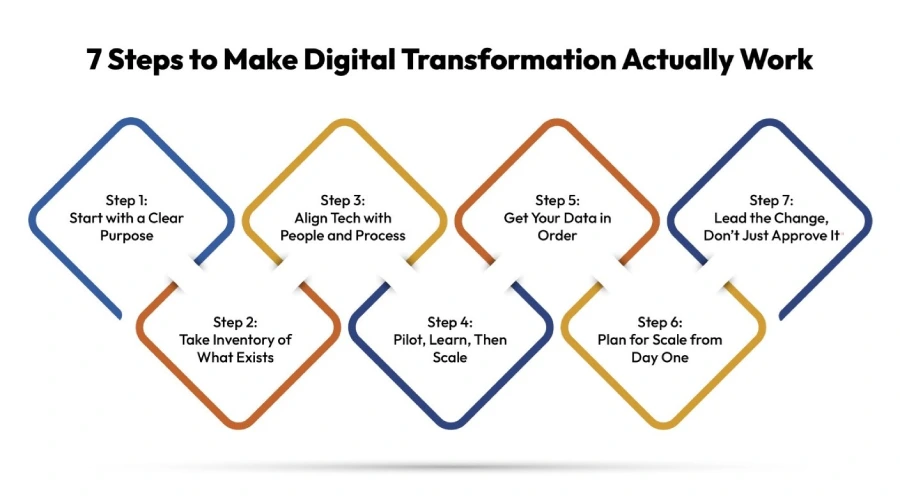
Step 1: Start with a Clear Purpose
If you can’t explain why you’re doing this in one sentence, don’t do it yet. Your transformation goals should be tied directly to business outcomes, whether it’s improving customer experience, cutting manual effort, or increasing speed. This clarity sets the direction for everything else, including how you rethink customer communications and internal workflows.
Step 2: Take Inventory of What Exists
Before layering in tools, assess your current systems. Where are the gaps? What’s outdated? What still works? This helps avoid tech bloat and reveals where your real gaps are. A smart Digital CCM platform can often replace multiple disconnected tools by centralizing and streamlining your communications in one place, further ensuring the success of your digital transformation.
Step 3: Align Tech with People and Process
Even the best tools fail if your teams can’t—or won’t—use them. The key is choosing solutions that fit in with how your teams work. Things like digital document delivery and paperless customer communications should simplify, not complicate. Your platform for digital transformation should adapt to your workflows, not the other way around.
Step 4: Pilot, Learn, Then Scale
Trying to do everything at once usually backfires. The smart move? Start small, test, learn, and iterate. This is where a flexible foundation matters. A solid digital CCM setup lets you test different communication journeys or document flows before rolling them out organization-wide.
Step 5: Get Your Data in Order
Disconnected, messy data is one of the top reasons transformation fails. If your systems can’t talk to each other, decision-making slows down and customer experiences suffer. Clean, connected data powers everything—from analytics to automation to personalization. And yes, your communication layer needs to work off that same data to stay aligned and compliant.
Step 6: Plan for Scale from Day One
Transformation isn’t a one-off project. What works at 10 users should also work at 10,000.
That means choosing tools that can grow with you. Your Digital CCM platform should grow with your needs, whether that’s handling bulk communications, managing multi-language delivery, or expanding your paperless customer communications strategy while adapting to evolving market needs.
Step 7: Lead the Change, Don’t Just Approve It
Transformation isn’t just IT’s job. Change doesn’t happen without leadership backing it. This isn’t about micromanaging—it’s about pushing the vision, clearing the roadblocks, and making sure people stay aligned. Without a strong change culture, even the best digital strategy stalls. Leaders don’t need to run every meeting, but they do need to set the tone.
What Connects It All? Your Systems, People, and Cincom Eloquence
A successful digital transformation doesn’t happen in silos. It works across teams, tools, and workflows to connect the dots and help your organization move together with purpose. But for that to happen, the fundamentals need to be in place: clear goals, the right systems, and communication that doesn’t slow things down.
That’s where a solution like Cincom Eloquence fits in. It’s not about making bold transformation claims. It’s about supporting the parts of your business that truly drive change, like getting accurate information to the right people, reducing manual work, and keeping customer communication consistent and compliant.
No tool can do it all on its own. But when the right one is in place, everything around it works better.
FAQs
1- Why do digital transformation initiatives fail?
Because they often lack a clear goal, rely too much on tech without aligning people and processes, and skip foundational checks like IT readiness. Many also underestimate change management and ignore the need for scalable, adaptable systems.
2- What is the role of communication in digital business strategies?
It’s core. If your communication—both internal and external—is inconsistent, manual, or fragmented, it slows everything down. Clear, automated communication keeps teams aligned and customers engaged.
3- How do modern CCM tools support digital transformation?
Modern CCM tools, like Cincom Eloquence, help centralize and automate customer communication. They reduce manual work, ensure compliance, and keep messaging consistent across all channels, making them essential to a smooth digital transition.
4- What are examples of communication-related failures in digital transformation?
Things like inconsistent messaging across channels, delays in document delivery, or teams working from outdated templates. These issues create confusion, damage trust, and increase operational risk.
5- How can businesses modernize their communication systems effectively?
Start by assessing your current tools and workflows. Identify gaps, eliminate manual steps, and adopt a CCM solution that integrates with your core systems. Prioritize scalability, automation, and compliance from day one.