Customer Experience Transformation: Make-or-Break Move in Financial Services and Insurance
It’s easy to make your prospects happy with a slick app, some good-looking UI, and a frictionless onboarding experience. However, the real test of your customer experience (CX) approach begins when a policyholder needs to change coverage, when a claim needs to be expedited, or when a valuable customer desires to customize their financial portfolio as per their income.
In these moments, how clearly, quickly, and consistently you show up to solve real problems of customers matters, and that’s what customer experience ultimately boils down to—not appearance, but results.
What Is Customer Experience Transformation?
Customer experience transformation implies redesigning the experience in a manner in which your firm listens, responds, and interacts with customers across all touchpoints, all departments, and all channels.
In practical terms, that means:
- Breaking down compliance-heavy documents into plain, human words.
- Granting the right tools to the frontline workers, which they actually use, not tick-box systems.
- Infusing feedback into workflows, not gathering it for ego metrics.
- Providing consistent, on-message communication across all channels, without silos.
How Digital Transformation Is Driving Customer Experience
Digital transformation should make the customer journey easier, not harder. This snapshot illustrates the manner in which leading firms utilize tech investments to drive digital transformation to improve customer experience.
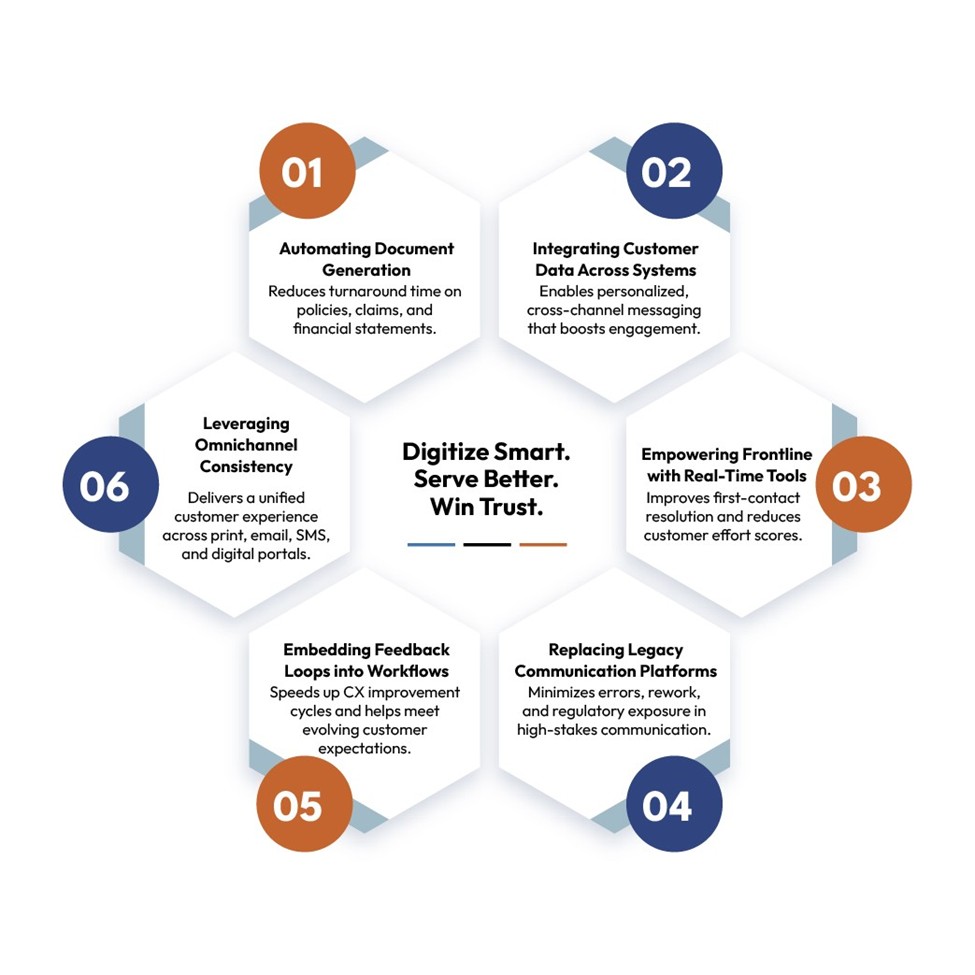
We’ve seen how leading firms align tech to transform customer experience. Now the concern is why so many digital transformation efforts are still falling short. To answer that, let’s explore the common hidden pitfalls.
Related: Customer Engagement vs. Customer Experience

Are Your Customer Communications Creating the Insurance Experience Your Customers Deserve?
Learn how your customer communication aligns with best practices and regulations—and discover areas to improve satisfaction, speed, and engagement.
The Hidden Pitfalls Undermining Customer Experience Transformation
The approach to transforming customer experience always begins with a good intention, but when the focus on transformational customer experiences fades mid-journey, the impact weakens. Let’s break down the missteps we see most often.
Seeing CX as a Launch, Not a Lifelong Strategy
CX isn’t a switch you flip or a quarterly project you wrap up.
Still, many enterprises approach it as just that. They launch a new portal, roll out an app, send out a fresh NPS survey, and call it a transformation. The result? An initial spike in customer engagement, followed by stagnation, confusion, and disillusionment. It means a “set-it-and-forget-it” mindset just doesn’t cut it.
To compete, you need a CX engine that can adapt, scale, and continuously improve a true customer experience transformation strategy.
Overlooking the Frontline’s Role in Customer Communications
Your CX strategy lives and dies with the people who deliver it.
That means the advisor responding to a policyholder, the claims rep on a tough call, or the wealth manager explaining a market dip—they are your CX. And yet, many organizations don’t equip them with the right communication tools to act with clarity.
If your transformational customer experiences plan doesn’t include and empower your frontline, then it’s not a plan but just a press release.
Not Leveraging Customer Communication Data for CX Insights
The irony? Most firms are sitting on a mountain of untapped insights: their own outbound communications.
Every email, letter, portal message, or push notification is a goldmine of insight. But most organizations aren’t mining it. They’re still relying on passive surveys or lagging metrics to understand experience gaps.
For effective digital transformation in customer experience, organizations must move beyond vanity metrics and activate the value hidden in their communication streams.
Treating CX as a Marketing or IT Initiative, Not a Business Strategy
CX isn’t something that sits in marketing decks or tech roadmaps. It’s a company-wide discipline that demands alignment from operations, legal, compliance, and service, not just the brand team.
When CX lives in silos, it becomes reactive. To make it proactive, embed CX across all the departments as part of your customer experience transformation strategy to ensure it’s not just another isolated initiative but a sustained business initiative.
Remember, for your customers, it’s one brand, one conversation across every touchpoint.
Treating Compliance and Personalization as Opposites
In highly regulated sectors like insurance and finance, there’s a myth that you can either stay compliant or create personalized experiences, but not both. That’s outdated thinking.
Today’s advanced Customer Communication Management (CCM) platforms prove otherwise. These tools are built for both flexibility and control so that you can tailor messages and meet regulatory requirements, which are essential for a successful customer experience in digital transformation.
The real risk isn’t over-personalizing; rather, it’s under-serving your customers with generic, impersonal, and overly legalistic content that confuses more than it clarifies.
Assuming Digital = Better CX
Just because it’s digital doesn’t mean it’s better.
Digitization can amplify customer experience—or just amplify confusion. A badly timed email, a tone-insensitive push alert, or a clumsy process can devalue trust in a matter of moments more effectively than an in-person letter ever could.
Don’t digitize your CX just for the sake of doing it. Instead, design it in a way that works across every channel, for every customer, and at every moment, and that’s the true essence of driving a meaningful digital transformation in customer experience.
The Fix: Turning Missteps into a Meaningful Customer Experience Transformation
You’ve seen the cracks in CX initiatives. Now it’s time to fix them by transforming customer experience with a system that’s continuous, measurable, and built for scale. These are actionable customer experience transformation ideas that your organization can start implementing tomorrow.
Build a Continuous CX Operating Model
CX is an operating system, not just another campaign. However, enterprises often start strong but stall because CX is treated as a project, not a process, which is a common issue when trying to transform customer experience.
What to Do:
- Set up a CX Command Center: Assemble a cross-functional team comprising CX, compliance, IT, legal, and frontline leadership to manage customer journeys from end to end.
- Implement an Agile CX Framework: Conduct bi-monthly sprints to review insights, pilot messaging refinements, and roll out updates quickly, particularly for regulated content.
- Integrate CX Reviews into Governance: Hold the same levels of rigor for CX metrics as for financial metrics. Regular stakeholder reviews, issue escalation procedures, and document audits should become standard.
- Track Experience Debt: Maintain a log of broken, delayed, or confusing communications that hurt trust, and assign owners to resolve them. It is a foundational step in customer experience in digital transformation.
Provide the Right Communication Tools to Frontline Teams
Your customer-facing frontline staff—agents, support reps, and advisors—are the public face of your business. However, they often have to work with outdated processes that hinder their productivity and annoy customers. That’s why investing in tools that support customer experience transformation is critical.
What to Do:
- Deploy a CCM Platform That’s Frontline-Friendly: Give teams access to dynamic templates that allow compliant personalization at speed.
- Reduce Dependency on IT and Legal: Build workflows where business users can generate regulated communications through rule-based logic without waiting on code or reviews.
- Train for Exceptional Cases: Equip reps with modular content for exception cases, such as, e.g., a policy dispute or a claim denial, so the customer still feels heard.
- Measure First Contact Resolution (FCR): Track whether your tools help resolve issues in one interaction. If not, revise templates and flows accordingly to support digital transformation to improve customer experience.
Turn Every Communication into a Feedback Loop
Customer insights shouldn’t come only from surveys. Your real-time communications hold a wealth of behavioral data to successfully transform customer experience.
What to Do:
- Instrument Your CCM Output: Track delivery, engagement, and response across every format—print, email, SMS, portal—and flag anomalies (e.g., drop-offs, repeat contacts).
- Close the Loop Internally: Build internal triggers so that if a customer clicks “not helpful,” a task is auto-assigned to review the content or workflow.
- Tie Feedback to Specific Templates: Don’t just analyze feedback at the macro level. Go deeper and identify which exact documents are causing friction to fix it.
- Move Beyond Surveys: Embed micro-feedback opportunities in communications. For instance, “Was this clear?” This micro feedback doesn’t burden the customer but guides internal improvements.
Tie CX Metrics to Business KPIs
CX teams often struggle to gain buy-in because their metrics (NPS or CSAT) aren’t directly tied to revenue, retention, or compliance. Linking CX to key business KPIs is a smart way to turn customer experience transformation into a measurable business impact.
What to Do:
- Map the CX-to-Business Impact Chain: For example, better onboarding communication → fewer support calls → lower cost-to-serve.
- Integrate CX Metrics into Risk and Financial Dashboards: Don’t isolate CX data. Visualize it alongside KPIs like renewal rates, claims leakage, or regulatory fines.
- Establish KPI Ownership: Assign owners to each CX metric and link their performance incentives accordingly.
- Forecast Experience ROI: If automating one document set reduces average call time by 30 seconds, calculate what that means in saved agent hours and improved NPS. Also, showcase how it ties into digital transformation to improve customer experience.
Use Rule-Driven Personalization Inside Your CCM Platform
Customers want relevance. Regulators want consistency. Rule-driven personalization is the only way to deliver on a scale and is a cornerstone of transforming customer experience.
What to Do:
- Define Personalization Segments: Think beyond name and product; include tenure, behavior, life stage, geography, and policy details.
- Set Personalization Rules Centrally: Use if/then logic to control messaging variations while locking regulated clauses to prevent rogue edits.
- Test and Optimize in Real Time: A/B test personalization blocks (e.g., claim guidance or upselling language) to see what resonates without compromising compliance.
- Build a Personalization Library: Maintain the data of approved tone, messages, and visuals tailored to different customer journeys and segments.
Optimize Omnichannel Messaging, Not Just Delivery
It’s not enough to “be present” on multiple channels. What matters is that the customer experiences one coherent journey, even if it spans print, email, SMS, and portals.
What to Do:
- Create Journey-Based Communication Blueprints: Clearly define what message should go out when, on what channel, and with what handoffs, especially during high-stress moments like claims or disputes.
- Unify Voice and Tone Across Channels: Customers should feel they’re talking to the same brand, whether it’s a mobile alert or a formal letter.
- Detect and Resolve Channel Conflicts: If a customer gets an email, don’t also send a print copy unless explicitly required. Minimize redundancy and confusion as much as possible.
- Adapt by Channel Behavior: For instance, send simplified language and shorter CTAs on mobile, but use longer-form education via email or the web.
Customer Experience Transformation: Patterns from High-Performing CX Teams
There’s no perfect CX formula. However, there are clear patterns that set exceptional teams apart. Here, have a look.
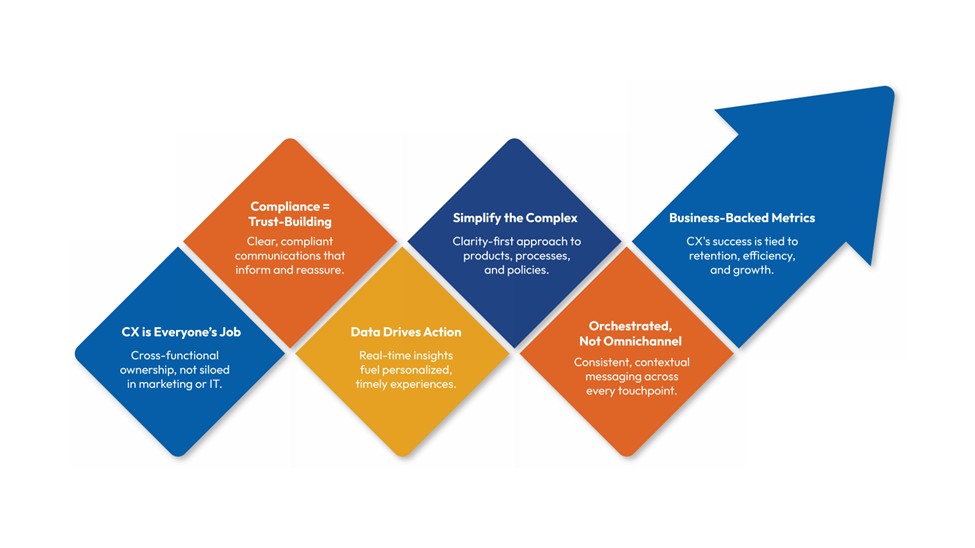
Customer Experience Transformation is a Commitment
The most successful insurance and financial services organizations aren’t chasing the next CX trend; they’re building communication ecosystems that scale, adapt, and endure. They’ve stopped asking, “What touchpoint can we optimize?” and started asking, “What mindset does our entire business need to adopt?”
Transforming CX isn’t about tools; rather, it’s about the integrity of your communication, the speed of your response, and the consistency of your performance across departments, channels, and customer requirements. That’s where Cincom Eloquence, a purpose-driven Customer Communication Management (CCM) solution, steps in to connect those requirements easily while bringing operational transparency to the table and building the foundation of trust that supports your business.
FAQs
1- What are the common pitfalls in customer experience transformation?
Treating CX as a one-time project, ignoring frontline roles, underusing communication data, and failing to align CX with business goals are some of the common pitfalls in transforming customer experience.
2- Why do many enterprise CX initiatives fail?
Many enterprise CX initiatives fail because they begin with excitement—new apps, new campaigns—but lack a long-term structure. Without tying CX to real business goals or giving teams the tools to act on insights, it all fizzles out. Great CX isn’t a phase; it’s a mindset baked into how you run your business.
3- How can companies align CX with business goals?
Start by tracking CX metrics that matter, things like policyholder retention, claims turnaround time, or NPS post-renewal. Then, connect those to core KPIs. When CX performance impacts business dashboards, it stops being “nice to have” and becomes essential.
4- What role does data play in improving CX?
It’s huge. Every email, statement, or notice tells you something about preferences, friction points, or even sentiment. The trick is using that data proactively. With the right CCM platform, you can turn everyday messages into smarter, more personalized experiences.
5- What are examples of successful CX transformations?
Top firms simplify policyholder communication, empower frontline teams with real-time data, and integrate omnichannel feedback into operations.