Introduction: Why Compliance Management Matters
Insurance companies face a constant flow of rules and regulations. Every customer document, from policy forms to claim notices, must meet strict requirements. Fonts, wording, timing, and even layout can affect regulatory compliance. Each state has its own rules, and companies operating in multiple states must track thousands of changes every year.
Mistakes are costly. Sending a document that does not meet regulatory compliance can lead to fines, wasted effort, and frustrated customers. Customer communication management compliance helps prevent these issues. Modern CCM systems give compliance teams the tools to maintain control, reduce errors, and ensure every document meets the standards regulators demand.
This article explains how CCM protects your organization, simplifies compliance work, and strengthens the role of regulatory compliance management in every document created and delivered.
Role-Based Authorizations – Controlling Who Can Do What
Ensuring compliance begins with controlling access to critical documents. Every customer document, whether it’s a policy form or a claims notice, passes through multiple departments. Without proper oversight, unauthorized changes can introduce errors, increase risk, and compromise regulatory compliance.
Modern CCM systems address this challenge through role-based authorizations. By assigning specific roles to individuals, these systems make sure only the right people can create or edit sensitive content. For example:
- A state-specific coverage clause can only be updated by a designated compliance officer.
- Marketing or policy teams can assemble documents but cannot alter regulated language.
- Managers can approve final versions before release, ensuring consistency across all outputs.
Benefits of role-based authorizations:
- Minimized Risk: Only authorized individuals can change regulated content, reducing errors and ensuring regulatory compliance.
- Improved Efficiency: Teams can collaborate without slowing down workflows or creating bottlenecks.
- Enhanced Transparency: Paired with a CCM audit trail, every action is visible, making audits straightforward.
- Stronger Compliance Management: Combines controlled access, automation, and traceability to strengthen customer communication management compliance.
By combining controlled access with automation and traceability, organizations can strengthen customer communication management compliance while minimizing risks and maintaining full alignment with regulatory compliance requirements.

Compliant Customer Communication in 2026
A practical playbook for insurers who want tighter control, lower regulatory risk, and audit-ready communications.
Mitigating Risk through Automated Document Version Control
Managing multiple versions of customer documents is one of the biggest challenges for compliance teams. Every update, whether driven by a new product, regulatory change, or state-specific requirement, increases the risk of errors. Manual version tracking can lead to confusion, outdated documents, and compliance gaps that result in fines or operational delays.
CCM systems use document compliance automation to simplify this process. Automated version control ensures that every document change is tracked, the correct version is always used, and approval workflows are followed consistently.
Key benefits include:
- Eliminates manual errors: Reduces the risk of sending outdated or incorrect documents.
- Maintains audit readiness: A complete CCM audit trail captures who made changes, what was modified, and when.
- Supports regulatory compliance: Ensures all documents meet state and federal requirements.
- Improves efficiency: Teams spend less time tracking versions and more time focusing on accuracy.
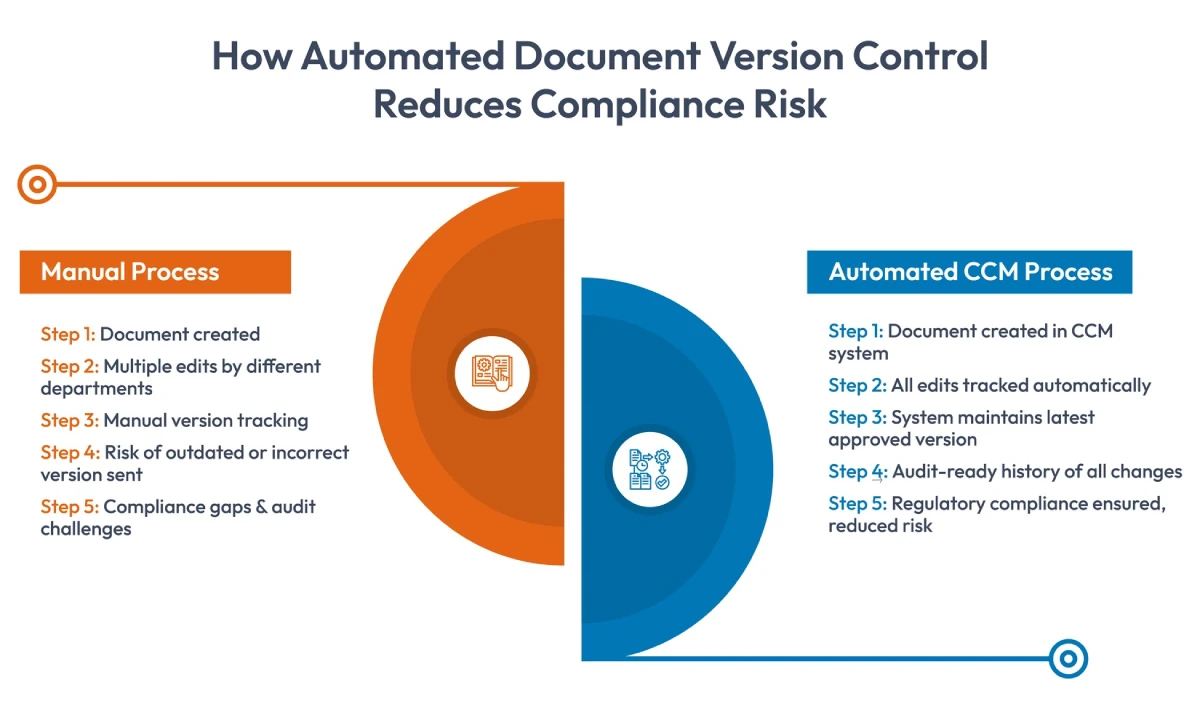
By combining document compliance automation with a comprehensive CCM audit trail, organizations gain full confidence that every customer communication meets regulatory compliance standards and reduce risk, increase efficiency, and strengthen overall compliance management.
Ensuring Regulatory Compliance with Comprehensive Audit Trails
Audit trails are a core requirement for effective compliance management. They create a permanent and verifiable record of every action taken on a document, from creation through approval and delivery. For organizations that handle regulated and sensitive information, detailed audit trails are essential for demonstrating accountability and meeting regulatory obligations.
Modern CCM systems record critical details such as:
- Who accessed or modified a document
- What changes were made to content or structure
- When each change occurred
- Approval status and release history
These records support compliance with a wide range of regulatory and accessibility standards, including:
- HIPAA (Health Insurance Portability and Accountability Act)
Ensures controlled access and traceability for documents containing protected health information. - ADA (Americans with Disabilities Act)
Supports documentation and verification of accessibility-related changes in customer communications. - EAA (European Accessibility Act)
Requires proof that customer-facing communications meet accessibility requirements across digital and print formats. - GDPR (General Data Protection Regulation)
Mandates traceability for personal data usage, consent handling, and document processing activities.
Comprehensive audit trails allow compliance teams to validate document history with confidence. They support internal reviews, regulatory examinations, and accessibility audits without relying on manual reconstruction of events.
When audit trails are embedded into CCM processes, organizations gain consistent documentation, clear accountability, and the ability to demonstrate compliance across jurisdictions and regulatory frameworks.
Scaling Compliance Accuracy with Centralized Rules-Based Logic
Managing compliance across thousands of documents and multiple jurisdictions requires consistency. Regulatory language changes frequently, and relying on individuals to remember when and where specific content must appear introduces risk. Centralized rules-based logic within a CCM system addresses this challenge by applying compliance rules automatically during document creation and assembly.
Rules-based logic evaluates the context of each document. Factors such as product type, customer location, delivery channel, and document purpose determine which content elements must be included. This ensures that regulated language is applied consistently and correctly every time.
How Rule-Based Logic Controls Document Content
Centralized rules define when specific components are required, restricted, or substituted. These rules operate behind the scenes, removing the need for manual checks while maintaining strict control over regulated content.
| Rule Trigger Condition | Document Component Affected | Rule Action Applied |
| Customer state or region | Coverage disclosures | Insert state-specific language |
| Product type | Policy exclusions | Include or suppress clauses |
| Delivery channel | Accessibility statements | Apply required formats |
| Regulatory update date | Legal text blocks | Replace outdated content |
| Customer profile data | Privacy notices | Select the appropriate version |
Rules are maintained centrally, allowing compliance teams to update logic once and apply it across all relevant documents. When regulations change, updates take effect immediately without requiring document-by-document revisions.
Maintaining Control at Scale
As document volumes grow, centralized rules-based logic ensures accuracy without slowing production. Compliance teams define the rules, and the CCM system enforces them consistently. This approach reduces reliance on manual reviews while preserving full control over regulated content.
By embedding compliance logic directly into document generation, organizations can scale communications confidently while maintaining precise control over regulatory requirements.
Conclusion
Compliance failures rarely happen because teams lack knowledge. They happen because systems allow too many decisions to be made manually, across too many documents, under constant regulatory change. That risk increases as document volumes grow and regulations continue to evolve.
Customer communication management compliance brings order to that complexity. With document compliance automation in place, regulated content is controlled at the system level rather than enforced through repeated reviews. This reduces dependence on individual judgment and creates consistency across every customer communication.
A reliable CCM audit trail provides something compliance teams are often asked for but struggle to deliver quickly: proof. Proof of what was sent, when it was sent, who approved it, and which rules were applied. This level of documentation strengthens regulatory compliance and allows organizations to respond to audits with confidence rather than urgency.
CCM shifts compliance from a reactive task to a controlled, repeatable process. For organizations that operate across states, products, and channels, that shift is no longer optional.
See how Cincom Eloquence helps your compliance teams control documents, track changes, and deliver compliant customer communications with confidence.
FAQs
1. How does CCM support compliance across different regions and regulations?
Customer communication management compliance allows organizations to apply region-specific rules centrally, ensuring documents meet local and global regulatory compliance requirements without manual intervention.
2. Can document compliance automation reduce review cycles for compliance teams?
Yes. Document compliance automation reduces repetitive checks by enforcing rules at the system level, allowing compliance teams to focus on exceptions rather than routine approvals.
3. How does a CCM audit trail help during regulatory audits?
A CCM audit trail provides clear records of document versions, approvals, and changes, helping teams respond quickly and accurately to audit requests.
4. Is CCM suitable for organizations with high document volumes?
CCM is well-suited for high-volume environments because automation and centralized controls maintain consistency without increasing operational strain.
5. How does CCM improve accountability in document creation?
By combining access controls, automation, and an audit trail, organizations can clearly identify who made changes, when they occurred, and why they were approved, strengthening overall regulatory compliance.