Now more than ever, the importance of communications has many businesses re-evaluating their customer interactions to meet increasing expectations for accurate, timely, and relevant content.
Good communication is especially important as we face new distance challenges due to COVID-19 that are forcing everyone to find new ways to interact without physical meetings.
As a result, digital communications, including email, SMS/text messaging, and portals, will become increasingly important, and potentially the new normal for doing business. And, while crisis workarounds are fine in the short term, longer-term solutions will require technologies and expertise that many businesses may not have today. As per studies, 89% of organizations have implemented or plan to adopt a digital-first strategy.
This is where Customer Communications Management (CCM) solutions play a critical role, especially for organizations planning legacy document system replacement initiatives.
What Are the Primary Challenges of Paper to Digital Transformation?
Understanding paper to digital transformation challenges helps businesses build stronger digital strategies and avoid costly missteps.
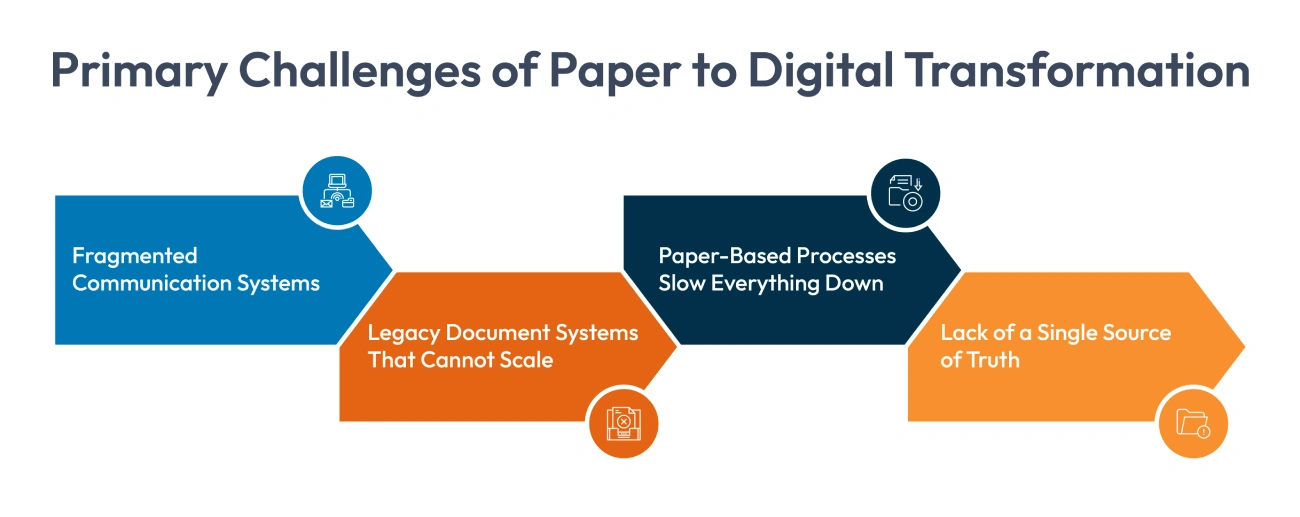
1. Fragmented Communication Systems
Many organizations rely on multiple systems to produce customer letters, statements, notices, and confirmations. Printed documents are often created on one platform, emails in another, and SMS alerts in yet another. This fragmentation causes:
- Inconsistent messaging
- Version control issues
- Delays in approvals
- Increased risk of sending outdated information
- Higher operational costs
When customers receive conflicting messages across channels, trust erodes quickly.
2. Legacy Document Systems That Cannot Scale
Older document-generation tools were built for a single purpose: producing paper. But today’s customers expect:
- Mobile-friendly communications
- Self-service options
- Omnichannel delivery
- Personalized, real-time updates
Legacy systems struggle to support these needs, making legacy document system replacement a strategic priority for many businesses.

3. Paper-Based Processes Slow Everything Down
Even simple communications can become bottlenecks when managed manually. Common issues include:
- Printing delays
- Human errors
- Slow postal delivery
- Limited visibility into what was sent, when, and to whom
When customers are waiting for important updates, delays create frustration and increase support calls.
4. Lack of a Single Source of Truth
Without centralized control, each department creates its own communication templates. This leads to:
- Hundreds of versions of the same document
- Compliance risks
- Higher cost of maintenance
- Confusion among internal teams and customers
A single integrated solution is essential for accuracy and consistency across every delivery channel.
Customer Communications Management Software Helps Businesses in Paper to Digital Transformation
Paper may never go away, but blending in digital can reap tremendous benefits. Customer Communications Management (CCM) solutions can help businesses make the shift to digital and fulfill the growing need to offer and manage multiple touchpoints (paper and electronic). This aligns perfectly with ongoing efforts in accelerating digital document transformation.
With today’s CCM software solutions, you can simply create a single communications template regardless of the number or type of delivery channels. This allows you to efficiently reformat and repurpose communications to accommodate multiple delivery channels (e.g., convert a printed document to PDF for e-mail delivery).
By enabling paper to digital transformation, businesses of all sizes operating in a multitude of verticals can significantly reduce operating costs and at the same time, improve customer satisfaction.
How Does CCM Accelerate Paper to Digital Transformation?
A modern CCM platform does more than generate documents. It creates a unified communications engine that speeds up digital migration and eliminates complexity.
Here’s how CCM centralization drives paper to digital transformation:
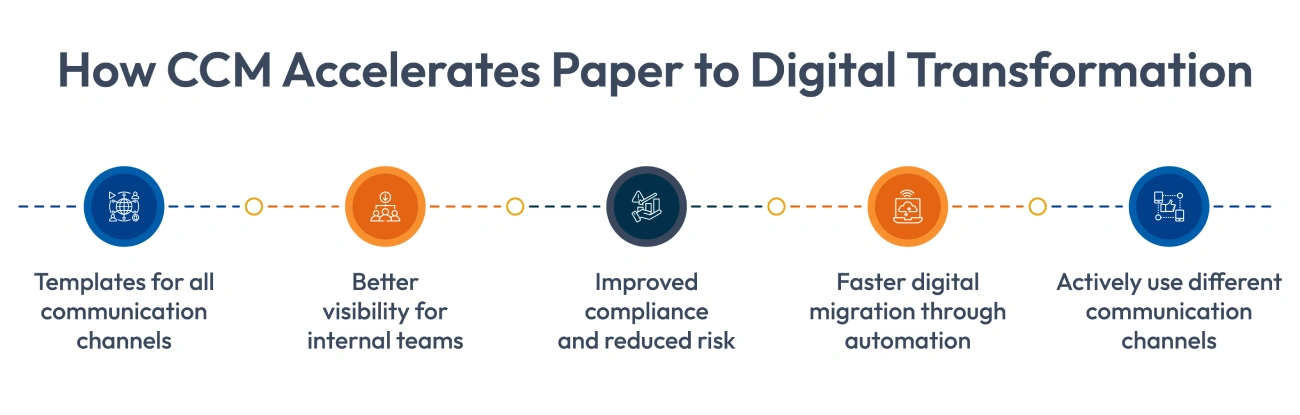
1. One Template, All Channels
The ability to design communications once and use them everywhere is one of the biggest advantages of CCM. A single template can be published across:
- SMS
- Portals
- Mobile apps
- PDF downloads
This reduces effort, ensures consistency, and eliminates manual rework.
2. Better Visibility for Internal Teams
Frontline employees must know what communications customers receive and through which channels. With CCM centralization:
- Teams can view the customer’s communication history in real time
- Duplicate messages across channels are avoided
- Service teams have a better context to solve issues
This streamlines service and builds customer confidence.
3. Improved Compliance and Reduced Risk
Regulated industries—banking, insurance, healthcare, utilities—depend on accurate, approved communications.
CCM centralization helps by:
- Ensuring every version is controlled
- Maintaining audit trails
- Automatically publishing the latest compliant templates
- Reducing human errors associated with scattered legacy systems
This is especially important during legacy document system replacement, when old templates and processes need modernization.
4. Faster Digital Migration Through Automation
Manual processes slow digital transformation. CCM eliminates these bottlenecks through:
- Automated workflows
- Template approval cycles
- Content reuse
- Batch and on-demand output
- Data-driven personalization
This speeds delivery and ensures accuracy.
5. Support for “Right-Channeling”
Businesses don’t have to be passive in how they use various communications channels. With CCM, organizations can:
- Encourage customers to adopt digital delivery
- Promote self-service portals
- Send email reminders instead of printing letters
- Lower communication costs
- Reduce the load on service teams
Cincom Eloquence, a robust CCM solution for your enterprise
Cincom Eloquence brings every communication process into one unified platform. It simplifies how organizations design, manage, and deliver documents across all channels.
For enterprises trying to replace legacy document systems, Eloquence offers a fast and scalable path to digital transformation. Everence, a financial services provider, faced significant challenges with its outdated solutions. Their IT team struggled with managing complex document templates and meeting compliance requirements. With Cincom Eloquence, they were able to achieve:
- 25% reduction in average template development time.
- 15% consolidation in the template library.
Read the complete story to learn how Everence revolutionized document management with Cincom.
How to Successfully Serve Customers Across Multiple Communications Channels
To successfully serve customers across multiple channels, businesses must:
1. Utilize a Single, Integrated Solution Across Delivery Channels
If customers get one answer from a printed letter and a different one from an email, they won’t trust either one, or they definitely won’t perceive their experience as being positive. CCM ensures that every channel delivers the same message, version, and quality.
2. Manage All Delivery Channels in a Common Manner
Frontline employees need to be able to see whether the customer they’re helping has recently received correspondence and in what form. Businesses should avoid sending an email in response to an issue that has already been resolved with a previously printed letter.
This highlights the importance of not treating each channel as a fragmented “silo” of communication—but instead managing all channels in a common manner.
3. Use “Right-Channeling”
Businesses can take steps to direct customers to the delivery channel that is most appropriate in terms of effectiveness and cost.
Examples:
- Email campaigns with links to self-service portals
- Printed letters promoting paperless enrollment
- Text notifications that guide customers to online resources
The result: lower operational costs, better customer experience, and fewer manual tasks.
Customers Expect Digital Communications and the Pressure Is Growing
Although the world was already moving toward digitalization, recent experiences due to the COVID-19 pandemic have permanently shifted expectations. Customers now assume:
- Digital access
- Faster communication
- Multiple delivery options
- Mobile-friendly formats
- Accurate, relevant updates
As companies accelerate digital document transformation, CCM has become a foundational technology for them. CCM enables organizations to:
- Reduce costs
- Improve communication accuracy
- Deliver omnichannel experiences
- Scale digital transformation
- Meet rising customer expectations
The shift to digital is happening fast, and CCM is the key to making that transition successful, secure, and future-ready.
FAQs
1. Why are more businesses moving toward digital communication?
Customers expect fast information. They want updates on their phones and laptops. Digital channels deliver messages quickly and with fewer errors.
2. What challenges do businesses face when shifting from paper to digital?
Challenges in paper to digital transformation include reliance on scattered systems, unorganized document templates and data, manual processes, and unwillingness to change.
3. How does CCM support digital document transformation?
It centralizes templates, automates steps, and sends content across multiple digital channels. This speeds up digital adoption and reduces manual work.
4. Can companies continue using printed documents with a CCM solution?
Yes. CCM supports both print and digital channels. Companies can keep using paper while expanding digital communication.