


Data protection laws now shape how organizations use and manage consumer data. They impose clear rules on collection, processing, and disclosure. Enterprises that handle personal data must understand these rules and apply them consistently.
The California Consumer Privacy Act, or CCPA, changed the direction of privacy regulation in the United States. It introduced enforceable rights for consumers. It also placed new responsibilities on organizations that collect data from California residents.
CCPA compliance is necessary to reduce legal risk and maintain customer trust. It involves more than technical safeguards. Organizations must also explain their data practices clearly. This blog looks at how CCPA requirements connect with customer communication. It covers key obligations, common challenges, and how communication platforms support compliance.
What is CCPA Compliance?
The California Consumer Privacy Act (CCPA) is a state law that provides consumers in California with greater control over how their personal data is collected, stored, and processed. Enacted in 2018 and amended in 2023 by the California Privacy Rights Act (CPRA), the CCPA is designed to bring data privacy and transparency.
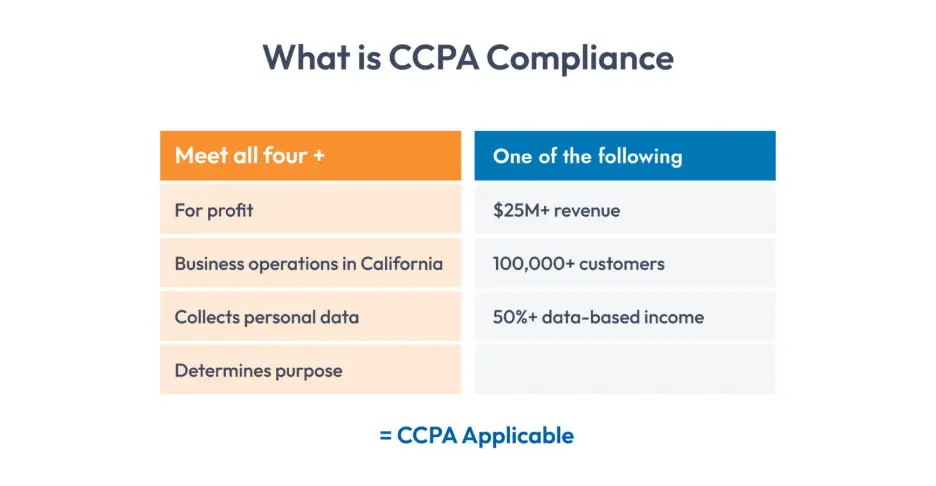
If your organization meets these criteria, you are legally obligated to provide transparency about data collection practices. That is where the challenge hits the sales, marketing, and customer teams. They are required to meet CCPA communication requirements to ensure active and visible disclosure:
- Notice obligations: Enterprises must notify customers about collecting their data before the point of collection. The notice should include key elements, such as the information they collect, purpose of data collection, how the data will be used, and a link to data privacy policy.
- Communicating consumer rights: Enterprises must convey all the specific rights that CCPA provides to customers. These rights include the right to know, right to delete, and right to non-discrimination.
- Handle customer requests: Enterprises must lay down processes to manage and respond to consumer requests in respect to the rights they have. Moreover, they are required to respond within 45 calendar days once a verifiable request is received.
Common Communication Challenges in CCPA Compliance
Many organizations struggle to meet CCPA communication requirements due to legacy systems and manual processes.
Manual processes and delayed responses
Manual workflows can lead to mistakes and delays in communication and responses. Emails can be missed. Files get sent incorrectly. Deadlines may slip. Furthermore, as request volumes grow, manual processes do not scale. All these can result in failure to meet compliance requirements.
Inconsistent messaging across channels
One of the biggest communication challenges is fragmented and inconsistent messaging which can lead to confused customers and weakens compliance defensibility.
Consistency across all channels, such as email, web, mobile, and print is non-negotiable for true CCPA compliance. When messages vary by channel, consumers may misunderstand their rights. Regulators may also question the reliability of the process. Inconsistent communication makes compliance harder to defend.
Lack of auditability
Many organizations manage privacy communication through manual steps. These steps are often spread across teams and systems. As a result, communication records are incomplete or missing. There is no single source of truth. Without a centralized log, organizations cannot show when a request arrived or how it was processed. They also cannot confirm what was shared with the consumer. This increases exposure during audits and regulatory inquiries.
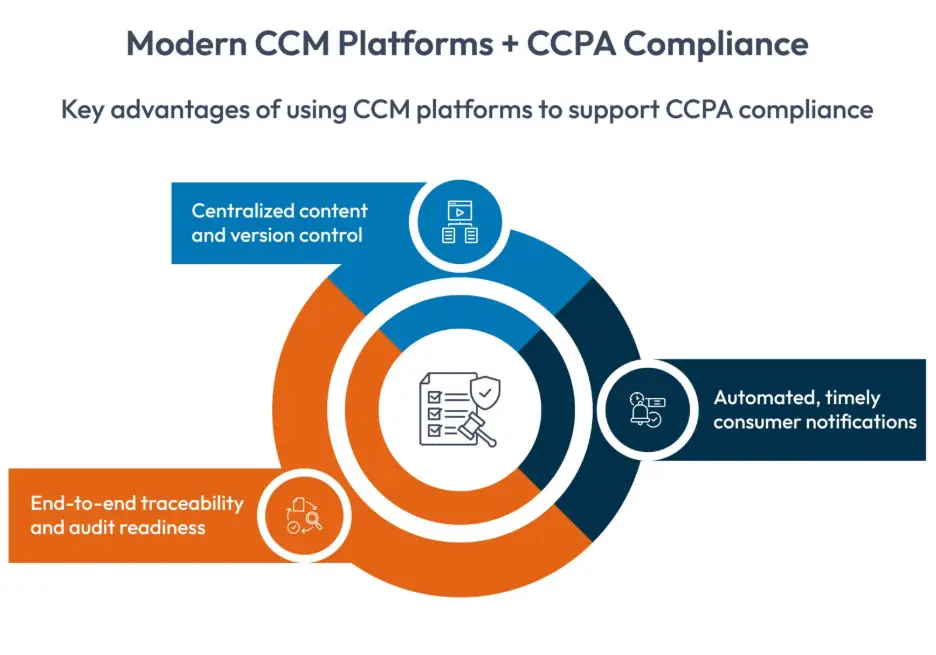

How Modern Communication Platforms Support CCPA Compliance
Customer Communication Management platforms address common CCPA challenges by reducing manual work. They replace fragmented workflows with structured and automated processes.
Centralized content and version control
Modern communication platforms allow organizations to store privacy content in one place. This includes legal notices and approved privacy language. Teams no longer need to copy text into each document. Templates pull the content automatically from a central repository.
When regulations change or legal teams update policy language, the update is made once. The system applies the change across all related templates. This keeps messages consistent and current. It also reduces the risk of outdated or conflicting language reaching customers.
Automated and timely consumer notifications
Handling privacy requests at scale requires automation. Communication workflows can start as soon as a consumer submits a request. The system sends an acknowledgment within the required timeframe. It references the correct request identifier.
The platform can track response deadlines and alert internal teams. If more time is required, the system can send an extension notice. This reduces reliance on manual tracking. It also helps ensure that legal timelines are met.
End-to-end traceability and audit readiness
Modern communication platforms support audit readiness. All interactions related to a consumer request are captured in one system. This includes submission, verification, response, and closure. Each action is recorded with a date and time.
This level of traceability allows organizations to demonstrate compliance when asked. Teams can produce a complete communication record without reconstruction. There is no need to search through emails, spreadsheets, or personal inboxes.
Best Practices for Mastering CCPA Compliance Through Communication
So, how to be CCPA compliant (and stay that way) through better communication? It requires a strategic approach that involves Legal, IT, and Customer Support.
- Map Your Data and Communication Touchpoints: You cannot communicate about data you can’t find. Create data inventory. Then, map every point where you interact with a customer. Ensure data privacy language is present at every entry point.
- Create Pre-Approved Response Templates: Do not ask customer support agents to draft legal responses. Create a library of pre-approved templates for every scenario: request receipt, identity verification needed, request fulfilled, request denied, and extension required.
- Train Your Frontline Staff: Your customer support team is your first line of defense. They need to know what a CCPA request sounds like. Customers rarely use legal terms. They must recognize customer requests and understand what is required and how to fulfil them.
- Test Your Process: Conduct “fire drills.” Have an employee submit a fake data request and track it through your system. Did they receive the acknowledgment in the stipulated time? Was the data accurate? Did the secure delivery work? Find the breaks in the communication chain before a real customer does.
Turning Compliance into Customer Trust
It is easy to view CCPA compliance requirements as a burden—a tax on doing business in the digital age. But there is a different perspective. In an era of data breaches and misuse, privacy is a premium product. Customers are increasingly aware of their digital footprint. When a company communicates clearly about data, respects requests promptly, and handles information securely, it signals integrity.
FAQs
1. How should organizations handle incoming CCPA requests?
Organizations should adopt automated solutions to capture and track requests in one place. Using communication platforms can help teams keep track of every step and gain deeper visibility.
2. Does automation help with CCPA compliance?
Automation helps ensure responses go out on time without depending on someone to remember every deadline, especially when request volumes increase.
3. How do communication platforms support CCPA compliance?
CCM platforms help manage privacy messages, responses, and records from a single system. This keeps communication consistent and easier to control.
4. Why does centralized privacy content matter?
When the privacy language is spread across systems, mistakes happen. Centralized content makes updates simpler and ensures customers see the same information everywhere.


