Introduction
Centralized Customer Communications Management (CCM) has become a critical control layer for insurance organizations operating under increasingly complex regulatory regimes. As insurers expand across jurisdictions, products, and delivery channels, the risk associated with inconsistent or outdated communications has grown significantly. Regulatory expectations now extend beyond the content of customer communications to include the ability to demonstrate how regulated language is governed, approved, distributed, and audited over time.
In insurance, compliance failures rarely originate from a single system defect. They emerge from fragmented communication processes in which policy, claims, billing, and servicing teams maintain independent templates, update disclosures at different times, and rely on manual coordination to enforce regulatory changes. This fragmentation introduces what can be described as “regulatory drift”, a condition in which approved legal requirements diverge from what is actually delivered to policyholders.
This article examines why centralized CCM is essential for managing insurance compliance communications at scale. It positions CCM not as a document production capability, but as a governance framework for regulated content.
What Is Centralized CCM in the Insurance Context?
Centralized Customer Communications Management (CCM) is an architectural approach in which regulated insurance communications are governed from a single, shared control layer rather than managed independently by individual systems or departments. It centralizes ownership of approved language, applies jurisdictional rules consistently, and ensures that all policyholder communications reflect current regulatory requirements. The result is greater control, traceability, and consistency across the insurance communication lifecycle.

Unified Content Governance |

Data Orchestration |

Omnichannel Delivery |
| Regulated templates, disclosures, and legal language are managed centrally, with controlled updates and approvals to prevent inconsistencies across lines of business. | Communication content is dynamically assembled using accurate data from core insurance systems, including policy administration, claims, and billing platforms. | The same compliant message is delivered consistently across print, email, SMS, and digital portals, regardless of channel or customer preference. |

Discover How Cincom Eloquence Supports DORA, GDPR, HIPAA, and LEA.
A practical examination of how enterprises can embed compliance into everyday communications while maintaining clarity, control, and operational discipline.
The Liabilities of Fragmentation: Risks of Decentralization
In insurance compliance communications, fragmentation introduces risk long before a document reaches a policyholder. When regulated content is distributed across disconnected systems and teams, updates become slow, inconsistent, and difficult to verify. This makes compliance dependent on coordination rather than control.
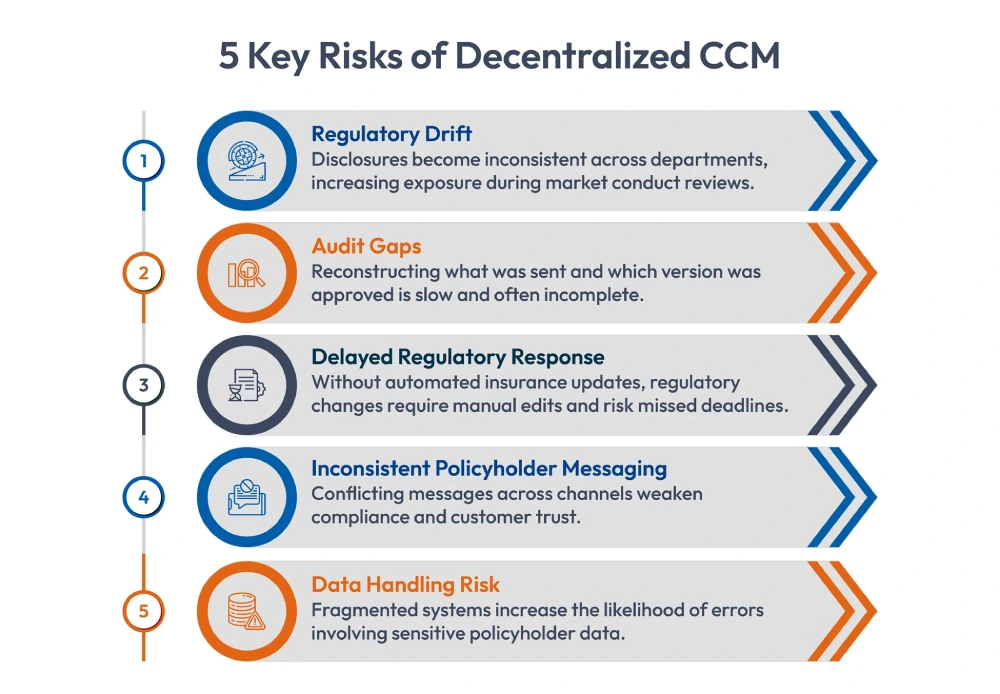
Centralized control is the only practical way to eliminate these risks at scale. Without it, insurers remain reactive, relying on post-incident corrections instead of enforcing compliance by design through automated insurance updates across all communications.
“Compliance by Design”: The Centralized Advantage
A centralized CCM architecture shifts insurance compliance communications from a reactive, manual review process to an automated technical constraint. By embedding regulatory requirements into the communication workflow, insurers achieve “compliance by design,” where the system mathematically precludes the generation of non-compliant output.
Global Content Locking and Ownership Separation
Centralization allows for the physical and logical separation of “regulated content” from “marketing/business content.”
- Hierarchical Permissions: Compliance and legal teams maintain exclusive write-access to mandatory disclosures and legal riders.
- Template Shielding: Business units can modify messaging around brand and tone but are programmatically restricted from altering “locked” regulatory blocks.
- Risk Isolation: This structure prevents shadow templates from proliferating, ensuring that local department edits do not inadvertently create legal liability.
Automated Regulatory Enforcement via Business Logic
Centralized platforms use data-driven triggers to automate the inclusion of required language, removing human discretion from the assembly process.
- Dynamic Jurisdictional Injection: The system utilizes metadata—such as the policyholder’s state of residence and Line of Business (LOB)—to automatically pull current, state-approved disclosures into the compliant insurance documents.
- Rule-Based Conditional Logic: If a policy meets specific criteria (e.g., a total loss claim in a particular state), the CCM engine forces the inclusion of required “Notice of Rights” documents without manual intervention.
- Attribute-Driven Accuracy: By linking document generation directly to the single source of truth, insurers ensure that policy values, deductibles, and expiration dates are pulled directly from the core system of record, eliminating manual data entry errors.
Version Control and Immutable Provenance
To satisfy legal and regulatory demands, centralized CCM provides a granular, timestamped history of the entire communication lifecycle.
- Audit-Ready Versioning: Every modification to a content fragment is archived with metadata detailing the author, the timestamp, and the specific regulatory mandate that necessitated the change.
- Chronological Integrity: Insurers can “point-in-time” reconstruct any document to prove exactly what language was active during a specific period.
- Chain of Custody: Establishing a clear digital trail of approval workflows, from the initial legal draft to the final production deployment.
Managing Evolving Mandates: NAIC, HIPAA, and EU Regulations
The regulatory environment for insurance is characterized by high volatility and regional fragmentation. CCM acts as a strategic buffer, allowing carriers to pivot in response to new mandates without exhaustive system overhauls.
Rapid Deployment and Change Management
Legacy, decentralized systems often require weeks of IT intervention to update a single disclosure across hundreds of siloed templates. Centralization compresses this timeline into hours.
- Update-Once, Deploy-Everywhere: Modifying a single content fragment in the central library pushes the update to every template utilizing that fragment across the enterprise.
- Regression Minimization: Centralized testing environments allow compliance teams to preview how a legislative change impacts various document types simultaneously, ensuring no “downstream” errors occur.
- Decoupling from Core Rewrites: Because the CCM layer is independent of the back-end policy system, insurers can update communications without touching the underlying core code.
Multi-Jurisdictional Agility
Handling 50 different State Department of Insurance (DOI) requirements requires a modular approach to content management.
- Standardized Reusable Blocks: Carriers develop a library of global blocks for standard language and regional blocks for state-specific nuances.
- Scale Without Complexity: As an insurer expands into new states or lines of business, it simply adds new regulatory fragments to the existing architecture rather than building new communication stacks.
- Adherence to HIPAA/GDPR and Privacy Frameworks: Centralized governance ensures that PII (Personally Identifiable Information) handling and privacy notices (GLBA/CCPA) are applied consistently across all touchpoints, reducing the risk of data-handling violations.
Universal Accessibility and Inclusion (ADA & EAA):
Compliance isn’t just about the words on the page; it’s about who can read them. Both the U.S. Americans with Disabilities Act (ADA) and the European Accessibility Act (EAA) now mandate that compliant insurance documents be fully accessible to policyholders with visual or cognitive impairments.
A centralized CCM solves this technical hurdle by automating PDF/UA (Universal Accessibility) generation. Rather than relying on manual, error-prone tagging, the system bakes in the necessary reading orders and alt-text into every policy form and claims letter at the source. This isn’t just a “nice to have”—it is a critical shield against discriminatory litigation and the heavy fines associated with EAA/ADA non-compliance.
Architectural Integrity: Fortifying Auditability and Regulatory Confidence
Regulators no longer accept “best effort” as a defense. The burden of proof has shifted; insurers must now demonstrate proactive governance through every stage of the insurance compliance communications lifecycle. Centralization transforms this from a manual data-gathering exercise into a push-button audit response.
Immutable Tracking: The Communication Lifecycle
A centralized CCM architecture provides a unified telemetry stream for every touchpoint.
- Granular Event Logging: Every document generation event is logged with metadata, including the specific policy form compliance rules applied at that moment.
- Proof of Delivery: By integrating with digital delivery platforms and print-service providers, the system captures delivery receipts and “open” timestamps, creating a definitive record of receipt.
- Version Provenance: You aren’t just proving that you sent a letter; you are proving which version of the legal language was active on that specific date.
Defensible Records for Legal Discovery
When a claim dispute arises, the ability to produce compliant insurance documents that are exact replicas of what the policyholder received is vital.
- Static Replicas vs. Data Reconstructions: Legacy systems often try to re-render old documents using current data, leading to discrepancies. Centralized CCM archives the exact CSS, fonts, and content fragments used at the time of mailing.
- Chain of Custody: The system maintains a digital paper trail of who drafted, reviewed, and approved a template before it went live.
The ROI of Governance: Synchronizing Operational Scale with Policyholder Trust
A common misconception is that strict compliance must come at the expense of a good customer experience. In reality, centralized insurance compliance communications improve CX by eliminating the “Frankenstein document” effect—where different departments send conflicting or confusing messages to the same customer.
Balancing Personalization with Compliance
The goal is to provide clear and conspicuous disclosures without sacrificing the personal touch that builds loyalty.
- Smart Content Injection: Centralization allows for compliance-locked blocks to sit alongside personalized blocks. The machine handles the mandatory legal text, while the business logic pulls in the policyholder’s specific claim details or next-best-action advice.
- Clarity Over Complexity: By centralizing the editing process, insurers can ensure that even regulated language is formatted for readability, reducing the volume of inbound “What does this mean?” calls to the service center.
Strategic Cost Containment
Non-compliance is expensive, but the process of staying compliant shouldn’t be. Centralization reduces the compliance tax on your operations:
- Eliminating Rework: When a state mandate changes, you update one content fragment instead of 500 individual templates. This drastically reduces manual editing time and the need for IT intervention.
- Automated Insurance Updates: Systems that handle automated insurance updates reduce the risk of manual copy-paste errors that lead to expensive remediation and re-mailing campaigns.
Unified Brand and Professional Tone
Consistency is a hallmark of trust. Centralization ensures that the voice of the company is the same whether the customer is receiving a renewal notice, a claims update, or a billing reminder.
- Visual Harmony: Standardizing fonts, logos, and layouts across all Compliant Insurance Documents.
- Global Tone Control: Ensuring that empathetic language is used consistently in sensitive communications, such as adverse action letters or total loss notifications.
Wrapping Up
Moving toward a centralized CCM model is about future-proofing the enterprise. It shifts the organization from a defensive, reactive posture to a proactive one where insurance compliance communications are a source of strength, not a recurring audit headache. When compliance is built into the architecture, insurers gain the agility to respond to market shifts and the transparency to build genuine trust with policyholders. In an unpredictable world, centralization is the simplest path to long-term resilience.
Master Your Compliance with Cincom Eloquence
Stop juggling document silos and start governing your communication lifecycle. Cincom Eloquence offers the control you need to automate policy forms, eliminate errors, and deliver professional, compliant documents across every channel—instantly.
Book a Demo with Cincom Eloquence!
FAQs
1. How does centralization speed up market conduct examinations?
Centralization provides a single repository for all insurance compliance communications, allowing for instant retrieval of “as-sent” records. Instead of searching through departmental silos, teams can produce an immutable audit trail that proves exactly what was sent and when.
2. Can a CCM platform handle sudden legislative changes?
Yes. Through automated insurance updates, insurers can modify a single legal fragment and push it across all active templates. This ensures that new state mandates are reflected enterprise-wide in hours rather than weeks.
3. How is policy form compliance maintained across different states?
A centralized hub uses business logic to automatically inject the correct state-specific riders based on policyholder data. This removes human error and ensures policy form compliance is a hard-coded constraint within the document generation process.
4. Does centralization help with ADA and EAA document requirements?
Centralized systems automate the generation of compliant insurance documents. By baking accessibility tagging into the core engine, carriers ensure all policyholders can access their information while meeting strict international accessibility laws.
5. How does this architecture protect sensitive policyholder data?
By routing data through one secure hub, insurers apply consistent encryption and privacy notices to every message. This unified approach reduces the risk of data breaches compared to using multiple, uncoordinated communication tools.