
Class definition in object-oriented programming
An object-oriented programming class is a template or blueprint used to define objects, which are instances of that class.
So, what are classes in object-oriented programming? And why are classes important in object-oriented programming? Let’s explore them in detail.
In classes, the structure and behavior are defined by specifying the methods (functions) and attributes (variables). The variables hold the data and functions execute specific actions on this data. Once you create a class, you can create multiple objects from the same class, but each has a different set of attributes while sharing the same methods.
Classes provide a clear structure for programs and help organize and manage code effectively. By combining related data and methods, classes promote modularity throughout the program.
Furthermore, classes support key OOP concepts such as inheritance and encapsulation, ensuring code reusability and program security.
Example for Class
Let’s take an example of a ‘Library’ class.
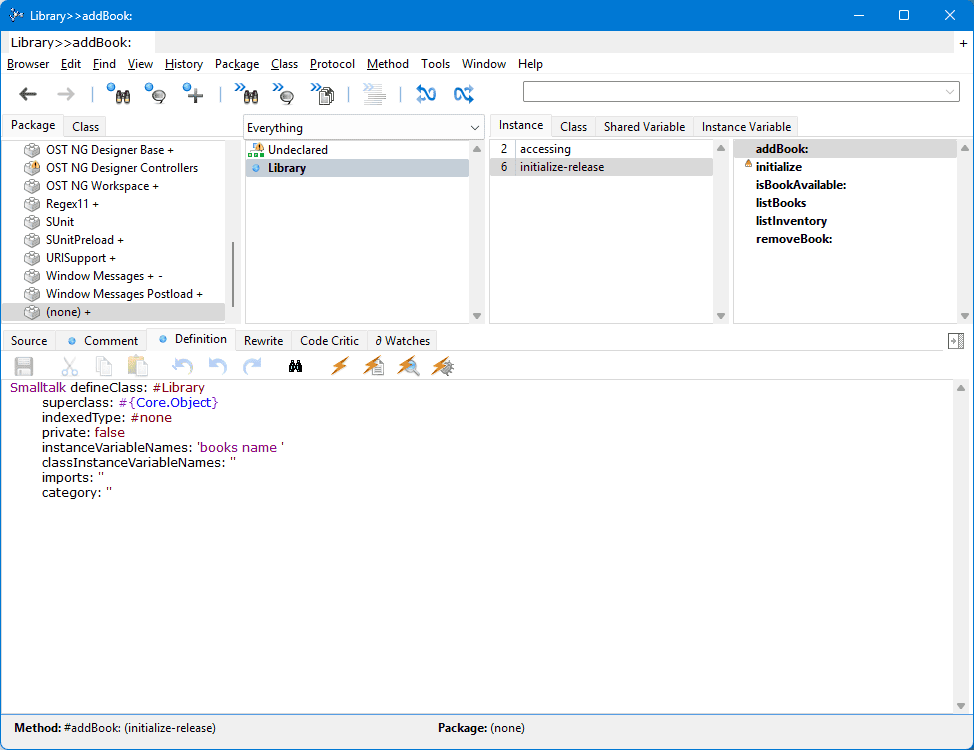
This class has attributes such as ‘library_name‘, ‘location’, and ‘books’. The methods for this class include addBook() to add a new book to the collection:

removeBook() to delete a book from the inventory, and isBookAvailable() to check if a specific book is available for borrowing:

listInventory() to display the inventory list:

The class also has a method check_due_dates() to verify the due dates for borrowed books, helping manage borrowed items effectively.

Object-Oriented Programming Class Vs Object
Objects are the actual, usable entities derived from a class. They are like real-world items created from the blueprint, which is the class. Each object has its own set of attributes and can perform actions using functions that are defined in the class. This process is called instantiation. It means that memory is allocated for the object’s data, and the object gains access to the methods from the class. Instantiation often happens through a special function called a constructor. The constructor ensures the object is set up correctly, such as providing its initial data and making it ready to use.
The difference between class and object in object-oriented programming lies in the fact that a class provides the blueprint, while the object is the actual instance created from that blueprint.

Why Choose Cincom Smalltalk? High-Performance Development Simplified
Discover how Cincom Smalltalk enables faster time to market, cross-platform delivery, and modern development practices.
Structure of a Class
Let’s break down a class and go through what it consists of in detail.
1- Attributes (Variables):
Attributes are the data elements in the class. They represent the state of the specific class’s objects and define which data and which type of data the objects will hold. For example, in a Car class, attributes might include color, make, model, or engine_type.
Attributes can be of various types:
- Primitive Data Types: These might include integers, floats, strings, or booleans. For example, age might be an integer, and name could be a string.
- Complex Objects: Attributes can also point to other objects or collections, creating more complex relationships. For example, a Car class might have an attribute called “engine,” which is actually an object of another class called Engine.
2- Methods (Functions):
Methods are the functions or actions defined in a class that its objects can perform with the associated attribute values (data). For example, the Car class may have methods like startEngine(), accelerate(), and brake(), which allow the objects of that class to perform actions.
Methods can also take parameters (input values) and return values. They allow interaction with the object’s data, enabling functionality like updating attributes or performing calculations based on them.
3- Constructors and Destructors:
These are special methods responsible for initializing and cleaning up objects.
- Constructor: A constructor is a special method that runs automatically when you create a new object. It sets up the object by giving it starting values. For example, in a Car class, a constructor might set default values for the model and color of the car when a new car object is created.
- Destructor: A destructor is a special method that runs when an object is no longer needed. It helps clean up by freeing any memory or resources the object was using. In some programming languages, destructors are explicitly defined, while in other OOP languages, memory management is typically handled automatically through garbage collection.
4- Access Specifiers:
Access specifiers are special keywords that control who can see and use the parts of a class, like its attributes and methods. In some OOP languages, these specifiers are not enforced but are used as a naming convention to indicate the intended access level. These keywords help decide where and how the class’s details can be accessed, and they help protect the data by keeping it safe from unwanted changes.
- Public: Public members are accessible from any part of the program. They can be accessed directly by any other class or function. This is useful for methods or attributes that need to be available throughout the application.
- Private: Private members are only accessible within the class itself. They cannot be accessed directly from outside the class, which helps hide implementation details and protect sensitive data. For example, an attribute like accountNumber in a BankAccount class might be private to ensure that it is not altered externally.
- Protected: Protected members are accessible within the class itself and by classes that inherit from it (subclasses). This allows derived classes to have access to some internal data or methods while still maintaining a degree of data encapsulation from the outside world.
Inheritance and Subclasses
The inheritance concept in OOP allows code reusability and helps to reduce errors by avoiding code duplication in the program. Once the attributes and methods are defined in a class, the same attributes and methods can be inherited by other classes. This helps programmers save time and use minimal coding as there is no code rewriting or redefining properties required in the inheriting classes. The class that defines the properties and methods is called a parent class or superclass and the classes that inherit properties are called child classes or subclasses.
The connection between a superclass and a subclass creates a hierarchy, as subclasses extend the functionality of a superclass. The superclass defines all basic functionalities, and subclasses specialize or add new features according to the program requirements. For example, the Vehicle superclass might include basic attributes like make, model, and speed. Its subclasses, like Car and Truck, would extend the Vehicle class with specific features, such as passengerCapacity for Car or payloadCapacity for Truck.
Polymorphism in OOP allows a subclass to use a method with the same name that is defined in the superclass but with a different implementation. This is often referred to as “method overriding.” It allows a subclass to provide its specific version of the method while still using the same method name.
With encapsulation, the members defined as private and protected in the superclass are handled in the subclass according to their access specifiers. Private members are not inherited by subclasses directly, maintaining the integrity of encapsulation. Protected members can be inherited and used by subclasses, ensuring controlled access to internal data.
Memory Allocation in Classes
Whenever a new object is created, the system sets aside some memory to store the object’s attributes (the data inside the object). The amount of memory needed depends on how many attributes the class has and what type of data they are (such as numbers, text, or lists). For example, if a class has attributes like text or lists, more memory will be needed to store that data for each object. Each object gets its own copy of the attributes, so each object is separate and doesn’t affect the others.
However, class methods are stored in one place in memory and are shared by all objects of that class. This means that while each object has its own unique attributes, all objects share the same set of methods. These methods do not consume extra memory for each object, as they are part of the class, not the individual instances.
What are Abstract Classes?
An abstract class is a class that cannot be instantiated directly. Instead, it serves as a base or template for other classes. Abstract classes can have abstract methods, which are methods that are mentioned in the class but don’t have any code to perform actions. Any class that uses (or “extends”) the abstract class must provide its own code for these methods.
Abstract classes are helpful because they let you define general behavior that should be shared by different classes. At the same time, they ensure that certain methods are created in any class that extends them.
For example, an abstract Shape class might define an abstract method calculateArea(), which every subclass (like Circle or Rectangle) must implement, ensuring all shapes have a way to calculate their area.
What are Static Members?
Static members are attributes and functions that belong to the class itself, not to the individual objects created from it. This means that all objects of that class will share the same static members. Instead of each object having its own copy, the class has one shared copy of these static members that all objects can use. Static methods and attributes are helpful when you want to perform actions or keep track of something that doesn’t depend on specific objects.
What are Final Classes/Methods?
A final class cannot be extended further, i.e., it cannot be inherited by any further classes. These types of classes in object-oriented programming can be used when you want to prevent any modifications in functionality. For example, a DatabaseConnection class might be marked as final to ensure that its functionality cannot be altered by subclasses.
Similarly, a final method cannot be overridden by any subclass. This is important when you want to ensure that a method’s behavior remains consistent across all subclasses, such as in the case of critical system operations that should not be altered.
Conclusion
Classes and objects are the building blocks of an object-oriented program as only through these blocks developers can build the structure and functionality of a program. Before starting to build your software product with an object-oriented programming language, it’s essential to learn these basic concepts thoroughly. This will help you use them properly and create strong, reliable software.
FAQs
1- What is a class in object-oriented programming?
A class is a blueprint used to create objects. It defines the structure (attributes) and behavior (methods) that its objects will have.
2- How is a class different from an object?
A class is just a template. An object is an actual instance created from that template, with its own values but shared methods.
3- What are constructors and destructors in a class?
A constructor sets up an object when it’s created. A destructor cleans up resources when the object is no longer needed.
4- What are static members in a class?
Static members belong to the class itself, not individual objects. All objects share them, and they’re useful for storing or performing actions that are common to all instances.


