Fragmented Communication Architecture in Insurance
In many insurance organizations, communication capabilities have expanded alongside core systems such as policy administration, claims, billing, and marketing. Each platform manages its own templates, workflows, and approval processes, which results in communication logic being distributed across the enterprise rather than being centrally governed.
Over time, this structure increases complexity. Similar documents exist in multiple systems, regulatory updates require coordinated changes across applications, and compliance reviews vary by department. As product lines grow and regional requirements evolve, document variations multiply, and oversight becomes more demanding.
These structural conditions directly influence the execution of a broader customer experience strategy. When systems are fragmented, delivering consistent and timely digital customer communications depends heavily on coordination between teams and platforms. The architecture behind communication, therefore, determines how efficiently insurers can manage updates, maintain consistency, and scale their operations.
Where Legacy CCM Actually Fails Insurers
Legacy communication environments often continue running because they technically function, yet the operational strain they create becomes embedded in daily workflows. The friction does not appear as a single system failure. It surfaces in delays, duplication, and escalating governance efforts across departments.
Below is a structured view of where the pressure typically builds inside insurance operations.
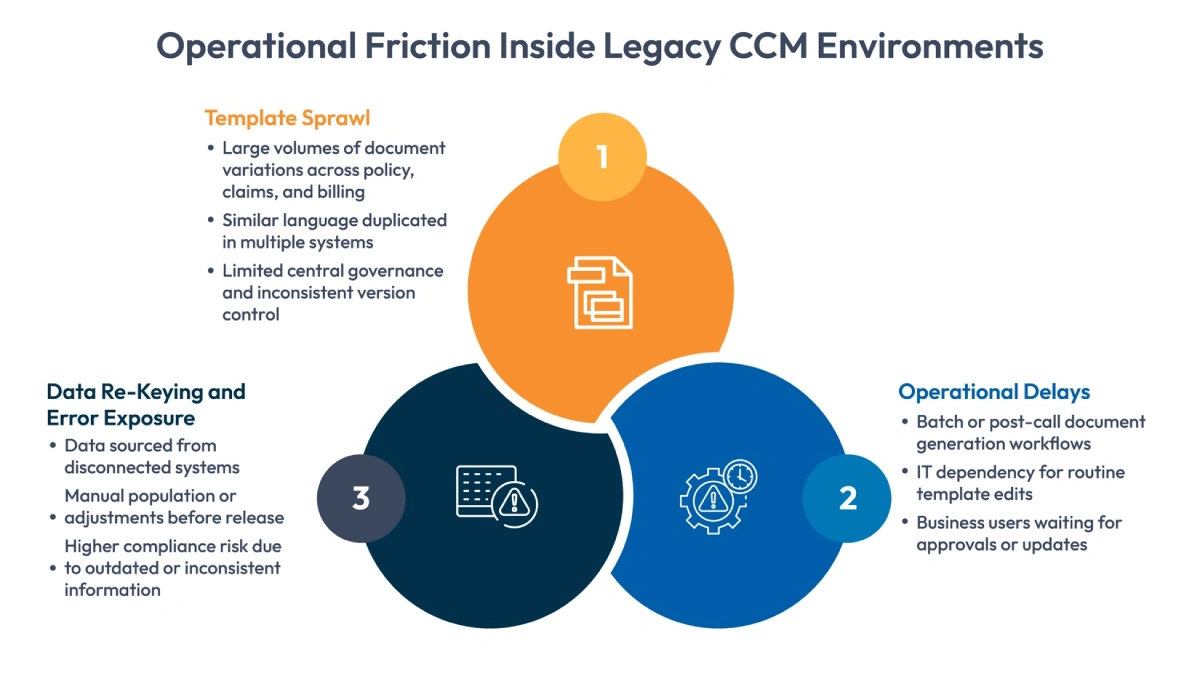
These friction points accumulate quietly. Each one adds incremental effort, yet together they shape how quickly insurers can respond to customers, regulators, and market changes.
Modern CCM systems address these conditions by restructuring how templates are governed, how documents are generated, and how data flows across core platforms. Without that structural shift, operational strain continues to expand as the organization grows.
Why Incremental Fixes Don’t Work
Many insurers attempt to improve digital customer communications by layering additional CX automation tools onto existing systems. While these additions may address immediate gaps, they often introduce new integration points, duplicate logic, and added governance overhead.
Custom-built extensions accumulate technical debt over time, especially when updates must be replicated across multiple environments. Department-level fixes may resolve local inefficiencies, yet they rarely align with the broader customer experience strategy, resulting in further fragmentation across the enterprise.
Without structural consolidation, patchwork upgrades tend to expand complexity rather than reduce it.

Exceptional Customer Experiences Start with Great Customer Communications
What a Modern CCM Architecture Looks Like
A modern communication environment is defined by structure and governance rather than isolated tools. The architecture determines how content is created, controlled, assembled, and delivered across the enterprise. When designed correctly, it supports a scalable customer experience strategy, strengthens operational control, and makes digital execution consistent across business units.
One Content Core
At the foundation of modern CCM systems is a centralized content model. Instead of maintaining separate templates inside multiple applications, communication components are stored and governed in a unified repository. Content is modular, reusable, and subject to controlled approval workflows. Regulatory updates, product changes, and language revisions occur in one place and propagate across all related communications.
This structure supports measurable customer communication management benefits by reducing duplication, strengthening oversight, and accelerating change management.
Key characteristics include:
- Centralized template and content repository
- Pre-approved language blocks and reusable components
- Built-in governance controls and audit visibility
- Standardized version management across departments
Embedded Within Core Systems
Modern CCM systems operate as part of the core insurance ecosystem rather than as a disconnected layer. Communication generation is embedded directly within policy, claims, billing, and underwriting platforms. Business users initiate and generate correspondence from the system they are already using.
This eliminates application switching and reduces coordination overhead. It also ensures that data used to generate correspondence is pulled directly from authoritative system sources.
| Legacy Environment | Modern Architecture |
| Separate document applications | Embedded generation within core systems |
| Manual data transfers | Direct system-level data integration |
| Isolated template ownership | Centralized governance with distributed access |
This embedded approach enables structured digital customer communications without increasing operational fragmentation.
Real-Time Generation at the Point of Service
Communication should be generated during customer interaction, not after it. In a modern environment, member-facing representatives can assemble compliant, personalized documents while engaging with policyholders. Correspondence is produced instantly using approved content and live system data.
Operational outcomes include:
- Document generation during live service interactions
- Elimination of post-call processing queues
- Reduced dependency on secondary applications
- Faster turnaround and fewer manual corrections
These capabilities directly contribute to operational efficiency and reinforce a consistent customer experience strategy.
Channel Agnostic by Design
Modern CCM systems treat output channels as delivery mechanisms rather than separate production workflows. A single template structure supports both print and digital outputs, preventing parallel builds for different formats. Whether delivered as a letter, email, or portal document, the underlying content model remains consistent.
This architecture supports:
- Unified template management for print and digital channels
- Consistent formatting logic across delivery methods
- Reduced duplication across CX automation tools
- Scalable expansion of digital customer communications
By aligning structure, governance, and integration, modern CCM systems deliver operational control and scalable customer communication management benefits across the enterprise.
What Changes Operationally When CCM Is Done Right
When communication architecture is structured correctly, the impact becomes visible across teams. The improvements are not limited to document generation speed. They reshape how departments coordinate, how quickly updates are implemented, and how consistently digital customer communications are executed. The customer communication management benefits extend beyond efficiency and begin influencing control, accuracy, and responsiveness at scale.
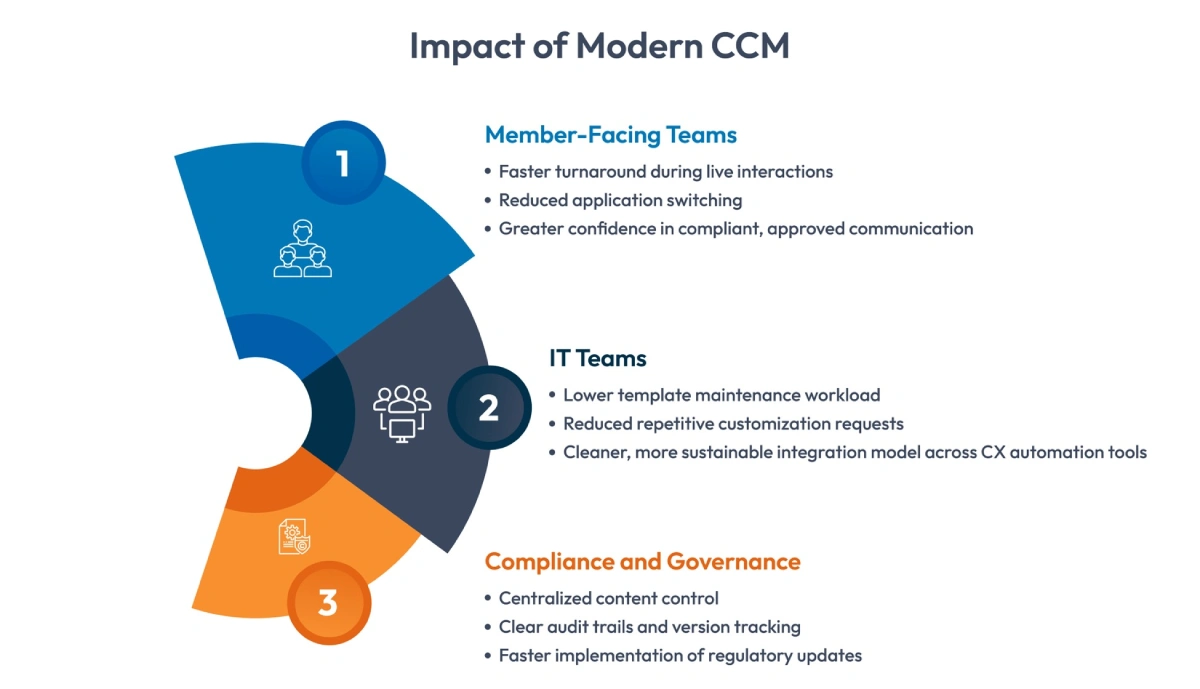
When these improvements occur simultaneously, digital customer communications become more predictable and scalable. Instead of managing exceptions and corrections, teams operate within a controlled framework. The cumulative effect strengthens governance, reduces operational friction, and reinforces measurable customer communication management benefits across the organization.
The Compounding Effect on Customer Experience
Customer experience improves when operational discipline produces consistent, accurate, and timely interactions across every touchpoint. A structured communication environment ensures that messaging, delivery, and compliance are aligned with the broader customer experience strategy.
When governance and integration are handled correctly upstream, the downstream impact becomes measurable across digital customer communications. Customers receive information that is consistent in tone, accurate in content, and delivered without unnecessary delay. Over time, this consistency shapes perception and trust.
The causal relationship is direct:
- Consistent messaging reinforces credibility across policy, claims, and billing interactions.
- Faster document generation reduces service friction and shortens resolution cycles.
- Personalized correspondence improves clarity and reduces follow-up inquiries.
- Fewer data errors lower complaint volumes and compliance exposure.
These outcomes represent tangible customer communication management benefits. They are the result of controlled architecture and coordinated execution. Customer experience, in this context, becomes the cumulative output of structured processes, governed content, and reliable digital customer communications delivered at scale.
Where Cincom Eloquence Fits in This Model
Within this architectural model, Cincom Eloquence functions as the centralized communication layer that supports structured execution across systems. It provides controlled template and content management while integrating directly within core insurance applications, allowing business users to generate correspondence without leaving their primary workflows.
Its design supports real-time document assembly using approved content and live system data, reducing operational dependency and coordination delays. Because it scales across departments, it can align policy, claims, billing, and other functions under a consistent communication framework.
In this way, it supports a broader customer experience strategy by stabilizing how digital customer communications are created, governed, and delivered, while complementing existing CX automation tools already in place.
Communication Is an Operational Decision
Core system upgrades, claims automation, and policy administration initiatives often dominate transformation roadmaps. Yet every one of these investments ultimately communicates with the customer through documents, notices, and digital customer communications.
When communication architecture is fragmented, operational improvements remain partially constrained. When it is structured and governed, the impact of those investments becomes visible at every touchpoint.
Modern CCM supports a customer experience strategy by ensuring that every policy update, claim decision, and billing notice is consistent, timely, and controlled. Communication defines how the organization is experienced. Treating it as operational infrastructure ensures that growth, compliance, and service quality scale together.
FAQs
1. How does communication architecture influence long-term customer retention?
A structured communication environment ensures consistency, clarity, and timely delivery across digital customer communications. Over time, this reliability strengthens trust, which directly supports a sustainable customer experience strategy and improves retention outcomes.
2. What role do modern CCM systems play during regulatory changes?
Modern CCM systems centralize content control, making regulatory updates easier to implement across all templates and channels. This reduces the time and risk involved in updating digital customer communications while maintaining compliance standards.
3. Can CCM improvements deliver measurable operational savings?
Yes. Customer communication management benefits often include reduced template maintenance, lower manual correction rates, fewer rework cycles, and decreased dependency on IT for routine document updates.
4. How do CCM platforms interact with existing CX automation tools?
Modern CCM systems complement CX automation tools by governing how communications are generated and delivered. While automation tools trigger workflows, CCM platforms control content accuracy, formatting, and compliance within those workflows.
5. What should insurers evaluate before selecting a CCM platform?
Organizations should assess integration flexibility with core systems, governance controls, scalability across departments, and the ability to support enterprise-wide digital customer communications aligned with their customer experience strategy.