Customer experience has always influenced how businesses are perceived, but the way it is created and delivered has changed fundamentally. Digital interactions now shape first impressions, ongoing relationships, and long-term loyalty across nearly every industry. What was once a supporting function has become a primary driver of trust, differentiation, and growth.
The shift accelerated rapidly as organizations adapted to remote work, reduced physical interactions, and greater reliance on digital channels. Customers and partners now expect experiences that are consistent, intuitive, and responsive, regardless of how or where they engage. As a result, businesses are reexamining how technology, processes, and communication come together to define the digital customer experience.
This evolution has made digital customer experience not just a strategic initiative, but an operational imperative. Understanding what influences that experience, and how to act on it, is now essential for organizations looking to remain relevant and competitive.
The Strategic Imperative of Digital-First Customer Communications
While the notion of the “customer experience” is not new, the energy and action that businesses are starting to devote to the digital aspects has reached new levels in the wake of the COVID-19 pandemic and “shelter-in-place” mandates. Many are contemplating or have launched initiatives and projects that are focused on improving the digital experiences they provide to their customers and those who help them access customers (e.g., channel partners).
More and more companies are bringing senior executives with the word “customer” in their titles. They are making organizational changes designed to increase the focus on the customer digitally. And more IT projects are tied directly to improving the digital customer experience. The collective activities of almost every industry truly make the digital customer experience one of the top imperatives for post-pandemic 2020 and beyond.
Business Implications of Modern CX Strategies
Businesses recognize that improving the digital customer experience has broad implications in terms of technologies, processes, products and culture. To fully understand the implications, it is instructive to consider the various factors that influence the customer experience.
Customer experience comes down to what an individual or individuals perceive about the business. No matter if it’s insurance, banking, retail or manufacturing, it still comes down to a variety of dimensions that influence an individual or the collective experience of a few individuals. Here are the four main areas that influence the customer:
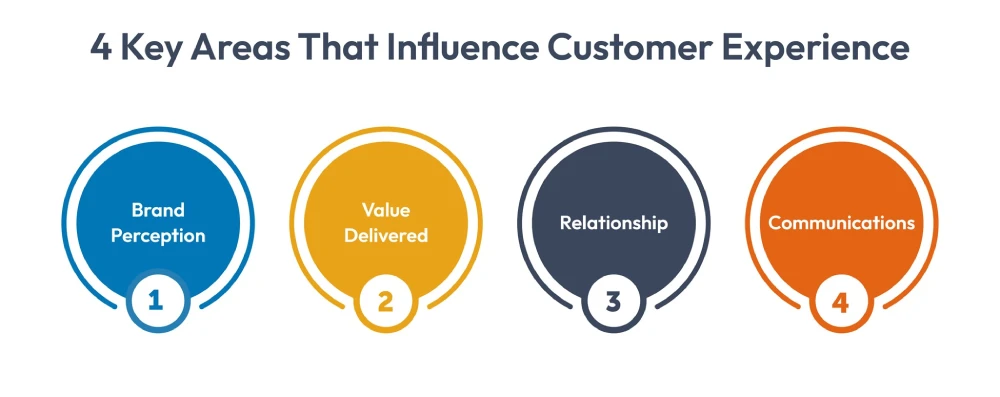
- Brand Perception – An individual’s perception of a business is based on what the business says about itself (in the form of advertising, social media and the communications received) and what a person hears or reads others saying about the company.
- Value Delivered – The value equation is about addressing the needs of the customer and delivering products and services at a price that the customer believes is fair. The customer considers how products fit their needs, the quality of the products, and how related services like billing, warranty, and claims are handled.
- Relationship – The relationship a customer has with a business is experienced in two dimensions: products and connections. The more products a customer has with a business, the stronger the relationship and loyalty are likely to be. When friends and family are also connected to the same business, the customer bond also tends to be stronger. It is vital for businesses to understand the nature of these relationships and reflect that in communications and offers to customers.
- Communications – The communication that a customer has with a business helps forms an impression. A single good or bad experience may have an impact on the customer’s perception, but the aggregate set of all communications certainly has a very large influence on the experience.
All of these areas of influence (brand, value, relationship and communications) result in interactions that the customer has with the business. Whether they work with the business via the website, portals, letters received in the mail, emails, phone calls or other forms, these interactions, individually and collectively, form the customer experience.

Discover how modernizing customer communication systems can enhance compliance and reduce manual workloads.
4 Actionable Insights to Improve Your Digital Customer Journey
Many businesses are now on a journey to improve the digital experience for both customers and channel partners. While journeys are different for each business, there are a few common actions that businesses should consider:
- Listen – Shaping or reshaping the digital customer experience should start with understanding what customers and channel partners really value. Investing upfront in gathering feedback and insights directly from customers will improve the chances that digital technology investments will pay off.
- Assess – Evaluate how interactions are supported today, including the manner in which digital content is created, managed, and delivered to customers.
- Analyze – Capitalize on customer analytics to gain new insights and operationalize actionable insights. Combining analytics with insights from customer roundtables, surveys and interviews will provide strong guidance on where the digital experience can be positively influenced.
- Act – Create a plan and roadmap to improve individual interactions through personalization and new delivery options. Continue to listen for customer feedback and requirements and be ready to adjust implementation as customer needs evolve.
Recognizing the different influencers of the experience and taking action based on listening to customer needs will ultimately enable businesses to capitalize on the digital customer experience and drive improved business results.
Conclusion: Turning Digital Customer Experience into Business Value
The digital customer experience is shaped by more than isolated interactions or individual technologies. It reflects how a business presents its brand, delivers value, builds relationships, and communicates consistently over time. Each of these dimensions contributes to how customers perceive the organization and decide whether to continue engaging with it.
Organizations that take the time to listen to customers, assess existing interactions, analyze meaningful insights, and act with purpose are better positioned to create experiences that resonate. These actions help align digital initiatives with real customer needs rather than internal assumptions or short-term trends.
As digital expectations continue to evolve, businesses that recognize the full scope of the customer experience and treat it as a continuous, adaptive effort will be best equipped to drive stronger relationships, greater loyalty, and improved business outcomes over the long term.
FAQs
1. What is meant by digital customer experience?
Digital customer experience refers to how customers perceive and interact with a business across digital touchpoints such as websites, portals, emails, mobile applications, and online communications throughout their relationship with the organization.
2. Why is CCM for digital transformation important today?
CCM for digital transformation helps organizations modernize how customer communications are created, managed, and delivered, ensuring digital interactions are consistent, compliant, and aligned with evolving customer expectations.
3. What does optimizing customer touchpoints with CCM involve?
Optimizing customer touchpoints with CCM involves managing every interaction, from onboarding to service communications, so that messages are timely, personalized, and consistent across digital and physical channels.
4. What is the long-term value of investing in digital CX solutions?
A strong digital customer experience leads to higher satisfaction, stronger relationships, improved loyalty, and more sustainable business performance over the long term.