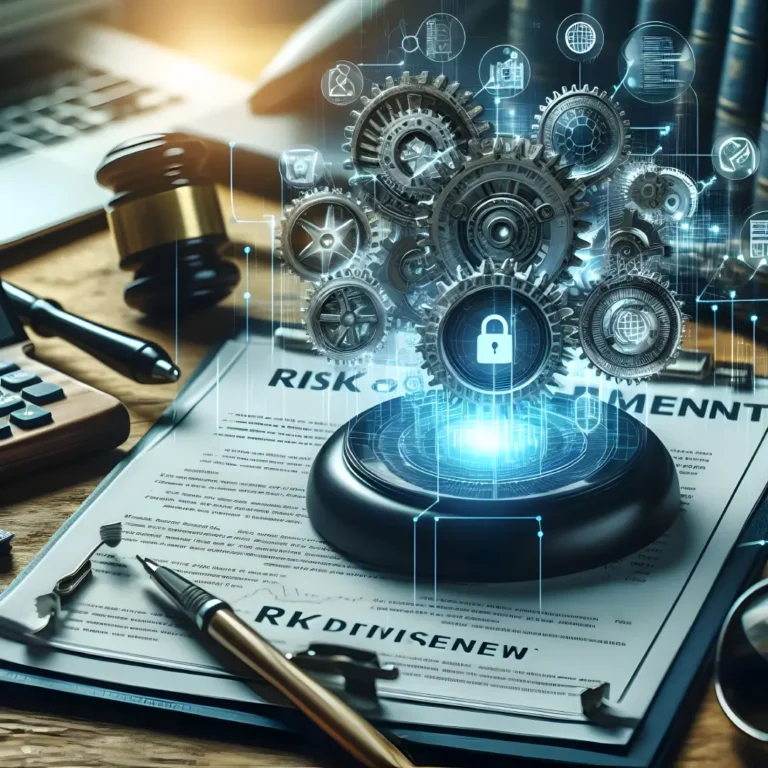
What is Risk Management?
Risk management is the process of finding problems before they cause harm. It helps organizations think ahead and prepare for danger. Every organization faces uncertainty, and risk management gives a clear way to handle it calmly and wisely. Some risks are small, while others can cause severe damage if ignored.
Organizations often face many types of risks. Financial risk appears when money is lost or wasted. Operational risk arises from system failure or human error. Strategic risk is linked to poor decisions or weak planning. Legal risk occurs when laws are broken, sometimes unknowingly. Reputational risk damages trust and public image. These risks cannot be erased, but they can be controlled with care and discipline.
Benefits of Risk Management
- Losses are reduced: Dangers are spotted early. Money, time, and effort are saved instead of being spent in a futile manner.
- Decision making becomes stronger: Leaders act with clarity rather than confusion, and impulsive choices are avoided.
- Stability is improved: Even during a crisis, organizations remain steady instead of collapsing under pressure.
- Trust is increased: Customers, investors, and employees feel secure when safety measures are visible and sincere.
- Growth is supported: When risks are understood, new opportunities are explored with confidence instead of trepidation.
Risk Management in Different Sectors
Insurance
In the insurance sector, risk management is not optional. It is the core activity. Future uncertainty is studied, and protection is offered through calculated promises. Every policy is shaped by probability, not guesswork.
Financial and Banking Services
In financial and banking services, risk management is treated with gravity. Credit defaults, market volatility, and fraudulent behavior are constant threats. Transactions are monitored, rules are enforced, and controls are applied to prevent financial ruin. Carelessness is costly and often irreversible.
Telecommunications
In the telecommunications sector, technical and data risks dominate concerns. Network failure can disrupt millions of lives. Customer data must be guarded with precision. Systems are reinforced, and breaches are investigated swiftly to prevent public indignation and loss of trust.
Public Sector
In the public sector, risk management protects collective interests. Government projects are reviewed to avoid waste and corruption. Public money is monitored closely. Accountability is demanded so that authority is not abused and services are delivered fairly.
Role of Technology in Managing Risk
Technology has transformed how risk is managed today. Large volumes of data are analyzed quickly using digital tools. Patterns of danger are identified before damage occurs. Automated systems reduce human error, which often causes failure. Real-time monitoring allows faster response, making risk control sharper and more reliable.
People Also Ask
Why do organizations fail without risk planning?
Without risk planning, small problems grow silently and turn into serious losses that are difficult to control.
Can risk ever be completely eliminated?
No, risk cannot be erased, but its impact can be reduced through careful preparation and control.
Who is responsible for managing risk in an organization?
Risk management is a shared responsibility, led by management but supported by every employee.
How often should risks be reviewed?
Risks should be reviewed regularly, especially when changes occur in systems, markets, or regulations.
Does risk management slow down business growth?
No, it supports growth by allowing organizations to move forward with awareness instead of uncertainty.