Sales success today is purely driven by data. The most competitive organizations are using real-time insights to guide every stage of the sales process, from prospecting to deal closure. At the heart of this transformation lies Configure, Price, Quote (CPQ) software.
A modern CPQ platform doesn’t just speed up quoting, it generates a wealth of valuable sales data. Every configuration choice, discount request, approval step, and closed deal becomes a measurable data point. When harnessed correctly, these CPQ metrics form the backbone of smarter sales automation, ensuring decisions are based on facts rather than assumptions. With the right metrics, you gain visibility, control, and the ability to scale revenue growth systematically.
In this blog, we’ll break down the most important CPQ metrics, how they enable smarter sales automation, and the measurable impact they have on business growth.
Why CPQ Metrics Matter for Sales Automation and Revenue Growth
In sales, you can’t automate what you can’t measure. That’s where CPQ metrics come in. They form the vital link between process visibility and sales performance, transforming raw data into actionable intelligence.
A modern CPQ platform tracks every step of the quoting journey — from configuration and pricing to approvals and deal closure. This level of detail gives sales leaders the clarity to identify bottlenecks, replicate winning strategies, and adjust instantly to shifts in customer demand or market conditions.
The business impact is immediate and measurable:
- Accelerated deal cycles create capacity to close more opportunities without adding headcount.
- Greater pricing precision eliminates costly errors, protects margins, and minimizes rework.
- Data-driven forecasting empowers leadership to allocate resources where they will deliver the highest return.
When sales teams have these insights in real time, automation becomes smarter, faster, and far more effective, directly translating into sustained revenue growth.

Transform Sales Process Automation and Drive Growth with CPQ Solutions
Discover how CPQ reduces quoting errors, accelerates sales cycles, and empowers multi-channel strategies.
Key CPQ Metrics That Drive Results
Not all data is equally valuable. To truly drive smarter automation, organizations should focus on the metrics that directly influence revenue growth and sales efficiency. They are:

1. Quote-to-Close Ratio
This metric measures how many quotes turn into closed deals. A low ratio might signal issues with pricing, proposal quality, or customer targeting. Automation can help by triggering guided selling prompts or alternative product recommendations when win rates dip.
2. Average Deal Size
Tracking average deal size helps identify upsell and cross-sell opportunities. CPQ automation can suggest relevant add-ons or premium configurations to boost deal value.
3. Time-to-Quote
Speed is a competitive advantage. If it takes too long to deliver a quote, prospects may turn to competitors. Automation can accelerate quoting by pre-approving standard discounts or using templates for common configurations.
4. Discounting Trends
Excessive discounting erodes margins. By monitoring discount trends, CPQ can automatically flag high-discount quotes for manager review or enforce tiered approval workflows.
5. Approval Cycle Time
Bottlenecks in approvals slow down the sales process. Automation can route approvals to the right stakeholders instantly and escalate urgent deals.
6. Configuration Error Rates
Errors in configurations lead to costly delays and rework. CPQ validation rules and automated error checks ensure only viable, profitable configurations reach production.
7. Sales Cycle Length by Product or Region
Understanding where and why certain deals take longer allows you to target automation where it matters most — for instance, automating proposal generation for slow-moving product lines.
When combined, these metrics give sales teams a full view of performance, enabling precise and impactful automation strategies.
Aligning CPQ Metrics with Revenue Goals
CPQ metrics are only valuable when they serve a purpose — and that purpose is advancing core business objectives. The real power lies in turning data into targeted actions that directly fuel revenue growth, protect margins, and strengthen customer relationships.
Here’s how the alignment works in practice:
- Revenue growth: Track and optimize metrics like average deal size and quote-to-close ratio to identify and replicate high-value wins.
- Margin protection: Keep a close watch on discounting trends and configuration error rates to safeguard profitability.
- Customer retention: Shorten time-to-quote and approval cycle time to deliver faster, more responsive service for existing clients.
With CPQ dashboards, sales leaders can clearly map each metric to a specific goal, making it easier to focus automation efforts where they’ll generate the greatest impact.
Sales Automation Powered by Real-Time CPQ Insights
While traditional reporting gives you a historical view, modern CPQ systems provide real-time metrics, enabling automation that reacts instantly to current conditions.
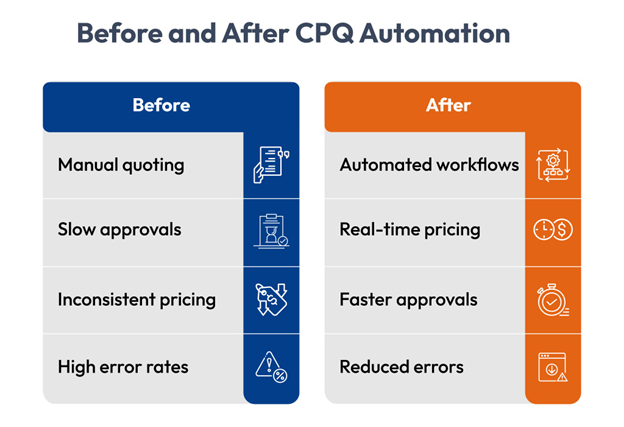
Here’s how real-time CPQ insights power smarter automation:
- Triggered workflows: If a quote’s discount exceeds a set threshold, it automatically routes to a senior manager for review.
- Dynamic pricing updates: Prices adjust instantly based on market conditions, inventory, or customer segment.
- Guided selling prompts: Reps receive in-the-moment suggestions for upsell or cross-sell opportunities based on customer history.
- Automated follow-ups: If a quote hasn’t been acted on in 48 hours, the system sends a reminder to the customer or flags the rep.
Next Steps: Making CPQ Data Actionable
Turning CPQ metrics into a true revenue growth engine requires a disciplined, repeatable approach. Here are five best practices to ensure your data drives measurable impact:
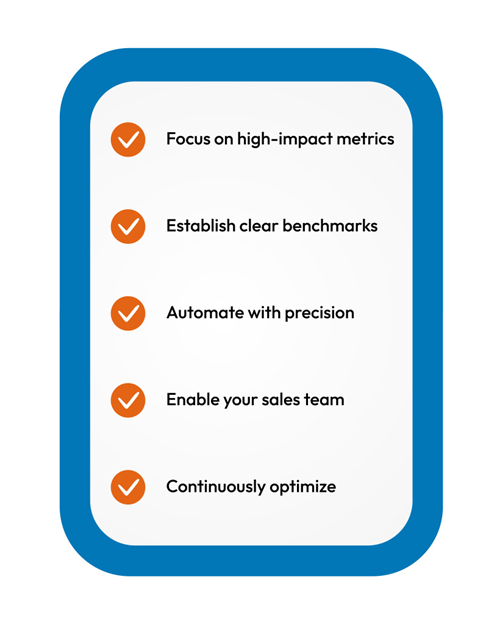
- Focus on high-impact metrics: Zero in on the metrics most closely tied to sales performance and revenue goals, rather than tracking everything.
- Establish clear benchmarks: Use historical performance data to set realistic baselines, then define specific, measurable targets for improvement.
- Automate with precision: Create CPQ rules that trigger actions when thresholds are met such as automatic approvals for standard discounts or alerts for delayed quotes.
- Enable your sales team: Provide training so reps can interpret CPQ insights and apply them effectively during the sales process.
- Continuously optimize: Review performance quarterly, refining metrics, rules, and automation workflows to ensure they stay aligned with evolving business priorities.
The objective isn’t simply to collect data — it’s to activate it. When CPQ metrics are translated into timely, targeted actions, they become a catalyst for faster cycles, higher win rates, and stronger profitability.
Data-Driven CPQ = Smarter, Faster, More Profitable Sales
In the CPQ-driven sales world, the most successful companies are the ones that track the right numbers and use them to make decisions quickly. CPQ metrics are more than just numbers on a report, they are signals that help you automate tasks, close deals faster, protect your profits, and grow your revenue.
When you match these insights to your business goals, give your sales team real-time guidance, and keep improving your automation, your sales process shifts from slow and reactive to fast, proactive, and easy to scale.
If your CPQ system is already collecting data but you’re not using it to guide automation, now’s the time to start. The sooner you link your metrics to smart actions, the sooner you’ll see better sales results and a stronger bottom line.
See how Cincom CPQ turns complex sales into fast, accurate, and profitable deals. Book a demo or try our ROI calculator to estimate your potential gains.
FAQs
1- What are the most important CPQ metrics for revenue growth?
Key metrics include quote-to-close ratio, average deal size, time-to-quote, discounting trends, approval cycle time, and configuration error rates. Tracking these helps identify bottlenecks, improve pricing accuracy, and close deals faster.
2- How does CPQ improve sales automation?
CPQ automates product configuration, pricing, and proposal generation—reducing manual work, speeding up approvals, and ensuring consistent, error-free quotes. This leads to shorter sales cycles and higher win rates.
3- Can CPQ integrate with CRM and BI tools for analytics?
Yes. Cincom CPQ seamlessly integrates with CRM systems like Microsoft Dynamics 365 and Salesforce, as well as BI tools, enabling unified data tracking, advanced reporting, and deeper insights into sales performance.
4- How do CPQ metrics support better sales forecasting?
By providing real-time visibility into deal progress, win rates, and pricing trends, CPQ metrics allow sales leaders to predict revenue more accurately and allocate resources strategically.
5- What’s the ROI of tracking CPQ performance metrics?
Tracking these metrics helps identify inefficiencies, boost sales productivity, and improve profitability. You can use Cincom’s ROI Calculator to see exactly how much CPQ can increase your revenue and reduce costs.