Sales and Strategic Planning for Complex Configuration Pipelines
You plan your production year. You staff up and tool up to build your product. Then sales sends in orders for configured products with unusual modifications. These often require engineering changes.
It is easier to plan configurability into a new product than to engineer changes into an existing one.
Why does this happen? Why can’t sales just sell what you make?
The answer is simple. Customers do not buy what you make. They buy what they need. Discounts, add-ons, and free training will not change that. A business will not pay for something that does not solve its problem.
Customers buy from people who listen and offer real solutions. So, ask yourself: who in your company spends time listening to customers and prospects?
In most cases, the answer is sales. Sales turns customer conversations into sales cycles.
Now ask a harder question: Who is involved in your planning, budgeting, and market strategy? If sales is not part of that process, it should be.
In many companies, sales is hardly included in annual planning. The conversation often sounds like this: “Can you sell $60 million worth of blue widgets next year?”
Sales should help set annual goals as well as shape product design and target markets. This is where complex product sales orchestration begins. Sales brings the customer’s voice into product development, long before a deal reaches quoting.
Key Strategies for Selling Highly Configurable Products Without Errors
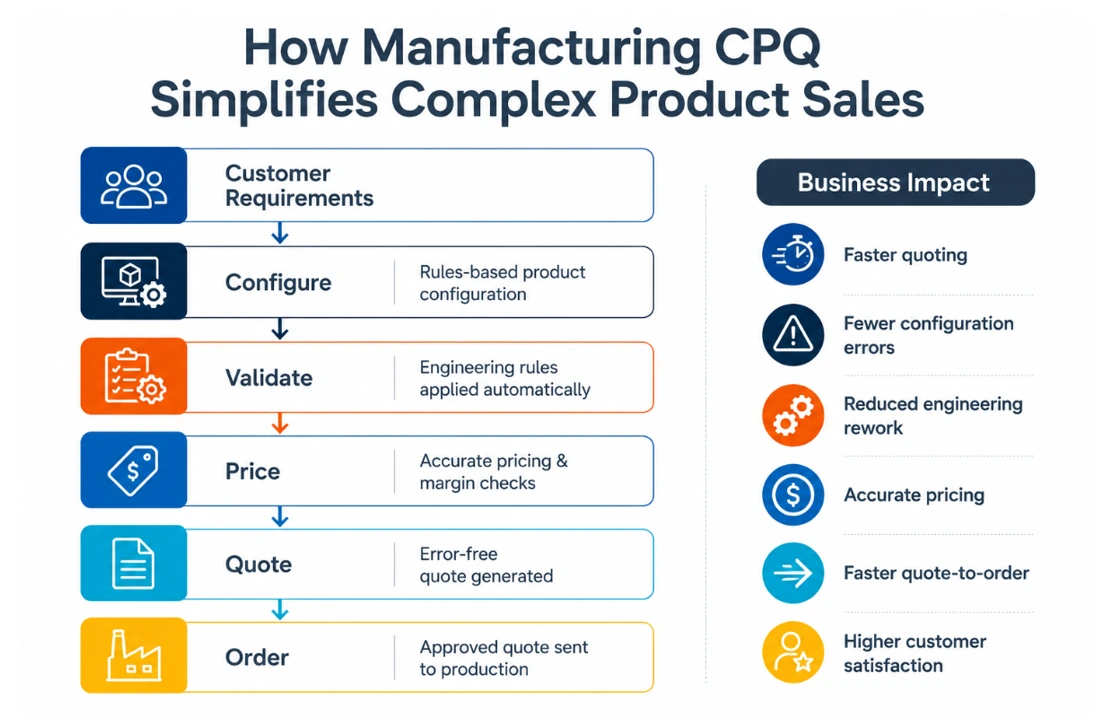
Manufacturers design configurable products to serve more customers. But configurability only works if the business can handle engineered orders as easily as it handles standard ones.
What sounds reasonable to an engineer or product manager does not always work in the field. Sales sees that gap firsthand.
Sales needs the tools to handle highly configurable or customized engineer-to-order products while staying aligned with the overall business plan. This is where engineer-to-order CPQ rules matter. When pricing logic, technical limits, and approvals are built into the system, sales can quote specials with confidence instead of guesswork. Planning configurability into a new product is easier than retrofitting it into an old one. Both are necessary.
A strong CPQ product configurator does more than generate a quote. It checks every configuration against engineering rules in real time. This means sales never promises something the shop floor cannot build.

Engineering and Change Estimating Solutions Within CPQ Software
Ask yourself if any of this sound familiar:
- You struggle to schedule special project runs.
- You lose money because special configurations are priced incorrectly.
- Special products regularly cost you more than they earn.
- Customers return products that do not meet their needs.
- Specials take so long to estimate that customers leave for a competitor.
These are common signs of quoting errors in manufacturing. They usually point to a gap between sales, engineering, and production. An automated quote-to-order process closes that gap. Configuration rules, pricing, and engineering limits are all in one system. Hence, quotes go out faster, and orders come in accurate.
If specials are causing delays, scheduling problems, or pricing losses, it is time to look at advanced manufacturing.
Stop relying on outdated processes. See how our intelligent solutions improve efficiency and support growth with integrated revenue management systems.
Ready to take the next step?
FAQs
1. How do I select the right product pricing configurator for complex products?
Choose a configurator with rules-based pricing, ERP integration, and built-in engineering checks that catch errors before a quote goes out.
2. What is the role of a CPQ configurator engine when selling complex configured products?
It confirms that every configuration a salesperson builds is valid, correctly priced, and possible to manufacture before the order moves forward.
3. How do advanced technical rules inside CPQ software prevent engineering bottlenecks?
Technical rules catch invalid or costly configurations at the quoting stage. This means engineering does not need to rework orders after the sale is made.
4. What are the primary challenges of managing complex pricing tiers in manufacturing?
The main challenges are keeping pricing consistent across configurations, accounting for engineering costs on specials, and avoiding margin loss from manual errors.