


Manufacturers today face constant pricing pressure. Material costs fluctuate, customers expect personalized products, competitors adjust prices quickly, and sales teams must balance profitability with winning business. In this environment, pricing is no longer just about assigning a number to a product. It has become a strategic decision that influences revenue, margins, customer relationships, and competitive positioning.
Before exploring different pricing models and automation tools, it’s important to understand ‘what is a pricing strategy’ and why it plays such a critical role in business success. This blog explores different types of pricing strategies, how to build a pricing strategy, and how CPQ pricing automation supports pricing excellence.
What is a pricing strategy?
A pricing strategy is a structured approach businesses use to determine how much to charge for their products or services. It considers various factors such as market demand, competition, production costs, and customer perception of value. A solid pricing strategy balances profitability with customer satisfaction and supports long-term growth.
Pricing strategy development directly impacts revenue, brand image, and market positioning. Whether you aim to penetrate new markets, increase margins, or reinforce your brand identity, pricing strategy plays a central role. Download this guide to discover CPQ expert Frank Sohn’s top tips for boosting CPQ ROI—covering planning, data accuracy, and performance tracking.
Why is an Automated Pricing Strategy Essential for Complex Manufacturers?
For manufacturers selling configurable or engineer-to-order products, pricing is rarely straightforward. Product options, customer-specific pricing, discounts, material costs, and approval rules all influence the final quote. An automated pricing strategy helps manufacturers apply pricing consistently, protect margins, and deliver accurate quotes faster. Here’s why it is essential:
1. Direct Impact on Profitability
Even a 1% price increase can significantly improve margins if done without losing customers. Conversely, underpricing might drive volume but damage long-term profitability. For complex manufacturers, automated pricing helps prevent pricing errors, unauthorized discounts, and inconsistent calculations that can reduce margins.
2. Shapes Brand Perception
Pricing strategy communicates value. Premium pricing suggests high quality and exclusivity. Competitive pricing signals affordability. Aligning price with brand positioning builds trust and loyalty.
3. Affects Customer Behavior
Accurate and consistent pricing builds customer confidence throughout the buying process. An automated pricing strategy ensures every quote reflects approved pricing rules, helping manufacturers deliver a reliable buying experience that encourages repeat business and long-term customer relationships.
4. Competitive Positioning
In a crowded market, competitive pricing strategy becomes a key differentiator. Smart pricing helps attract and retain customers without entering destructive price wars.

Accelerating Sales Cycles with CPQ Strategies for Industrial Manufacturers
Learn how a smart strategy helps CPQ accelerate sales for industrial manufacturers.
Which Pricing Strategy is Right for Your Business?
Once you understand the question ‘what is a pricing strategy’, the next step is choosing the approach that best aligns with your business goals, target audience, and market conditions. Here are seven common types of pricing strategies to consider.
1. Cost-Plus Pricing
This pricing strategy adds a fixed markup to the total production cost. It’s simple and ensures cost recovery with a consistent profit margin. Common in retail and manufacturing, cost-plus pricing may overlook customer demand and competitor prices, limiting profitability in dynamic markets.
2. Value-Based Pricing
With value-based pricing, you price based on the customer’s perceived value rather than cost. It’s ideal for premium products or services—like Tesla or Rolex—that offer unique features or brand value. This pricing strategy can boost margins but requires deep customer insight and market research.
3. Penetration Pricing
Penetration pricing involves launching at low prices to gain market share quickly, especially in competitive or price-sensitive markets. Startups and new entrants like Netflix often use this to build a customer base fast. However, it may delay profitability and raise challenges when prices increase later.
4. Skimming Pricing
Skimming pricing sets high initial prices to target early adopters, then gradually lowers them. Used in tech (like smartphones), it helps recover development costs quickly and creates exclusivity. The downside is the potential loss of price-sensitive customers and competitive undercutting.
5. Competitive Pricing
This competitive pricing strategy aligns prices with those of competitors to stay market relevant. It’s widely used in airlines and retail. While it helps maintain market share, it can reduce profit margins and trigger price wars without clear differentiation.
6. Dynamic Pricing
Dynamic pricing adjusts prices in real time based on changing business conditions such as demand, costs, or customer requirements. Dynamic pricing in complex manufacturing enables businesses to respond quickly to these changes while protecting margins.
7. Freemium and Subscription-Based Models
Popular in SaaS and digital services, this pricing strategy offers basic features for free while charging for upgrades. The freemium model encourages adoption and supports recurring revenue through subscription-based pricing. The key is balancing free value with enough incentive to convert users to paid plans.
How to Build an Efficient 7-Step Pricing Strategy for Manufacturing
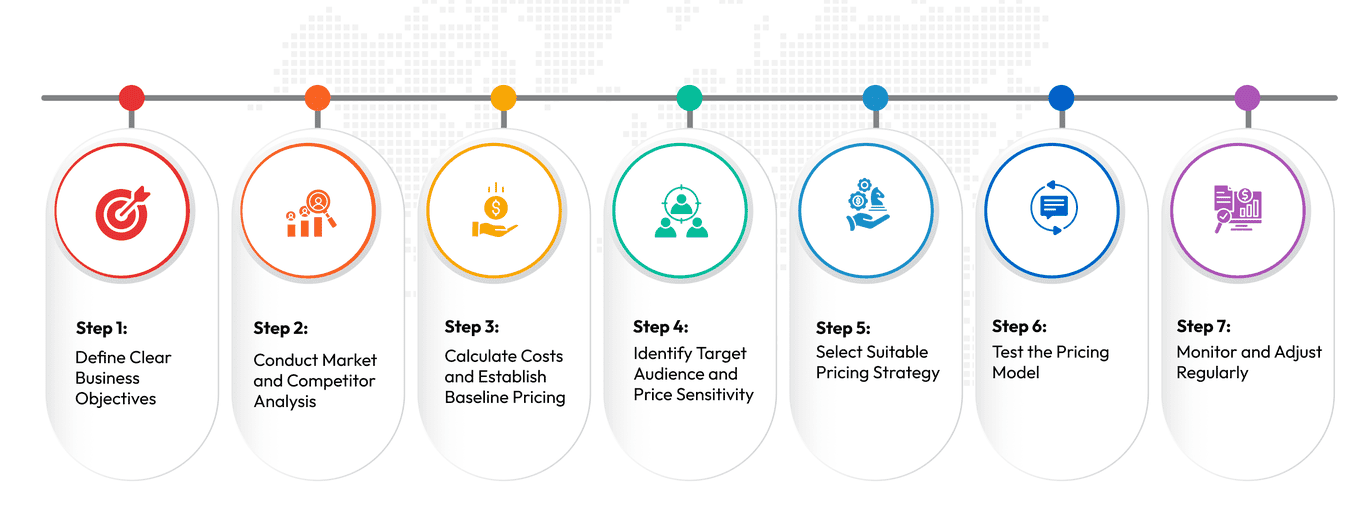
Step 1: Define Business and Pricing Goals
The first step in how to build an efficient pricing strategy is defining clear business and pricing objectives. Whether your goal is protecting margins, increasing market share, improving quote accuracy, or supporting business growth, your manufacturing pricing strategy should align with these broader goals.
Step 2: Conduct Market and Competitor Analysis
Research your industry landscape thoroughly. Analyze market trends, customer behavior, and competitor pricing strategies. Use tools like SWOT and pricing benchmarks to identify gaps, opportunities, and threats. This analysis helps build a competitive manufacturing pricing strategy.
Step 3: Calculate Costs and Break-Even Points
Assess fixed and variable costs. Calculate the break-even point to determine the minimum price needed to cover your expenses. This ensures your pricing strategy is sustainable.
Step 4: Understand Your Target Audience
A successful manufacturing pricing strategy must resonate with your buyers. Identify segments, understand their needs, willingness to pay, and perceived value. The more accurately you define buyer personas and price sensitivity, the better your pricing strategy development.
Step 5: Choose the Right Pricing Strategy
Once you understand ‘what is a pricing strategy’ and have analyzed your goals, costs, customers, and market, select the pricing model that best fits your business. Depending on your products and market conditions, this may include cost-plus, value-based, competitive, or dynamic pricing in complex manufacturing.
Step 6: Test and Gather Feedback
Use A/B testing, limited launches, or segmented rollouts to validate your pricing strategy. Collect feedback from customers, sales teams, and partners to optimize.
Step 7: Monitor and Adjust Regularly
The pricing strategy is not static. Continuously monitor sales data and market shifts. Leverage CPQ pricing automation to adjust in real time and stay competitive.
Building an effective pricing strategy is only the first step. The real challenge is executing it consistently across configurable products, customer-specific pricing, and every sales channel. That’s where Cincom’s CPQ pricing engine automation makes the difference. By applying approved pricing rules, automating calculations, and reducing manual errors, it helps manufacturers maintain pricing consistency while accelerating the quoting process.
4 Common Pricing Strategy Pitfalls in Complex Sales Cycles
| Mistake | What It Means |
| 1. Undervaluing Your Offering | Lowering prices may seem appealing, but it can devalue your brand and reduce margins. |
| 2. Ignoring Competitor Pricing | Without price benchmarking, you risk overpricing or losing market share. |
| 3. Misreading Customer Perception | Pricing must reflect perceived value. Misalignment reduces conversions. |
| 4. Overcomplicating Price Models | Too many tiers or unclear pricing confuses buyers. Simplicity builds trust. |
How Cincom CPQ Automates and Enforces Manufacturing Pricing Strategies
Cincom CPQ helps manufacturers execute their pricing strategy by automating pricing decisions, enforcing approved business rules, and generating accurate quotes for every configuration.
- Automated discounting and approvals
- Customer-specific pricing strategy
- Geographic price variation
- CRM and ERP integration
- Quote generation in minutes
Cincom CPQ eliminates guesswork, accelerates quoting, and helps enforce your custom pricing strategy with precision. Want to see the financial impact? Use our ROI Calculator to estimate how much revenue and time Cincom CPQ can help you save.
Defined your pricing strategy but struggling to execute it?
Cincom CPQ helps you build pricing strategy execution into your sales process and adapt fast to market changes.
FAQs
1. What is a pricing strategy, and why is it critical for industrial manufacturers?
A pricing strategy determines how a business prices its products or services based on factors such as production costs, market demand, competition, and customer value. A well-defined pricing strategy helps industrial manufacturers maintain consistent pricing, protect profit margins, improve quote accuracy, and ensure competitive pricing across every sales opportunity.
2. What is a manufacturing pricing strategy?
A manufacturing pricing strategy refers to the structured approach manufacturers use to set prices for their products based on production costs, market demand, competitor pricing, and value delivered to customers.
3. How does CPQ software support an efficient pricing strategy?
CPQ software automates pricing rules, applies approved discounts, calculates prices based on product configurations, and ensures consistent pricing across every quote. This reduces manual errors, speeds up the quoting process, and helps manufacturers execute their pricing strategy more effectively.
4. How to build an efficient pricing strategy?
An efficient pricing strategy involves various important factors, including customer demand, perceived value, cost structure, competitor pricing, market conditions, and your company’s overall goals.
5. How does CPQ software support dynamic pricing in complex manufacturing?
CPQ software enables dynamic pricing in complex manufacturing by automatically applying approved pricing rules based on factors such as product configurations, customer agreements, material costs, and market conditions.
6. Can a pricing strategy help improve sales efficiency?
A clear, consistent pricing strategy, especially when integrated into CPQ, reduces negotiation time, minimizes errors, and helps sales teams quote faster and more confidently.
7. How does Cincom CPQ compare against Tacton, Experlogix, and PROS CPQ for pricing management?
Cincom CPQ helps manufacturers manage complex pricing with rules-based automation, customer-specific pricing, approval workflows, and seamless CRM and ERP integration. Compared to other manufacturing CPQ solutions, it is designed to support highly configurable products while improving quote accuracy, pricing consistency, and sales efficiency.


