Why CPQ and Multi-Channel Sales Strategies Matter for Growth
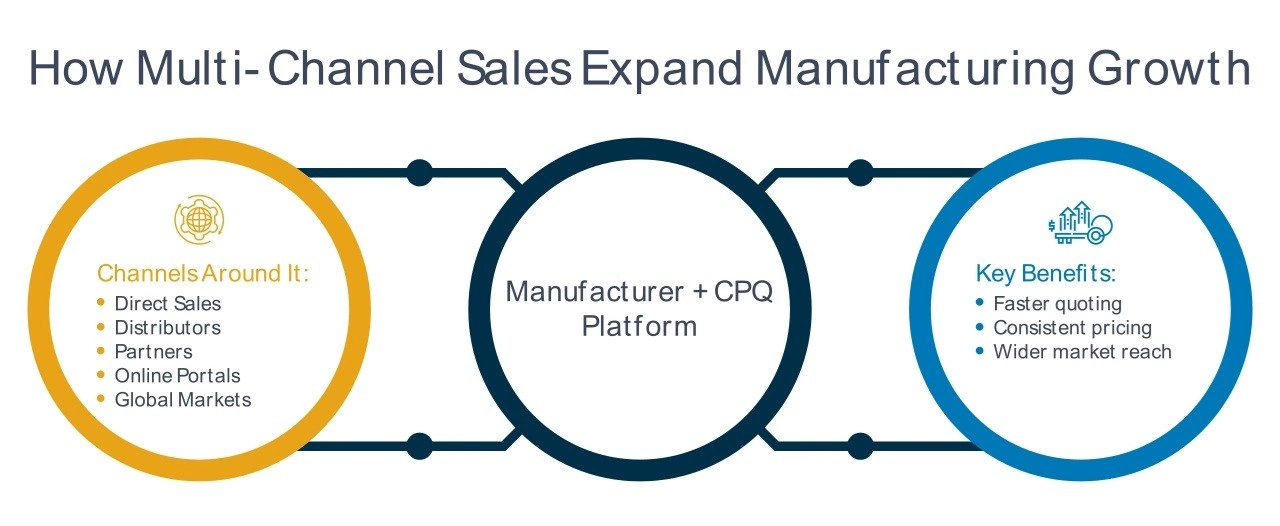
Organic growth can be an elusive goal for manufacturing enterprises. Yet, when companies identify their goals and objectives for a given year, growth is nearly always included near the top of the list. This is especially true for local and regional enterprises that are trying to expand their footprints into more highly diversified markets and larger geographical national or global markets.
For many enterprises, especially those that are currently operating via a direct or single-channel sales organization, the lure of adding channels and moving to a multi-channel sales model is strong. After all, who isn’t intrigued by the idea of expanding the sales force without adding the overhead that comes with additional feet on the street?
Many manufacturers support this strategy through structured channel sales programs that enable distributors and partners to sell their products effectively.
It sounds so simple. Find distributors, agree on a cost structure, sign them up and wait for the sales orders to roll in. The operative word being wait.
Well, to borrow a phrase from the late, great Tom Petty, the waiting is the hardest part.
There are many challenges for enterprises that want to cross the bridge from direct to indirect selling. Luckily, there are also some sales tools that companies can rely on to offer wide-ranging sales support to multiple-channel sales organizations or even omnichannel sales support.
One of these is Configure-Price-Quote (CPQ).
Transitioning from Single-Channel to Multi-Channel Sales
Geographical challenges include the need for price lists that are aligned with local currencies and languages. Additionally, most geopolitical subdivisions have their own unique regulatory and legal requirements related to selling practices, as well as those that are specific to the vertical market you are addressing.
Finally, there are assorted logistical requirements involved in moving products from your manufacturing facility into the hands of the buyer or into the inventory of your distributor.
New vertical market challenges also emerge in terms of specialized language and terminology that are common to each market. This type of knowledge is critical for establishing credibility when entering a new industry.
New markets may also expect specialized pricing models that align with other established players in that space. Other selling practices may vary as well. Some markets expect online ordering instead of onsite sales visits. You will also need to prepare for buyer expectations after the sale.
Training and product familiarity become immediate requirements in order to effectively sell products. However, training often requires significant investment in time.
Sales representatives in a new channel will almost always sell what is easiest to sell. If your product requires months of training and time out of the field to learn the product and the business case associated with buying it, many reps will naturally gravitate toward easier solutions that they more readily understand.
Sales reps do not like to waste time talking to prospects about applications they do not fully understand or feel credible discussing.

Single-Channel vs Multi-Channel Sales Efficiency
| Factor | Single-Channel Sales | Multi-Channel Sales |
| Speed to Quote | Slower manual quoting processes | Faster with CPQ automation |
| Error Rate | Higher due to manual configuration | Reduced with automated configuration |
| Customer Reach | Limited to direct sales teams | Expanded through distributors and partners |
| Pricing Consistency | Often inconsistent across deals | Centralized pricing rules |
| Sales Scalability | Limited growth potential | Scalable across markets and regions |
How CPQ Software Supports Multi-Channel Sales Accuracy
CPQ has a special role in addressing the major challenges associated with multi-channel sales environments.
Geographical variations in pricing are supported by CPQ by allowing companies to build multiple price lists for different currencies and customer classes such as national accounts or government-qualified buyers. It also helps maintain consistent pricing for international customers who may purchase products from multiple distributors.
If your product must comply with specific local regulations, compliant product versions can be automatically configured based on the usage inputs collected during the configuration process.
Logistical issues are also addressed through CPQ by accommodating shipping requirements for markets that involve long distances or extended delivery times.
Vertical market differentiation is driven by CPQ through the vocabulary and content used in the configuration interview portion of the selling process. Customers or resellers are not confused by irrelevant questions during configuration.
The interview questionnaire can be tightly customized to match any market or sales process. Online sales portals can support both customer-driven configurations and guided selling experiences for sales representatives walking prospects through a needs analysis.
Expert knowledge embedded within CPQ ensures that configurations follow best practices while maintaining credibility for both the product and the sales representative assisting the prospect.
Training requirements often determine whether sales personnel embrace or avoid a product. CPQ embeds expert data into the configuration process, freeing both the buyer and seller from having to memorize specifications and complex product rules.
This reduces the time required to learn product specifications and variable configuration data.
Sales personnel become knowledgeable sooner and can begin selling faster without relying heavily on experts inside the organization for support with every sales inquiry.
Maximizing CPQ Benefits for Multi-Channel and Omnichannel Sales
CPQ acts as the central source of product and sales information that supports both multi-channel sales and omnichannel selling for manufacturers.
It distributes product knowledge, pricing information, and configuration rules in a way that is tailored to each participant in the selling process. Customers, distributors, sales managers, order-entry personnel, and sales support teams all have access to the information they need to perform their roles effectively.
Through sales process automation, CPQ ensures that every sales channel generates accurate configurations and pricing. This allows manufacturers to scale partner sales, support digital commerce initiatives, and maintain consistency across direct and indirect selling models.
Ultimately, CPQ helps manufacturers expand their reach while maintaining control over product complexity, pricing accuracy, and overall customer experience.
FAQs
1. What is multi-channel sales in manufacturing?
Multi-channel sales refers to selling products through multiple routes such as direct sales teams, distributors, resellers, and online platforms. This approach allows manufacturers to expand market reach and increase revenue opportunities.
2. How does CPQ support multi-channel sales?
CPQ for manufacturing centralizes product configuration, pricing rules and quoting processes so that all sales channels can generate accurate quotes quickly and consistently.
3. What is the difference between multi-channel and omnichannel selling?
Multi-channel sales involve using several separate sales channels, while omnichannel selling for manufacturers connects those channels to create a consistent customer experience across every touchpoint.
4. Why is sales process automation important in multi-channel sales?
Sales process automation helps ensure pricing accuracy, configuration compliance, and faster quoting across direct sales teams, distributors, and digital sales platforms.
5. Can CPQ help distributors sell complex products?
Yes. CPQ provides guided configuration, automated pricing, and embedded product knowledge, so distributors can generate accurate quotes without needing extensive technical training.