Upselling and Cross-Selling Enhance Customer Experiences
In the B2B world, cross-selling and upselling are not only good business; they are good for the customer, as well. It’s the process of making sure that you and your customer know what is needed and what is available.
No One Cross-Sells and Upsells Better than Your Friendly Hamburger Stand
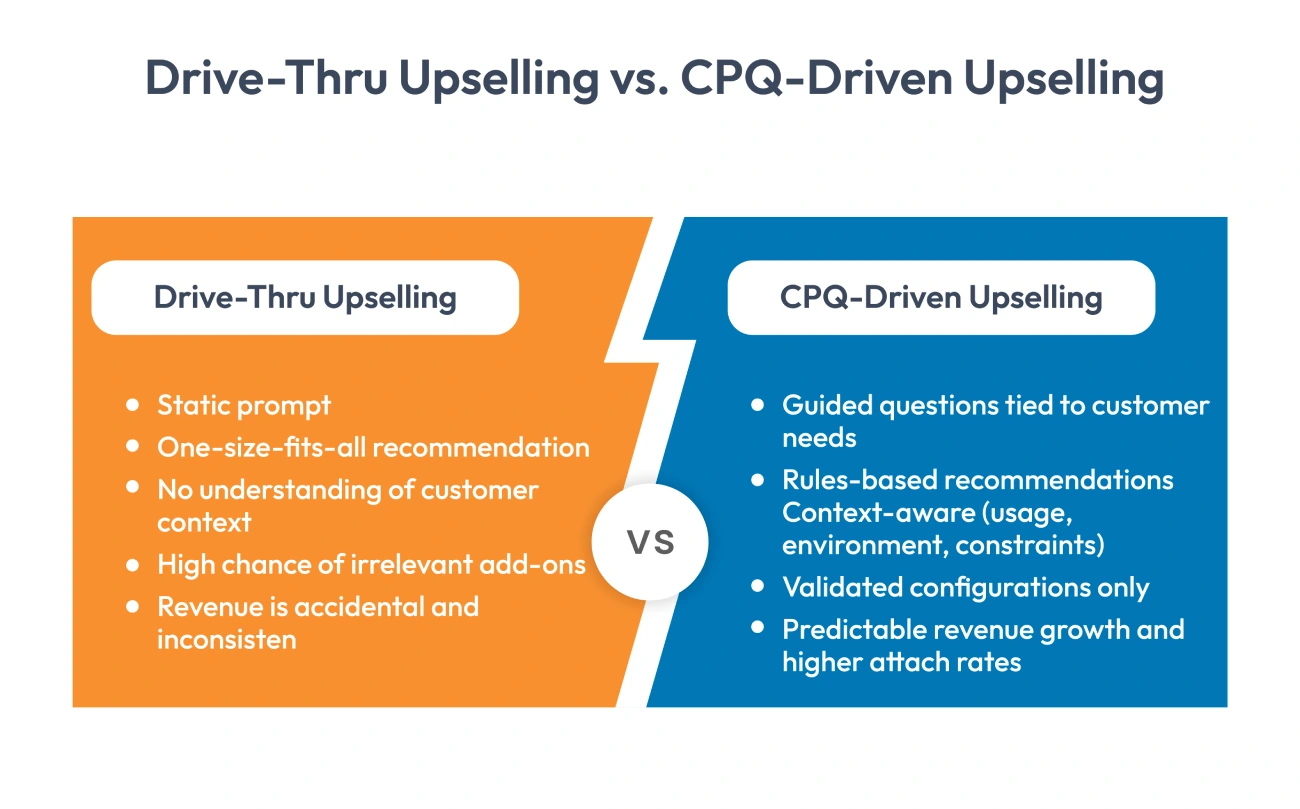
You pull into the drive-through, and there is a large plastic clown head waiting to take your order. The face lights up, and a scratchy voice emanates from the grinning face asking, “Would you like to try our combo meal today?”
This kind of honks me off. All I really want is the “Big Burger,” and the clown head has kind of screwed up my train of thought.
“I just want the big burger please.”
“Would you like fries with that?”
“Damn,” I think to myself, “just give me my burger,” as I respond, “yeah, give me a small fry!”
Sorry, the talking clown head will not allow me to have it my way: “Large fries are only a dime more!”
I stare at the plastic face of the clown and start to stutter a protest, “No, I just want …”
“That’s one big burger and one large fry. Pull forward. I’ll have your total at the window.”
A big plastic clown head has just taken you downtown for a load of over-salted, deep-fried starch that you really didn’t want in the first place. You were feeling pretty smug about not falling for the combo meal, but you just weren’t quite fast enough to get out of the fries.
It’s ironic that we can easily train a ninth-grader to upsell unwanted fries at your local burger doodle, but getting a college-educated sales professional to do this with a million-dollar, industrial-equipment order can be nearly impossible.

How CPQ Software Helps with Upselling and Cross-Selling
Sales reps often leave this stuff to the end, and then they avoid it for fear of delaying the sale. Money is left on the table, and opportunities that should be almost no-brainers are lost. Sales managers come up short at the end of the month, and customers are even disappointed to find that their needs have not been fully addressed.
CPQ software provides a natural way to build the cross- and upselling conversation into the normal question-and-answer discussion that defines the project itself. It’s not a “special” conversation, it’s just more questions related to the customer’s needs.
Deliver on the Upsell Potential
Let’s say you are discussing your prospect’s requirements for an elevator. The form-driven questions might run something like:
Question 1 – Is the elevator primarily for passengers or freight?
Question 2 – How many people should it accommodate?
Question 3 – How much weight should it accommodate?
Question 4 – What type of building will it be located in?
Question 4 seems somewhat out of place and not really relevant to the performance specs associated with the elevator; however, this is an area where some upselling might be justified.
The guided-selling form may offer several choices, including: executive office building, warehouse, factory or sales offices. Each of these answers can impact different features that are offered or included in the elevator design.
Let’s look at each from the standpoint of upselling potential.
Executive Office Building — Selecting this option will drive additional selections such as an air freshener, sound insulation or carpet.
Warehouse or Factory — Cosmetics are not important here, but the floor and walls may need to be fabricated with a tougher material that’s resistant to scratching or gouging. Perhaps a removable ceiling for over-sized loads would be offered.
Sales Offices — If you are bringing customers into your offices, you will likely want to consider the same options offered for the executive office building, plus you will want the nicer wall surfaces and high-grade carpet. No doubt you will also want the elevator to be outfitted with the latest in background music systems!
These questions are all presented during the guided product specification interview, which are driven by the CPQ software. The answers for question one drive the question-and-answer available options for the next round of questions.
CPQ Makes Cross-Selling Easy and Delivers Accurate Sales Quotes
The same process may be used for cross-selling.
Selecting the warehouse or factory option may drive some questions related to other material-handling needs. How are goods transported to the elevator? Hand truck? Forklift? Conveyor? The point is, the elevator may be only one part of a larger material-handling equipment need.
Offer Customers Product Options at the Point of Sale
Too often sales reps are encouraged to “just get the order,” and handle the other needs of the customer in the future. If it’s the last week of the fiscal year and the rep has a specific quota to attain, the salesperson will be reluctant to risk the base sale by attempting to upsell add-ons or other related products.
When I was in sales, we were told to never show the customer the paint-chip chart that shows all of the colors our product line came in. We were told to tell the customer the product (office furniture) came in putty or black. People will agonize over color far longer than they spent deciding to buy your product.
Sales reps learn to take these little lessons to heart. Salespeople don’t want their year-end performance shot because the customer couldn’t decide between rainforest green and autumn sky blue.
CPQ Guides Salespeople through Product Options and Makes Upselling Easy
When CPQ is employed, the whole array of possibilities can be built into the specification guided selling questionnaire. The temptation might be to just get the basic order and then go back and sell the rest. Customers hate that. No one likes to find that they really only bought half of what they thought they were getting.
CPQ Enhances Customer Satisfaction and Puts Buyers in the Driver’s Seat
Cover the whole usage scenario upfront and maximize your sale without delay.
By building all of these options into your product specification selling script, you are making sure:
- the customer is fully served
- your product is properly applied to mitigate the customer’s issues
- your delivery of value is maximized
How does CPQ Guided Selling Maximize the Attach Rate of Products?
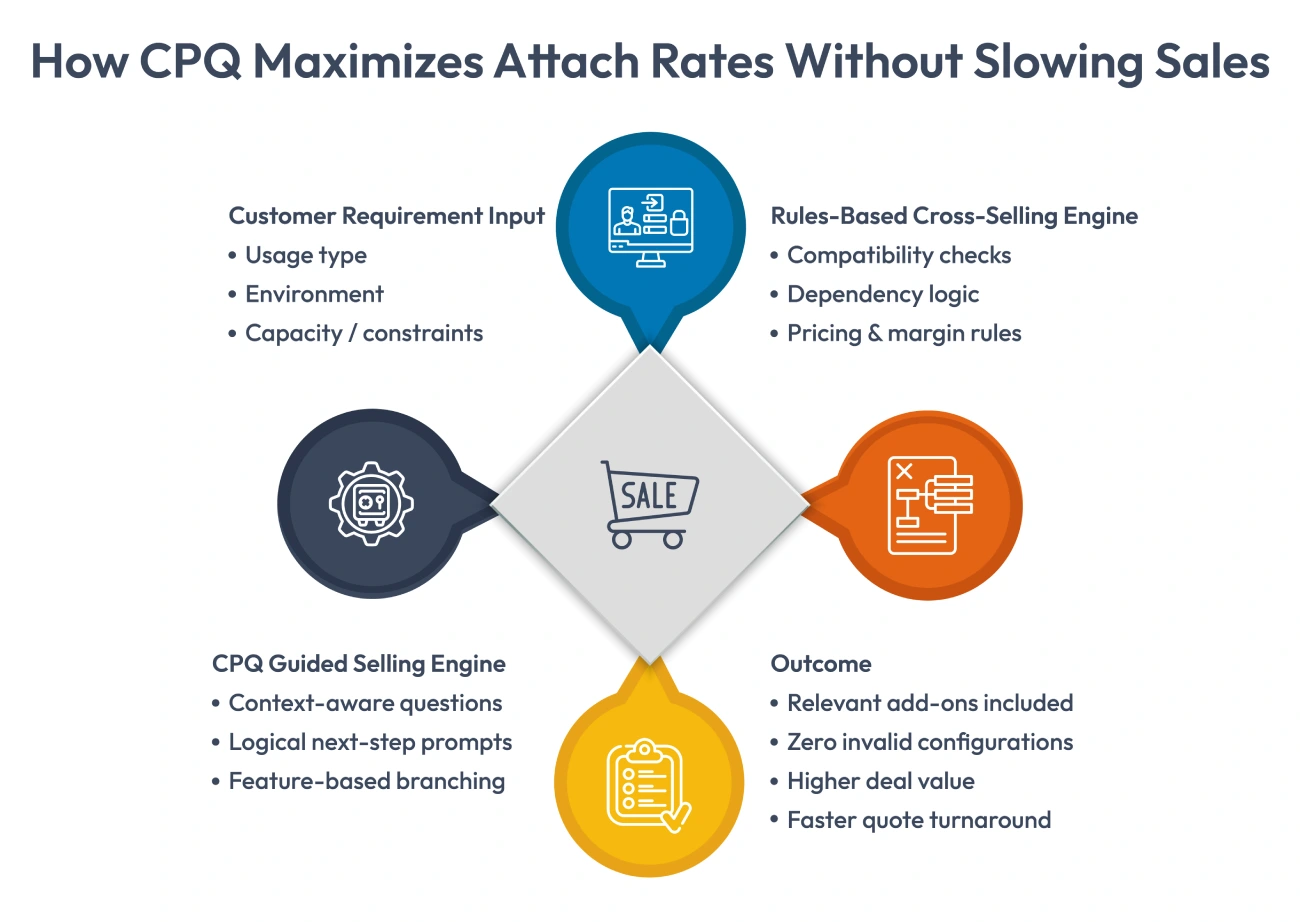
- Introduces relevant add-ons and upgrades at the right moment in the configuration process
- Aligns product options directly to customer requirements and usage context
- Uses guided selling CPQ features to prompt logical next-step selections, not random recommendations
- Ensures complementary products are consistently included across all sales reps
- Increases attach rates without adding friction or extending sales cycles
- Supports CPQ for upselling and cross-selling by keeping the conversation consultative, not pushy
How do CPQ rules prevent errors in complex cross-selling?
- Enforces product compatibility and dependency logic automatically
- Applies pricing rules, discount thresholds, and margin controls in real time
- Prevents invalid or non-manufacturable product combinations
- Eliminates misquotes caused by manual configuration or rep assumptions
- Maintains accuracy even in complex, multi-option upselling scenarios
- Delivers reliable, repeatable results that manual or intuition-based selling cannot match
Complex vs. Simple Upselling Strategies
| Aspect | Simple Upselling Strategies | Complex Upselling Strategies (CPQ-Driven) |
| Recommendation Logic | Static, one-size-fits-all suggestions (e.g., “Would you like fries?”) | Dynamic, rules-based recommendations driven by product logic |
| Decision Context | Transaction-focused with little understanding of customer use case | Built on customer requirements, usage context, and operational needs |
| Product Dependencies | Ignores compatibility and configuration constraints | Enforces product dependencies and validation rules automatically |
| Risk of Errors | High—can result in irrelevant or invalid add-ons | Low—CPQ ensures only viable, manufacturable options are offered |
| Sales Rep Effort | Relies on memory, experience, or scripts | Guided selling workflows lead reps step-by-step |
| Customer Experience | Can feel pushy or random | Feels consultative and value-driven |
| Impact on Revenue | Inconsistent and opportunistic | Predictable, scalable approach to increasing revenue with CPQ software |
| Deal Integrity | May compromise accuracy or feasibility | Protects pricing, configuration, and operational integrity |
What Is the Financial ROI of CPQ Driven by Upsell and Cross-Sell Revenue?
- Higher average deal size: CPQ systematically introduces relevant upsell and cross-sell options during configuration, increasing total contract value without extending the sales cycle.
- Improved attach rates: Guided selling and rules-based recommendations ensure complementary products are consistently included, eliminating missed revenue opportunities.
- Faster sales cycles: Preconfigured rules reduce back-and-forth between sales, engineering, and pricing teams, accelerating quote turnaround times.
- Greater quote accuracy: CPQ enforces configuration, pricing, and compatibility rules, minimizing costly errors and rework.
- Reduced operational costs: Fewer incorrect orders mean less rework, fewer change orders, and lower engineering and production overhead.
- More predictable revenue growth: Standardized upselling and cross-selling processes create repeatable, scalable revenue improvements across sales teams.
- Stronger deal integrity: Revenue growth is achieved without compromising feasibility, margins, or customer satisfaction.
FAQs
1. What is CPQ for upselling and cross-selling?
CPQ for upselling and cross-selling uses guided selling and rules-based logic to recommend relevant add-ons and complementary products during the quoting process.
2. How does CPQ increase revenue?
By embedding upsell and cross-sell opportunities directly into sales workflows, CPQ helps increase deal size, improve attach rates, and reduce lost revenue.
3. Can CPQ handle complex upselling scenarios?
Yes. CPQ is designed for complex product environments where dependencies, constraints, and pricing rules must be enforced automatically.
4. Is CPQ better than manual upselling techniques?
Unlike manual techniques, CPQ ensures consistency, accuracy, and scalability—especially critical for high-value or engineered-to-order products.
5. Does CPQ slow down the sales process?
No. CPQ accelerates sales by guiding reps through validated options, reducing back-and-forth with engineering and pricing teams.