How Does CPQ Extend CRM to Improve Customer Visibility?
CPQ (Configure-Price-Quote) software extends CRM (customer relationship management) systems and enables visibility to all customer interactions and provides accurate data for enhancing customers’ experiences.
As businesses, we know more about our customers today than we did five years ago. Yet, we still need to improve our customer knowledge to continue to retain, engage, and acquire them in large numbers.
Companies not only need to have accurate account and contact information and customer-transaction data; they also need to go a step further and gain more visibility into their customer buying habits. We need to know what types of products they are buying? How are they buying? What vertical markets are they buying in? When are they buying? What are they willing to pay for a product? This is only a snapshot of the types of information companies may need to improve and support the overall customer experience.
Why Do CRM Systems Focus on Customer Interactions but Still Fall Short?
To help drive the improvement of customer experience, companies implement Customer Relationship Management (CRM) strategies to manage and gain visibility to all customer interactions. They frequently use CRM software solutions to facilitate and capture these interactions in a systematic, automated, unified approach.

Integrating CPQ with ERP and CRM Systems: A Roadmap for Sales and Operations Leaders
Why Is CRM Only One Piece of the Sales Puzzle?
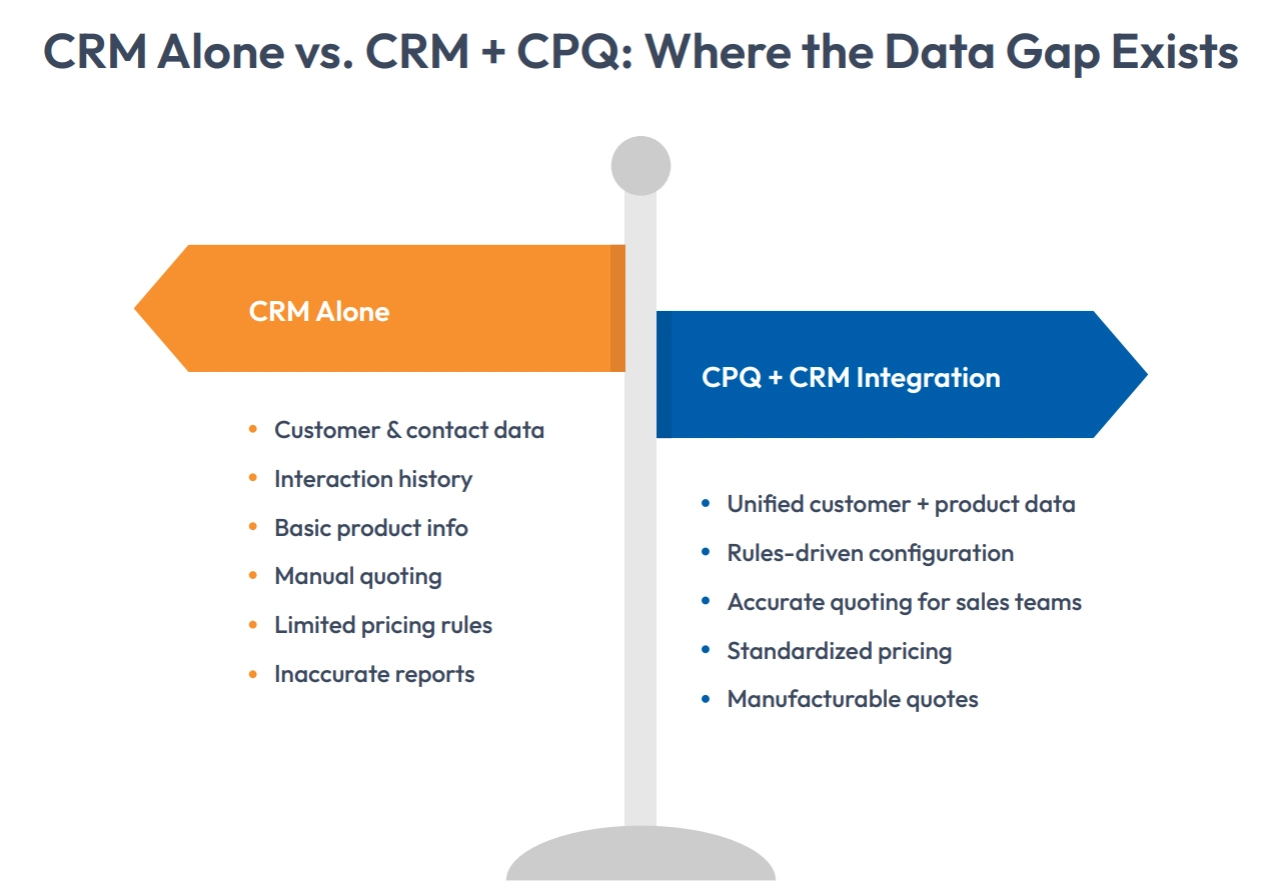
But CRM software is only a piece of puzzle. What else should be captured and currently, isn’t? Extensive product knowledge data.
Most standard CRM systems include, at best, very elementary product-quote and product-order functionality. I believe this is a major gap in CRM systems today, and I know from my experience this gap is sometimes taken lightly and skirted over by businesses, vendors and consultants alike.
The Hidden Value: How Does CPQ Fill the CRM Data Gap?
How can we bridge the gap and begin to capture this much needed data to gain extensive product information? You do this by integrating a CPQ solution with your CRM. Think of it as blending the best of CRM and CPQ functionalities to produce a robust customer-to-order solution. Commonly, when companies think of CPQ, they think of standardizing the selling process and configuring a product or a service through guided-selling methods or engineered-to-order configuration selections. Although this is true, they do so much more.
The value of CPQ is often hidden and not thought about until:
- you can’t produce a product that has been quoted,
- your customer isn’t happy with the service you have provided or
- your company can’t produce the kind of reports they need to make key business decisions.
Why Does Accurate Data Matter So Much in Customer Interactions?
A pet peeve of mine is the vicious cycle of creating or modifying reports because they aren’t producing the type of information you were expecting and needing to make more informed business decisions. Instead of realizing there is a data problem, you think it is a report criteria problem. It goes back to the saying “garbage in garbage out.” If you have a CPQ solution integrated to your CRM, you may already experience the hidden value that such an offering presents, but if you haven’t, the light bulb just went off. CPQ bridges the gap between customer-account and contact information and your customer’s buying cycle.
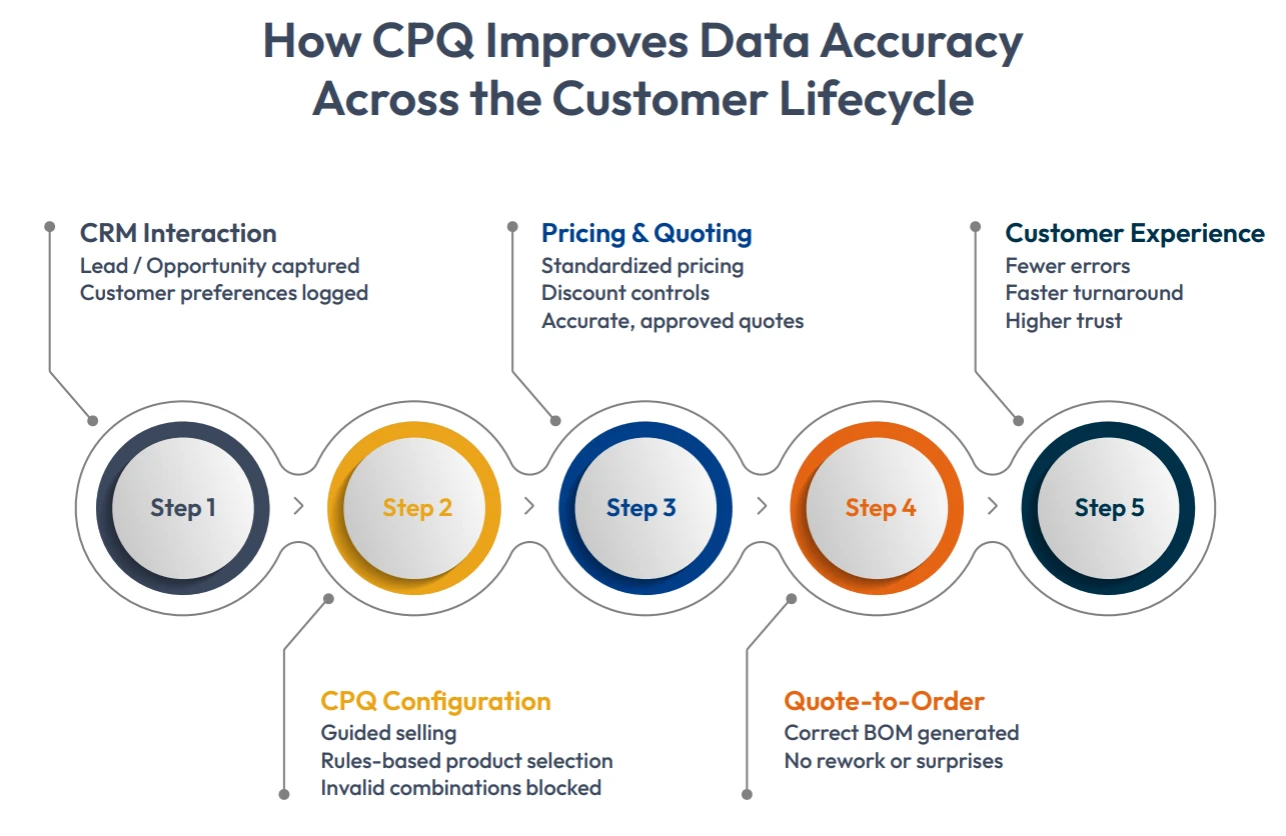
Every interaction with your customer relies on the accuracy of your data. With CPQs, you aren’t allowed to enter inaccurate data. You are guided to the right product or you are systematically constrained by selection rules to product selections.
What Should You Look for When Evaluating a CPQ System for CRM?
When it comes to the configure-price-quote process, ask yourself: How will this help you manage your customers? When evaluating your next CPQ software solution, here are some features you might consider improving your customers’ overall experiences.
Improved Knowledge
- Provides 360-degree-view, meaningful dashboards
- Offers personalized interactions
- Improves analytics
Improved Accuracy
- Produces correct product the first time from quote-to-order and manufacture to ship
- Reduces errors and redundancies
- Improves customer interaction
- Reduces internal and overhead costs
Products and Services
- Offers customer-preferred products
- Shows products being won and lost
- Offers lower-cost product alternatives when necessary
Target Markets
- Supports product marketing campaigns
- Shows best customers and products
Pricing
- Supports standardized pricing
- Supports target-market pricing
- Enables you to react proactively to market changes
Documents
- Provides accurate and easy-to-understand documentation
Improved Interactions
- Reduces phone calls to fix pricing issues, shipping errors and lead times
- Improves relationships between buyers and sellers
Improved Decision-Making
- Improves data integrity, which is the root of all accurate information
- Provides accurate information to guide accurate decision-making
Learn how Cincom enables seamless CPQ and CRM integration to ensure accurate quoting and better customer experiences.
FAQs
1. Why is CPQ considered a necessity for CRM systems?
CPQ adds product configuration, pricing logic, and quoting accuracy that standard CRM systems lack, making it essential for accurate quote-to-order execution.
2. What are the key CPQ benefits for CRM systems?
CPQ improves data accuracy, enhances visibility into customer buying behavior, and supports better reporting and decision-making.
3. How does CPQ enable accurate quoting for sales teams?
CPQ enforces configuration and pricing rules, preventing invalid selections and reducing manual errors during the quoting process.
4. Can CRM work effectively without CPQ?
CRM can manage interactions, but without CPQ it lacks deep product intelligence, often resulting in errors, rework, and inconsistent quotes.
5. How does CPQ improve customer experience when integrated with CRM?
By ensuring consistent, accurate data from quotes through order and delivery, CPQ builds trust and reduces friction in buyer–seller interactions.