Sales operations are under constant pressure to improve sales results. Effective integration of marketing and sales is critical to producing not just a one-time performance increase, but more importantly to actually deliver sustained improvements in sales operations over the long term. Organizations that successfully integrate marketing and sales operations create a repeatable engine for growth rather than relying on isolated wins.
Marketing and Sales must be “of one mind” on certain things. If they move independently, success will be a piecemeal and driven more by luck than intent. True sales and marketing alignment ensures that both teams pursue the same markets, communicate the same value, and measure success against shared objectives.
It all sounds so simple. Marketing identifies a market, creates a message to differentiate the product, and selects an audience in which to deliver the message. The audience responds to the message in assorted ways, some of which are identified as opportunities. The sales team interacts with the audience and turns those opportunities into deals.
It actually can be simple; maybe not three-sentence simple, but it’s not rocket surgery either.
The key is getting the parts in place first. Marketing and Sales must be “of one mind” on certain things. If they move independently, success will be a piecemeal and driven more by luck than intent. When organizations deliberately integrate marketing and sales operations, they reduce friction, improve visibility, and create accountability across the revenue cycle.
Those parts include alignment in terms of strategy, tactics, operational plan, and execution. Let’s examine how these elements can bring Marketing and Sales together to achieve success.
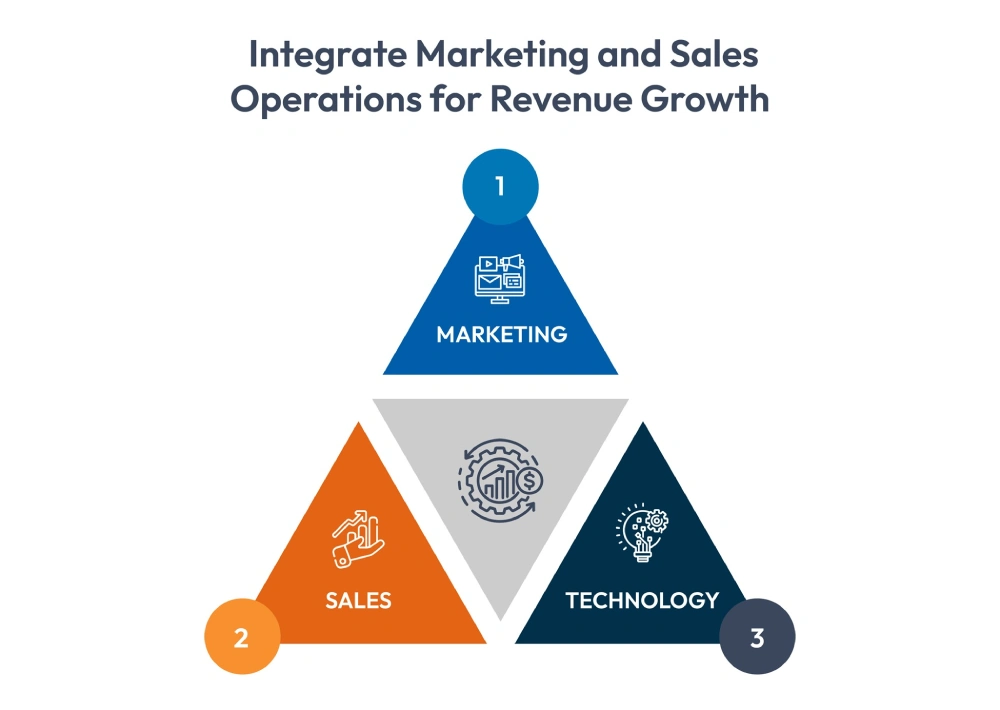
Why Alignment Is the Foundation of Revenue Performance
Sales Operations Strategy
Strategy starts with agreement on what value you are delivering to your buyer. It is critical that Marketing and Sales have a common vision in terms of the value prop for the enterprise and for the individual product as well. Without this foundation, efforts to integrate marketing and sales operations will lack direction.
As an example, let’s say you are selling riding lawn mowers to homeowners.
Marketing sees the market as financially secure professionals looking for a reliable means of mowing larger pieces of property quickly. Their audience data suggests that the typical riding lawn mower owner wants to get the lawn done early enough on Saturday to get them on the golf course no later than midmorning. They expect reliable performance, simple operation, and quick completion of the task at hand.
All of the marketing materials are aimed at showing how quickly the mower gets the job done, along with messaging and emphasizing low maintenance and high reliability delivered in an easy-to-use machine. They reach their audience by advertising in Golf Digest, televised tournament sponsorships and hiring a golf pro to be a spokesperson for their brand.
What happens if Sales sees this market and product differently? What if Sales sees the market as landscaping contractors? They quickly find out that their product does not offer the range of features necessary to fulfill a landscaping role. They find that their brand is nearly invisible in that marketing segment, and they are told that their product is overpriced.
This alignment is a prescription for failure. It also proves why sales and marketing alignment is not optional. Until Marketing and Sales agree on the target market, audience and value prop, it will be difficult to find success. The other elements, tactics, operational plan, and execution will suffer. Strategic clarity is the first step in meaningful sales operations integration.

Translating Strategy into Coordinated Marketing Tactics
In our example, Marketing has set up Sales with an audience of well-heeled homeowners who are looking for ways to minimize time spent on household chores. In our example above, Sales ignore this and go down a road not contemplated by Marketing. The preferred tactic would seek to engage with the target audience and reinforce the broader effort to integrate marketing and sales operations.
Specific ideas would include emails contacting local subscribers to Golf Digest. Sponsoring a golf tournament at the local golf courses and country clubs would be an excellent event tactic. Local pro shops and golf suppliers would likely be happy to participate in smaller winter recreation shows, perhaps featuring a mower giveaway via a raffle ticket.
These specific tactics fit like a glove with the marketing collateral produced and with the messaging related to the product. When Sales follow through with outreach that reflects these campaigns, sales and marketing alignment becomes visible in the marketplace.
Using Technology to Strengthen Sales Operations Integration
Technology also offers considerable assistance in the tactical effort to improve sales and sales operations. CRM systems are able to segment markets by isolating prospects and customers and sharing specific attributes such as location; size, SIC or NAICS codes; department or LOB labels and other useful identifiers. These capabilities support structured sales operations integration by giving both teams access to the same data.
CPQ is another technology that helps sales operations match product with needs and potential buyers. CPQ maintains information well beyond price and product description. Actual usage and product application data associated with product options and with existing users is available within the CPQ data.
If Marketing aims for a campaign at electronic-device manufacturers that are looking for ways to reduce costs and grow, CRM will easily identify the prospects and customers that manufacture electronic devices in the geographical area selected. CPQ can help identify what solutions are available to reduce costs based on the knowledge known about each prospect.
Are there possible product upgrades or cross-selling opportunities within the target market? Would additional capacity aided by additional product help solve the growth issue? What are the current capabilities of the customer, and how can your product help improve sales? These questions can all be answered by CPQ to reveal potential opportunities. When this insight feeds directly into campaign workflows, integrating CPQ with marketing automation strengthens both targeting and conversion rates.
Operational Planning: Where Alignment Becomes Action
None of this will happen if Marketing and Sales don’t sit down together early in the planning process and share their ideas, knowledge, and needs. Sales should have good input on strategy and tactics, and Marketing should be willing to listen and incorporate that input into the plan. This collaboration is the operational backbone required to truly integrate marketing and sales operations.
The finished operational plan should look like a continuous process—high-level information about the product, value and market, supporting messaging that targets the market and audience with specific actionable outcomes. Resulting contact operations are identified and planned with specific responses or follow-up actions tied to specific behaviors evidenced by the prospect.
Each of these elements should include an assignment of who is responsible for completion of the item. Some will be joint while others will be specifically Marketing or Sales.
This is what operational alignment looks like—the strategic foundation that supports a tactical structure to deliver messaging to the audience who’s most interested in what you are offering. You can improve sales and build sustained improvement into the sales operation by aligning the power of Marketing and Sales into an integrated process. Organizations that intentionally integrate marketing and sales operations, invest in structured sales operations integration, and prioritize integrating CPQ with marketing automation position themselves for measurable, repeatable growth rather than unpredictable results.
Conclusion: Turning Alignment into Sustained Revenue Growth
Marketing and Sales alignment is not a campaign tactic or a quarterly initiative. It is an operating discipline. When leaders deliberately integrate marketing and sales operations, they create shared accountability, shared data visibility, and shared performance metrics.
The organizations that commit to sales and marketing alignment do more than improve quarterly numbers. They build a coordinated revenue engine that produces predictable, scalable, and sustained growth.
FAQs
1. What does it mean to integrate marketing and sales operations?
To integrate marketing and sales operations means aligning strategy, messaging, data, technology, and execution across both teams. It ensures Marketing generates qualified demand aligned with business goals, while Sales engages those opportunities with consistent value propositions and structured follow-up processes.
2. Why is sales and marketing alignment important for revenue growth?
Sales and marketing alignment reduces wasted effort, improves lead quality, shortens sales cycles, and increases win rates.
3. What are the benefits of integrating CPQ with marketing automation?
Integrating CPQ with marketing automation connects buyer engagement data with configuration and pricing intelligence. Marketing gains insight into which products and options resonate most, while Sales can generate accurate, personalized proposals.