CPQ and Seasonal Selling Cycles in B2B Sales
Google the term seasonal selling, and you will find thousands of resources related to retail surviving beyond the holiday rush. But seasonal demand affects more than just retail. B2B manufacturers and industrial sales organizations also face significant seasonal sales fluctuations.
These fluctuations often create B2B seasonal sales challenges, including unpredictable demand, fluctuating production schedules, and inconsistent revenue flow. Some months bring high quote volumes and rapid order fulfillment, while others create extended slow periods.
This is where CPQ seasonal selling strategies become valuable. Configure-Price-Quote solutions help organizations manage seasonal demand more effectively by supporting flexible product configurations, pricing adjustments, and faster quoting processes.
There are many ways to address seasonal demand cycles. Some strategies require deep changes to product management or engineering. Others focus on improving sales efficiency and seasonal demand planning in sales operations.
CPQ software falls into the latter category. It provides the tools needed to support several strategies that help sales teams maintain momentum even during slower periods.
CPQ allows organizations to boost revenue by combining products, options, and pricing strategies that stimulate demand during off-season periods.
Understanding Seasonal Selling Cycles and CPQ
Seasonal demand affects almost every product or service to some degree. Industries such as HVAC, specialty vehicles, construction equipment and outdoor equipment often experience predictable spikes and slowdowns.
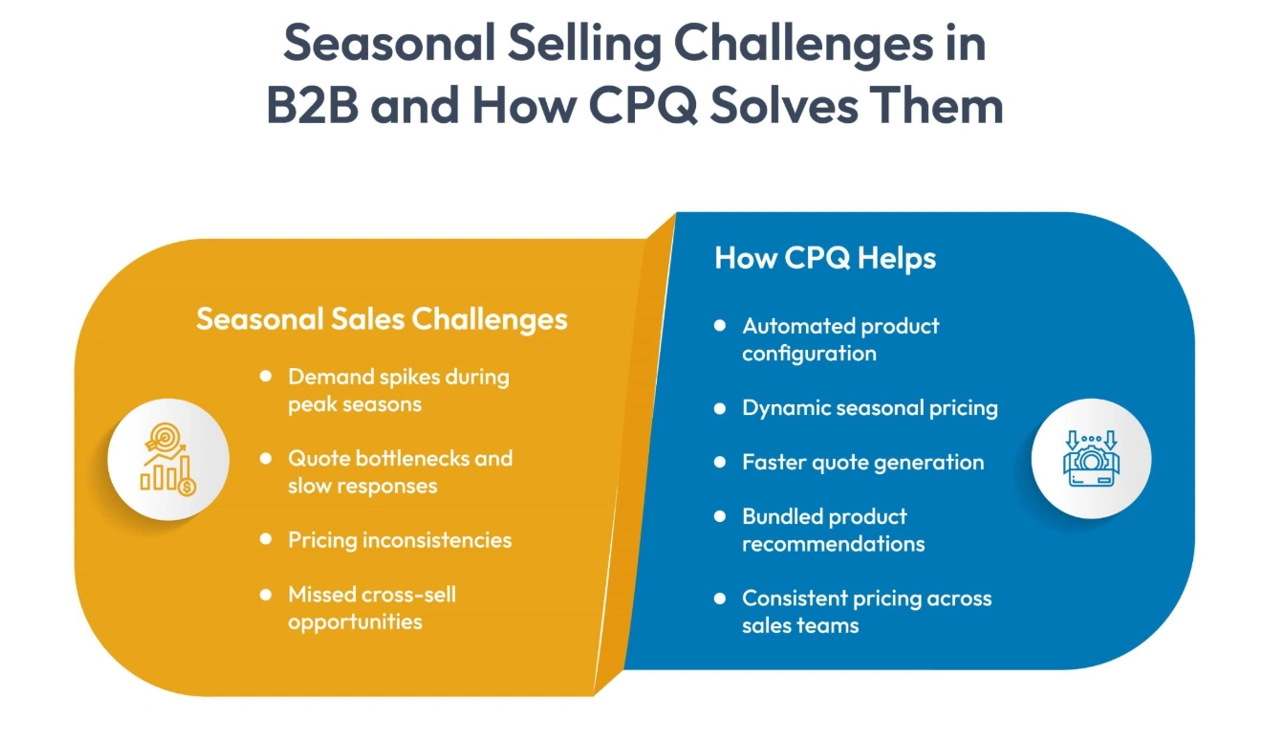
Without the right systems in place, these fluctuations can lead to:
- Quote bottlenecks during peak demand
- Pricing inconsistencies across sales teams
- Inventory imbalances
- Missed upsell or cross-sell opportunities
A high-volume quoting software solution like CPQ helps manage these fluctuations by automating configuration, pricing and quoting even when sales activity spikes.

HVAC Manufacturing Market Segments
In most industries, the implications of seasonal business activity go beyond the calendar. Consider HVAC as an example.
HVAC manufacturers can segment their market into four major divisions:
- Commercial HVAC
- Residential HVAC
- New construction
- Replacement products for existing buildings
These four markets behave very differently.
Commercial HVAC manufacturing often involves contract-level customization, while residential HVAC sales tend to follow a more standardized, repeatable sales model.
Similarly, new construction demand is tied to economic development, while replacement demand is driven by equipment failure, regulatory changes, or upgrades in existing structures.
Understanding these market dynamics helps manufacturers spread production schedules and sales activity more evenly throughout the year.
Managing Seasonal Demand with CPQ Software
Let’s take a look at five specific strategies and how they help mitigate the extremes of seasonal selling cycles.
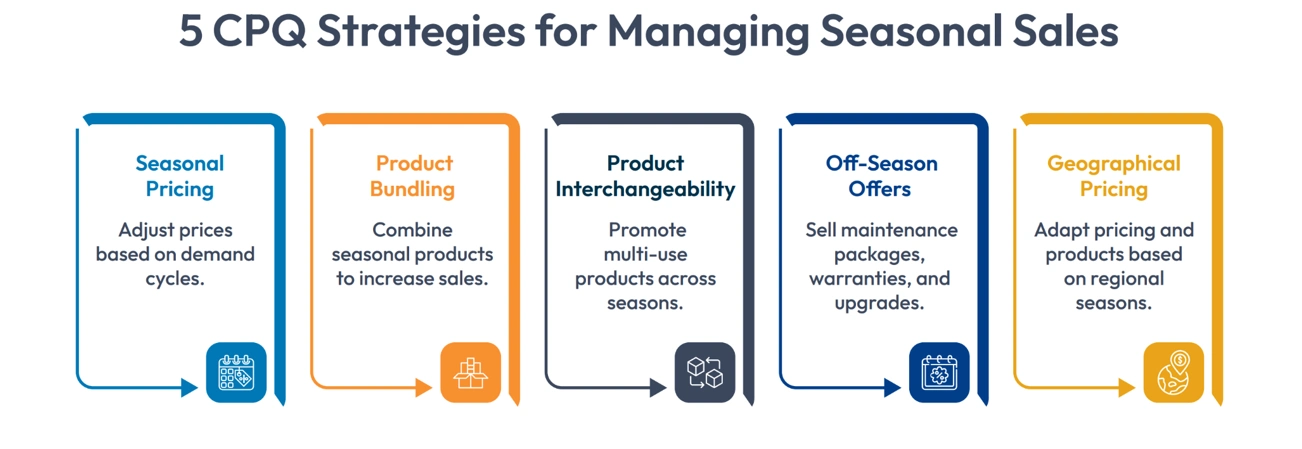
1) CPQ-Enabled Seasonal Pricing
Products like snow shovels, Christmas trees, convertibles, sandals and space heaters rarely experience consistent demand throughout the year.
These products often command premium pricing during peak season and lower prices during the off season.
Consider a specialty vehicle manufacturer that sells attachments for municipal street maintenance. Snowplows and salt spreaders may only see strong demand between October and March.
Discounting these products during summer months can help move inventory and maintain production activity.
CPQ supports this seasonal pricing strategy by allowing organizations to adjust pricing rules in real time. Sales teams can quickly apply off-season discounts, promotional offers, or incentives designed to stimulate demand.
2) CPQ-Enabled Bundling
Bundling is another powerful strategy for balancing seasonal demand.
For example, a lawn equipment manufacturer might offer tools powered by a single rechargeable battery system. Customers may buy a hedge trimmer in spring while also purchasing a snow blower attachment at a reduced price.
This strategy encourages cross-selling and upselling across seasonal product categories.
The same concept applies to HVAC sales. Residential HVAC systems are often sold as bundled furnaces and air-conditioning units.
Bundling both systems into one solution reduces the cost of selling while allowing sales teams to close multiple product deals in a single sales cycle.
CPQ simplifies this process by automatically presenting recommended bundles during product configuration.
3) CPQ-Enhanced Product Interchangeability
Some products have multiple uses across different seasons but are often marketed for only one primary use.
For example, a blower attachment can clear grass clippings in summer, leaves in fall and light snow in winter.
With CPQ, sales teams can present these products with different contextual descriptions depending on seasonal needs.
The automotive industry uses a similar strategy when the same components are shared across multiple vehicle models.
CPQ ensures these interchangeable products appear as relevant options during the configuration process, increasing visibility and driving additional sales.
4) CPQ-Enhanced Off-Season Offers
Even when primary product demand slows, there are still opportunities to generate revenue.
Sales teams can promote:
- Preventive maintenance packages
- Equipment tune-ups
- Training services
- Extended warranties
- Feature upgrades
Many organizations now separate service packages from the base product price. These add-on offerings can be sold during follow-up sales calls or customer support interactions.
CPQ enables these off-season revenue opportunities by presenting service packages and upgrades directly within the quoting process.
5) CPQ-Enhanced Geographical Pricing Support
Seasonality often varies across different regions of the world.
For example, summer in the northern hemisphere coincides with winter in the southern hemisphere. HVAC manufacturers may sell air conditioning systems in one region while promoting heating systems in another.
CPQ supports geography-based pricing and product availability by maintaining multiple price lists across markets.
This capability allows manufacturers to manage global seasonal demand more effectively while ensuring consistent pricing accuracy.
How CPQ Supports High-Volume Seasonal Sales
During peak seasons, sales teams often face surges in quote requests. Manual processes struggle to keep up with these spikes.
CPQ solves this challenge by functioning as high volume quoting software that can:
- Automatically configure complex products
- Apply pricing rules instantly
- Generate accurate quotes at scale
- Maintain pricing consistency across sales teams
This allows organizations to maintain speed and accuracy even during the busiest sales periods.
CPQ Use Cases for Seasonal B2B Sales
Across industries, CPQ plays an important role in managing seasonal sales cycles. Common use cases include:
- HVAC manufacturers balancing heating and cooling product demand
- Specialty vehicle manufacturers selling seasonal municipal equipment
- Agricultural equipment manufacturers managing planting and harvesting cycles
- Industrial equipment providers offering maintenance services during off-season periods
By supporting pricing flexibility, product bundling, and global market segmentation, CPQ enables organizations to manage seasonal demand with greater agility.
FAQs
1. What is CPQ seasonal selling?
CPQ seasonal selling refers to using Configure-Price-Quote software to manage seasonal sales cycles by adjusting pricing, product bundles, and quoting processes to match fluctuating demand.
2. How does CPQ help manage seasonal demand in B2B sales?
CPQ helps manage seasonal demand by automating configuration, adjusting pricing dynamically, and enabling faster quote generation during peak sales periods.
3. Why is CPQ important for high-volume seasonal sales?
During peak demand periods, sales teams may receive a large number of quote requests. CPQ acts as high volume quoting software, enabling teams to generate accurate quotes quickly while maintaining pricing consistency.
4. What are common B2B seasonal sales challenges?
Common challenges include fluctuating demand, pricing inconsistencies, long quote turnaround times, and inventory imbalances during peak and off-season periods.
5. Can CPQ support seasonal pricing strategies?
Yes. CPQ allows organizations to create dynamic pricing rules that adjust based on season, geography, promotions, or market conditions.