While implementing CPQ systems across manufacturing, industrial equipment, and subscription-driven businesses, there is a persistent problem. Most revenue problems don’t start with billing. They start in the disconnect between quoting and billing.
For years, traditional billing systems worked just fine. Companies sold products. Finance generated invoices. Revenue was recognized and done.
But things started changing with changing business models over time.
Products became configurable. Services became bundled. Pricing became dynamic. Subscriptions became the norm. Suddenly, the old way of billing started breaking under pressure.
That’s where CPQ billing enters the conversation. How? This blog will give you the answer!
The Traditional Billing Mindset
Traditional billing was built for a simpler sales model, one-time transactions with fixed prices. In that world, billing is a downstream activity. Sales closes the deal, and finance figures out how to invoice it.
The problem that arises repeatedly is that complex deals don’t translate clearly from quote to invoice.
A sales team configures a customized solution. They apply layered discounts. They structure milestone payments. They bundle services. Then the deal moves to finance, and someone must manually interpret what was sold.
Every time human interpretation enters the process, risk follows.
In traditional billing environments, that often means:
- Re-entering data from CRM into ERP
- Adjusting invoices manually
- Correcting pricing discrepancies
- Reconciling mismatched contract terms
It works but it doesn’t scale.

What CPQ Billing Changes
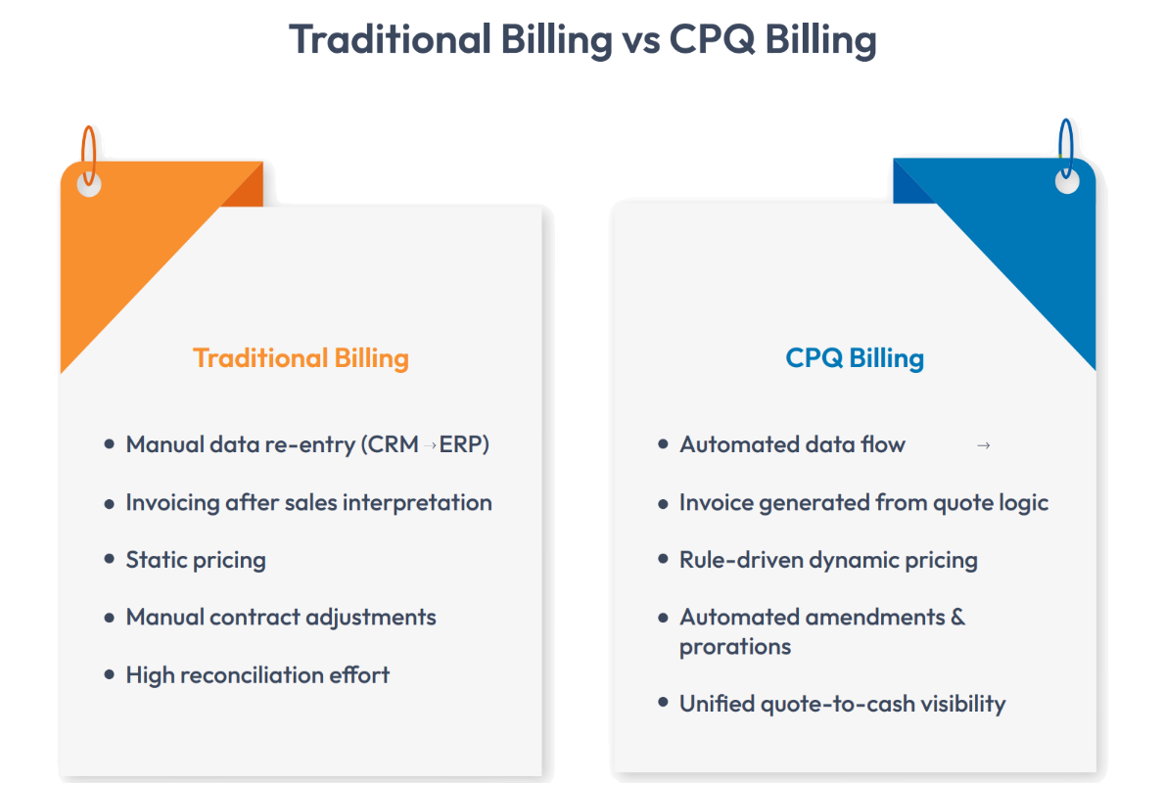
CPQ billing fundamentally changes the relationship between sales and finance.
Instead of treating billing as an isolated financial function, CPQ billing connects the configuration logic, pricing rules, and contract structure directly to invoicing.
In modern automated quote-to-cash solutions, the quote is not just a sales document. It becomes the operational blueprint for billing.
The configured product structure flows directly into:
- Contract generation
- Billing schedules
- Recurring charges
- Revenue recognition rules
There is no reinterpretation. The system already knows what was sold.
That’s the difference.
Where Traditional Billing Starts to Break
In my experience, traditional billing systems struggle most in three scenarios:
First, subscription and recurring models.
Second, contract amendments.
Third, hybrid revenue streams.
When businesses adopt recurring pricing, they typically implement subscription billing software. But if that software is disconnected from CPQ, the problem simply shifts from manual invoicing to manual reconciliation.
In many organizations sales teams sells a subscription package with custom terms, but finance has to manually configure the recurring billing structure because the systems don’t integrate to each other.
That gap is where revenue leakage happens.
Strong CPQ and billing integration eliminates that gap. The recurring logic defined in CPQ automatically drives billing behavior.
Amendments: The Real Test of System Maturity
The real stress test of any revenue system is not the initial sale. It’s the change.
Customers upgrade. They downgrade. They add modules. They cancel features mid-contract.
Traditional billing systems require recalculations. Someone adjusts spreadsheets. Someone manually calculates proration. Someone double-checks revenue allocation.
With CPQ billing, contract changes automatically update billing schedules. Prorations are calculated by rule. Audit trails are preserved.
That level of automation is not about convenience. It’s about revenue accuracy and compliance.
The Role of a Unified Platform
One of the biggest shifts over the years is the move toward a unified CPQ billing platform.
When quoting and billing live in separate systems, friction is inevitable. When they share a logic engine and data model, alignment becomes natural.
A unified approach gives organizations:
- A single source of pricing truth
- End-to-end visibility from quote to invoice
- Predictable recurring revenue tracking
- Reduced operational overhead
It also builds trust internally. Sales trusts finance. Finance trusts sales. Leadership trusts numbers.
That’s not a small benefit.
Why More Companies Are Moving Toward CPQ Billing
Revenue models today are no longer linear.
Companies are combining:
- One-time equipment sales
- Installation services
- Ongoing maintenance contracts
- Subscription add-ons
- Usage-based fees
Trying to manage that complexity with traditional billing tools designed decades ago creates constant friction.
CPQ billing aligns with modern revenue architecture. It ensures that what is configured, priced and approved is exactly what is invoiced, automatically.
For organizations scaling globally or expanding product portfolios, that consistency becomes critical.
So, What’s the Real Difference?
Traditional billing asks: “How do we generate an invoice?”
CPQ billing asks: “How do we ensure the invoice reflects the exact commercial intent of the deal?”
Companies often delay the shift because traditional billing “still works.” And often, it does until growth introduces complexity.
At that point, manual processes start eroding margins, increasing billing disputes and slowing cash flow.
CPQ billing isn’t just about automation. It’s about protecting revenue as your business evolves.
FAQs
1. What is CPQ billing?
CPQ billing connects Configure, Price, Quote processes directly to invoicing and revenue management, ensuring that configured products and pricing rules automatically drive billing without manual intervention.
2. How is CPQ billing different from traditional billing?
Traditional billing generates invoices after the sale and often relies on manual adjustments. CPQ billing integrates quoting, contracts and billing into a continuous revenue process that reduces errors and improves scalability.
3. Can CPQ billing work with Subscription Billing Software?
Yes. CPQ billing integrates with Subscription Billing Software to automate recurring charges, prorations, renewals and contract amendments.
4. Why is CPQ and Billing Integration important?
CPQ and Billing Integration ensures pricing accuracy from quote to invoice, eliminates rekeying of data and reduces revenue leakage across the quote-to-cash lifecycle.
5. Who benefits most from CPQ billing?
Manufacturers, SaaS providers, industrial equipment companies and service-based organizations with configurable products or recurring revenue models benefit most from CPQ billing.