Complex manufacturers deal with long sales cycles, custom configurations, and the need for accurate, engineering-aligned quotes. They require much more than basic quoting tools, a CPQ solution that can handle complexity, support guided selling, and integrate seamlessly with ERP and CRM systems.
The two of the leading options available are Cincom CPQ and Experlogix CPQ. Both offer core CPQ functionality and serve a wide range of industries. But when it comes to complex manufacturing, there are many differences—especially in how they handle rules-based configuration, scalability, and integration with engineering systems.
This blog compares Cincom CPQ vs Experlogix CPQ from a complex manufacturing perspective. The side-by-side analysis will help you determine which solution is better suited to your quoting needs and operational complexity.
What Complex Manufacturers Need in a CPQ Solution
Manufacturers dealing with complex, configurable products face a lot of quoting challenges. Their sales process is often entangled with engineering input, compliance rules, and constantly shifting customer requirements.
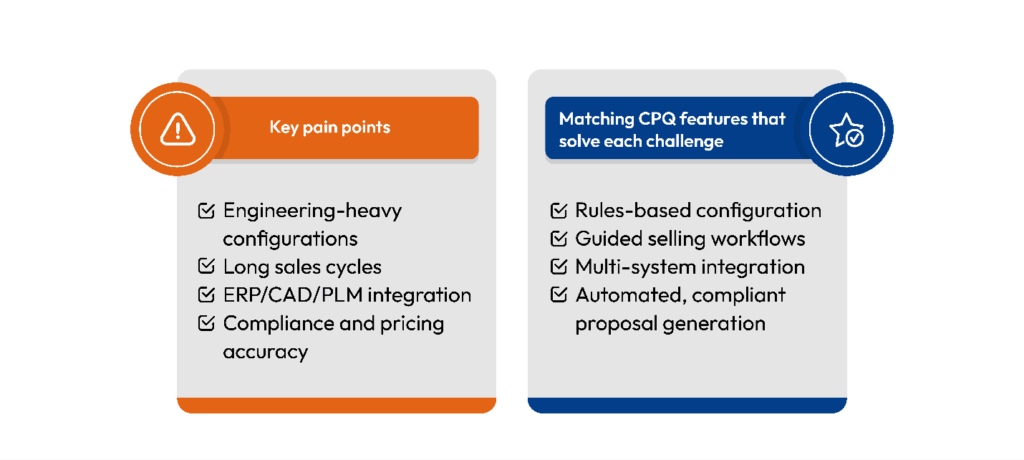
Key challenges include:
- Complex configurations need rules-based logic for it to be manufactured.
- Long sales cycles with internal approvals and technical reviews.
- Must integrate with ERP, PLM, and CAD for real-time data sync.
- Strict compliance and pricing accuracy, especially in regulated industries.
To navigate these demands, complex manufacturers need a CPQ solution purpose-built to handle depth and variability.
Essential features should include:
- Rules-based logic to model complex products and dependencies.
- Guided selling to simplify complex product selection.
- Multi-channel quoting for consistent quotes across reps and partners.
- Automated proposals to speed delivery and reduce errors.
- Scalable integration with back-office and digital sales systems.
These capabilities form the core evaluation criteria for comparing Cincom CPQ and Experlogix CPQ.

How CPQ Helps Manufacturers Protect Margins and Increase Sales
Download the whitepaper to see how CPQ boosts sales, protects margins, and helps manufacturers scale with speed and customer focus.
Overview: Cincom CPQ and Experlogix CPQ
Cincom CPQ is specially designed for complex manufacturers, especially those working in engineer-to-order (ETO), configure-to-order (CTO), or make-to-order (MTO) environments. It handles deep product customization, complex pricing rules, and seamless alignment with engineering and operations. It’s built to reduce quoting errors, speed up sales cycles, and ensure compliance across every quote.
Experlogix CPQ is a popular choice for small to mid-sized businesses. Known for its ease of use, it integrates tightly with the Microsoft Dynamics ecosystem and supports a wide range of industries. It’s best suited for companies with simpler or moderately configurable product lines that want a fast, straightforward quoting experience.
Integration-wise, both tools connect with leading CRM and ERP systems, including Microsoft Dynamics 365, Salesforce, and Oracle. However, Cincom offers deeper, cross-functional integration, making it better suited for complex enterprise environments.
Feature Comparison: Which CPQ Handles Complexity Better?
| Feature | Cincom CPQ | Experlogix CPQ |
| Product Configuration | Advanced rules engine; supports ETO/CTO with nested logic and dependencies. | Suitable for simpler to moderately complex products; limited support for ETO. |
| Guided Selling | Customizable workflows based on role, channel, or region. | Basic guided selling; more limited customization options. |
| Proposal Automation | Built-in proposal engine with rich template control and multilingual output. | Supports automated proposals; customization may require third-party tools. |
| Rule Management | No-code + developer-level control for complex pricing and configuration. | Primarily no-code tools; suitable for straightforward pricing rules. |
| Scalability | Enterprise-grade; supports global teams, large catalogs, and rule libraries. | Geared towards SMBs; may require upgrades or workarounds for enterprise scaling. |
| Visualization Support | Optional 2D/3D product visualization tied to the configuration process. | Limited native visualization; typically requires third-party add-ons. |
Cincom CPQ offers broader capabilities for companies with highly complex, configurable products and global operations. Experlogix CPQ works well for businesses with simpler needs and tighter Dynamics integration but may fall short in handling advanced configuration and scale.
Integration & Ecosystem Fit
| Criteria | Cincom CPQ | Experlogix CPQ |
| ERP Integration | Deep, native integrations with Microsoft Dynamics, SAP, and Oracle | Primarily optimized for Microsoft Dynamics 365 ERP |
| CRM Compatibility | Works across multiple CRMs (Dynamics, Salesforce, etc.) | Strongest fit within Microsoft Dynamics CE |
| PLM & CAD Integration | Supports PLM and CAD integration for engineer-to-order workflows | Limited support; custom work may be required |
| Configuration Logic Reusability | Centralized logic deployable across direct sales, dealer portals, and eCommerce | Primarily CRM-embedded logic, harder to extend across channels |
| Ecosystem Flexibility | High – suitable for hybrid or multi-vendor enterprise environments | Lower – best for Microsoft-centric organizations |
While Experlogix CPQ works well for businesses heavily invested in the Microsoft ecosystem, its flexibility outside that stack is limited. In contrast, Cincom CPQ offers broad platform compatibility, robust enterprise integrations, and reusable configuration logic that spans both front-end and back-end systems—making it a better fit for manufacturers operating in complex, multi-system environments.
Usability and Adoption
Experlogix CPQ
- Simple, intuitive UI ideal for standard configuration use cases
- Quick onboarding for sales teams working with predefined product lines
- Limited flexibility when dealing with complex, multi-layered configurations
- Lacks strong support for hybrid roles, such as collaboration between sales and engineering
- Not optimized for ETO/CTO workflows, where configuration logic and approvals evolve dynamically
Cincom CPQ
- Built for complexity – handles advanced rules, dependencies, and nested logic without overwhelming users
- Role-based user experience, enabling tailored views and actions for sales, engineering, and operations
- Guided selling workflows help reps quote accurately without needing deep technical knowledge
- Governance and rule visualization tools simplify oversight, change management, and onboarding
- Supports collaboration across departments, ensuring smooth handoffs and configuration accuracy
Bottom Line
- For standard, less complex quoting, Experlogix offers ease of use.
- For complex manufacturing environments, Cincom CPQ delivers the right balance of depth, usability, and team alignment—making it easier to adopt and scale across departments.
Pricing Transparency and Total Cost of Ownership (TCO)
At first glance, Experlogix CPQ appears more cost-effective, especially for businesses seeking quick deployment and standard quoting processes. It offers a lower upfront cost and can be ideal for organizations with simpler, more repetitive product configurations. However, this affordability often comes with limitations in scalability, rule complexity, and long-term system flexibility.
In contrast, Cincom CPQ may require a higher initial investment, but it’s engineered for the long haul—particularly for manufacturers dealing with complex configurations, global sales teams, and frequent product updates. The total cost of ownership (TCO) becomes more favorable over a 3–5 year period when you factor in:
- Reduced maintenance overhead thanks to reusable product logic and centralized rule management
- Lower change management costs, since updates can be made without disrupting quoting workflows
- Long-term agility, allowing manufacturers to adapt to new business models, market demands, and regulatory changes without reimplementing CPQ logic
For manufacturers whose products evolve rapidly or require tight integration with ERP and engineering systems, Cincom CPQ delivers long-term ROI by minimizing rework, reducing IT dependency, and scaling across regions and product lines. Simply put, the platform pays for itself in productivity, accuracy, and business adaptability.
Customer Support and Industry Expertise
Cincom CPQ:
- Deep industry experience in industrial manufacturing, medical devices, and specialty vehicles.
- Provides a hands-on, consultative implementation team for personalized onboarding and support.
- Offers long-term strategic partnership with a focus on evolving manufacturing needs.
- Support team collaborates across departments—engineering, IT, and sales—for successful deployment.
- Ideal for enterprises needing customized, scalable, and compliant CPQ deployments.
Experlogix CPQ:
- Known for responsive and friendly customer support.
- Follows a more templated implementation approach, best for standard product lines.
- Smaller support team may limit flexibility for highly complex or customized scenarios.
- Better suited for SMBs or mid-market companies with simpler CPQ needs.
Cincom CPQ offers stronger industry alignment and a collaborative support model, making it the better fit for manufacturers with complex sales processes and long-term transformation goals.
Final Thoughts
When it comes to CPQ for complex manufacturing, the right fit depends on your business model and configuration needs. For manufacturers with relatively simple, build-to-order (BTO) product lines operating primarily within the Microsoft ecosystem, Experlogix CPQ can be a practical and cost-effective option. Its ease of use and quick deployment are well-suited to straightforward configurations.
However, for engineer-to-order (ETO) environments, global sales teams, or businesses managing intricate product rules, multi-layered pricing, and compliance-heavy documentation, Cincom CPQ stands out as the stronger, purpose-built solution. It’s engineered to handle complexity—enabling faster, more accurate quoting, seamless integration with ERP/PLM systems, and scalable performance across channels.
Final word? If your quoting process is deeply tied to engineering, customization, and global operations, Cincom CPQ is the better investment.
FAQs
1. Which CPQ solution is easier to implement?
Experlogix CPQ is generally easier and faster to implement, especially for organizations with standard product configurations and existing Microsoft Dynamics environments.
Cincom CPQ, while requiring more initial planning, offers a more robust implementation for complex, engineer-to-order or configure-to-order workflows—making it worth the investment for manufacturers with deeper requirements.
2. Does either tool integrate with Dynamics 365 or Salesforce?
Both solutions support integration with Microsoft Dynamics 365 and Salesforce.
However, Experlogix CPQ is more tightly embedded within the Microsoft Dynamics ecosystem, while Cincom CPQ offers broader integration flexibility—including Oracle and SAP—and deeper cross-system connectivity for ERP, PLM, and CAD systems.
3. What industries benefit most from Cincom or Experlogix?
- Cincom CPQ excels in industries with high product complexity, such as industrial manufacturing, medical devices, specialty vehicles, and HVAC, where rules-based configuration and engineering alignment are critical.
- Experlogix CPQ is well-suited for SMBs and mid-market companies in light manufacturing, discrete manufacturing, and professional services that require basic to moderately complex quoting.
4. How scalable are these CPQ platforms?
Cincom CPQ is built for enterprise scalability—supporting global deployments, multiple product lines, extensive rule libraries, and multi-language use.
Experlogix CPQ scales well within smaller or mid-sized organizations but may require custom workarounds when managing advanced configuration logic or international operations.
5. Which has better support for multi-level BOMs (Bill of Materials)?
Cincom CPQ provides strong support for multi-level BOMs, nested configurations, and engineering-aligned product structures—making it ideal for ETO and CTO manufacturers.
Experlogix CPQ has more limited BOM support and may not efficiently handle deep or dynamic BOM hierarchies without additional customization.