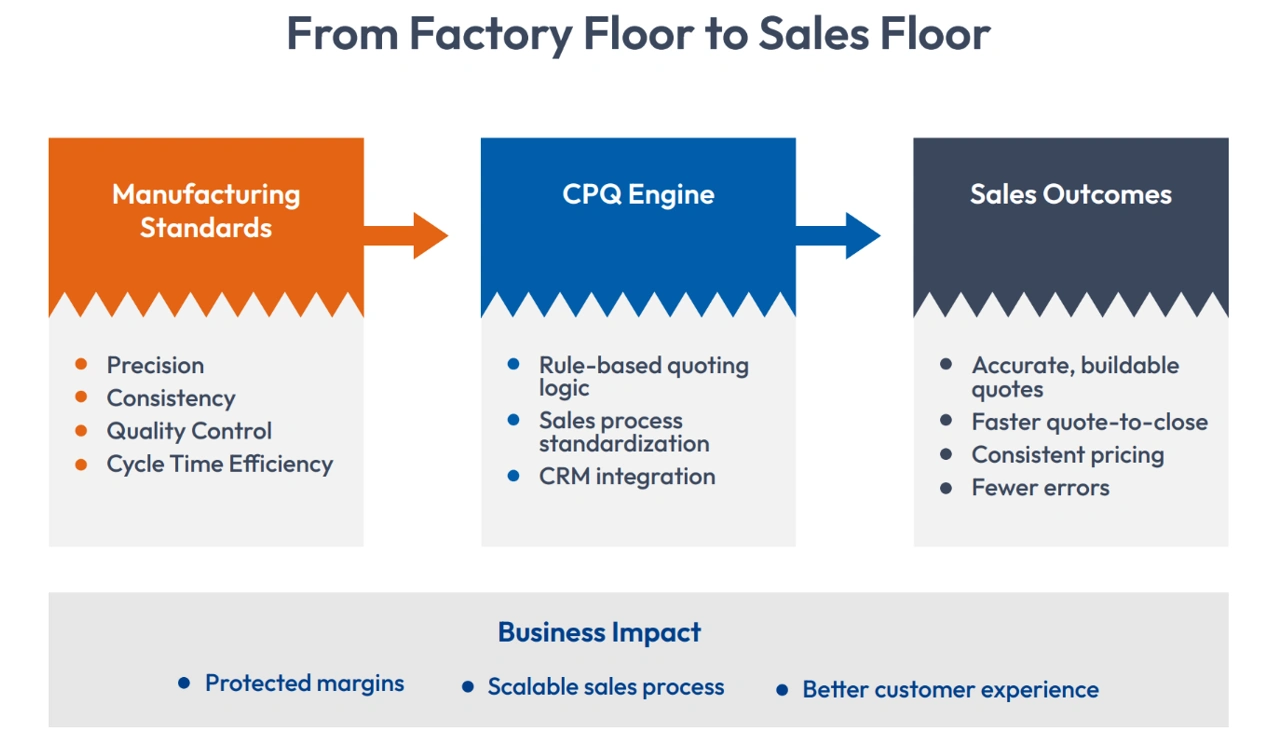
To say the rate at which manufacturing has evolved since the start of the Industrial Revolution is significant would be an understatement. While there’s always room for improvement, we’ve pretty much got the big stuff down to such a science that we’ve turned a lot of our attention to trying to perfect all of the minute details.
CPQ makes the company easy to do business with, and that’s becoming an increasingly important variable in why consumers make purchasing decisions.
Think about the things you evaluate on your factory, shop or warehouse floor: uniformity, consistency, manufacturing cycle time, capacity utilization, machine precision and so much more. You measure and re-measure everything to save every dime you can and yield the right quality and quantity of product.
Without a doubt, these things have driven the exponential progress of the industry over the years.
But there’s something that has been around just as long as manufacturing that does not seem to have reached this same level of perfection and precision: sales.
Because of rapidly changing markets, the way we sell evolves every day. However, this is no excuse for not perfecting the sales process itself. What if we were to take the dedication we have to precision and efficiency on the factory floor and apply it to our sales process? That could make for an eye-opening experience!
Getting Started: Using CRM to Evaluate Effectiveness
These days, customer relationship management (CRM) systems are very sophisticated at least they can be if you know how to use them properly. You can track your buyers’ journeys from their very first touch with you all the way to the close of the sale, as well as your relationship afterwards.
Now put on your factory floor lenses.
Study everything from your qualified and disqualified leads to the open, closed and lost opportunities to your sales pipeline and revenue streams. Dig into your system and start looking very closely at metrics like:
- Length of the sales cycle
- Sales by contact method
- Sales revenue trends
- Quote-to-close ratio
- Opportunity win rate
Once you have identified these numbers and other important KPIs, compare them to industry trends and track and measure against them on a consistent basis. Precision starts with metrics. Be dedicated to your tracking methods and your rules of measurement.
Want to know more about how CPQ integrates with CRM systems? Take a look!
CPQ Adds Accuracy and Efficiency to Sales
If we compare sales to an assembly-line process, then the goal of sales is to close more deals faster without sacrificing the quality or value of each individual sale. While CRM systems are great for evaluating and tracking your sales process, it doesn’t put the pieces together for you. Your sales assembly line needs that “robotic arm” that can pick up the right components and put them where they need to be quickly, repeatedly and consistently.
This is why CPQ (configure-price-quote) technology is commanding more attention from senior leadership in sales. CPQ adds accuracy and efficiency to the sale. It puts back-house knowledge into the hands of the salesperson.
Implementing Rule-Based Logic to Enforce Production Standards
The rules operating behind CPQ govern a few major things:
- They only allow your sales team to configure and sell products that your company actually makes (in other words, sales can’t promise something the company can’t deliver).
- Pricing is consistent across the board.
- The entire process is standardized across individuals and channels (no one can go rogue; easier onboarding, training, etc.).
This front-end efficiency is also a major bonus from the customer’s perspective. CPQ makes the company easy to do business with, and that’s becoming an increasingly important variable in why consumers make purchasing decisions.
Finding the Competitive Edge in Process Details
When it comes to manufacturing products, there’s a pretty good roadmap for how to organize and operate factories and produce goods. Now manufacturers are looking for their competitive edge in the details of their processes. It’s time to view sales through the same lens. The way your organization sells can be just as big of an advantage as the way you make what you sell. It’s all about precision and efficiency. Do it right, and you’ll be turning out dollars with assembly-line efficiency.

Do you want to know how to accelerate your standardized sales process with CPQ?
FAQs
1. What does applying manufacturing standards to the sales process mean?
It means bringing the same precision, consistency, and process control used in manufacturing into sales activities like configuration, pricing, and quoting.
2. How does CPQ support sales process standardization?
CPQ enforces standardized rules for configuration and pricing, ensuring every quote follows approved logic regardless of salesperson or channel.
3. Why is CPQ important for complex manufacturing sales?
CPQ for complex manufacturing ensures only viable, buildable product configurations are sold, reducing errors, rework, and downstream production issues.
4. What is rule-based quoting logic?
Rule-based quoting logic uses predefined constraints and dependencies to automatically guide sales teams toward valid configurations and accurate pricing.
5. Can CPQ integrate with existing CRM systems?
Yes. CPQ integrates with CRM platforms to align customer data, opportunities, and quotes into a single, streamlined sales workflow.