It was just a policy renewal notice, but it said everything…
A few weeks ago, a friend’s car was involved in a late-night collision. Thankfully, no one was hurt. The next day, she called her insurance company to file a claim for damages. But the claim process was rough, with long waiting times and updates that weren’t always clear. Still, she eventually managed to get through it.
Two days after her claim was approved, she received an automated email from the same insurer:
“Good news! Your premium is up for renewal. Here’s how to lock in the same great rate.”
No acknowledgment of the accident. No empathy. No explanation of how her recent claim might impact her coverage. Just a generic sales pitch sent from a system that clearly didn’t “know” what had just happened.
In finance and insurance, giving each customer a unique experience is a must for business. Also, regulators are expecting communications to be more relevant, clear, and in line with today’s disclosure standards. It means what you say and when you say it must be in line with what the customer is doing and adhering to the guidelines at the time.
However, legacy systems weren’t made to handle this kind of communication because they use static templates, batch processing, and siloed data, which makes it hard to keep customers engaged and follow the rules throughout the customer journey.
The “Compliance and Personalization” in Delivering a Personalized Customer Experience
Insurance and financial companies must deliver communications that are timely, contextual, and personalized. Today, customers expect relevance at every touchpoint. At the very same time, every message must also comply with strict regulatory and compliance standards.

Now, the thought of balancing personalization and compliance using legacy systems is simply not feasible.
The Cracks in the Foundation: Why Legacy Systems Can’t Support Personalized Customer Experience
On paper, legacy systems still “work.” They process claims, issue policies, and run billing cycles. But scratch beneath the surface, and the architecture tells a different story—one that can’t keep up with the expectations of a personalized customer experience, especially in regulated environments.
Here’s where the cracks start to show:
Architectural Inertia
Legacy platforms weren’t built for flexibility. They were built for batch jobs and monthly statements. That might’ve worked ten years ago, but not when you’re trying to personalize experience in real time.
Say a policyholder files a complex claim or an investor’s portfolio hits a threshold. You want to tailor messaging based on urgency, tenure, and even preferred language. In a modern system, CX or compliance teams can tweak a few business rules, and it’s done. In a legacy setup? You’re filing a change ticket, waiting on IT, and hoping nothing breaks in production.
Impact:
- Slow response to market or regulatory shifts.
- Business users depend on IT for even the smallest changes.
- Delays and rigid workflows hurt the personalized user experience.
Data Fragmentation and Silo Syndrome
If you’re in insurance or finance, your customer data probably lives in six different places—CRM, billing, underwriting, claims, call center logs, and the list goes on. Legacy systems don’t unify that view.
That means:
- Often, customers get billing reminders after they’ve already paid.
- Account or claims updates don’t reflect recent interactions.
- Regulated disclosures may go out with stale or mismatched data.
Impact:
- Customer experience personalization fails when messaging is mistimed or off-target.
- Compliance teams can’t verify who got what, and when.
- CX teams can’t act on insights needed for personalizing customer experience.

Are Your Customer Communications Creating the Insurance Experience Your Customers Deserve?
Learn how your customer communication aligns with best practices and regulations—and discover areas to improve satisfaction, speed, and engagement.
Compliance as a Patch, not a Platform
This is where legacy systems really show their age. Compliance is bolted on, not baked in. Disclaimers live in Word docs. Approvals get lost in email chains. When a new rule drops—say, a data privacy clause—teams scramble to hardcode updates across dozens of templates.
And forget about audit trails. Most of the time, it’s a manual, reactive fire drill.
Impact:
- Due to inconsistent messaging, there is a high risk of non-compliance.
- No centralized view of what was sent, to whom, and when.
- Regulatory audits become painful, manual exercises and further delay personalized digital experiences.
Missed Moments, Missed Trust
Modern CX runs on signals. Legacy systems run on timers. That means they can’t trigger the right message at the right moment.
Think about this: a customer files a health claim, or there’s sudden market volatility. That’s your chance to reassure, upsell, or guide; however, if your system can’t detect the event, it can’t send the message where the customer will see it, and you’ve missed the moment.
Impact:
- Frustrated customers get delayed or irrelevant updates.
- Missed upsell or retention opportunities.
- You lose trust instead of building a personalized experience.
Channel Constraints and One-Size Messaging
Legacy tools were made for print and email. SMS? App push? Secure portals? Not a chance. And even when you do send, many can’t vary message formatting by channel.
So, your customer prefers text alerts but gets a policy lapse warning via email, or receives a bulky PDF welcome kit on mobile. That’s not just bad UX—it’s potentially non-compliant.
Impact:
- Violations of communication preference mandates.
- Low engagement, especially from mobile-first customers.
- One-size-fits-all communication kills personalized user experience and the trust it depends on.
Why the Case for Modernization Is Urgent for Delivering Personalized Customer Experiences
A few years ago, relying on legacy systems just meant slower innovation. Today, it means not being able to provide a personalized customer experience and respond to real-world shifts—many of which aren’t optional anymore.
Let’s look at what’s changed and why companies in insurance and finance are being forced to rethink their communication tech stacks.
Regulation Is Real-Time Now, Not Retrospective
It used to be enough to store records and submit disclosures on request. But now:
- Financial regulators want timestamped logs of communication—what was said, when, and through which channel.
- Insurance departments expect proactive outreach for policy changes, benefit updates, and critical notices, with clear proof that each message was delivered in compliance with mandates.
Legacy systems, with their nightly batch jobs and manual approvals, weren’t built for this. If your platform can’t generate message-level audit trails, your compliance team ends up reactive and exposed, while your efforts to deliver personalized digital experiences stall at the starting line.
Expectations Aren’t Just “Higher”—They’re Shaped by Other Industries
Your customer might be receiving a personalized retirement plan summary from a robo-advisor in the morning and then a generic lapse warning from their life insurer in the afternoon. The contrast is jarring.
Customers no longer compare their digital experience to other insurers or banks; rather, they compare it to Amazon, Netflix, and Apple. That’s where the real pressure is.
This isn’t about having a sleek UI; it’s about earning trust through relevance by delivering a personalized user experience. If your message overlooks a recent claim, a major life event, or even a stated communication preference, trust breaks instantly.
The Cost of Silence Has Gone Up
When communication breaks down, it’s not just about customer churn anymore. It’s about:
- Failing to warn a customer of a lapse and triggering reputational fallout.
- Sending the wrong loan disclosures and inviting legal action.
- Missing onboarding windows and letting competitors get there first.
In regulated industries, personalization isn’t about “delight.” It’s about accuracy, timing, and risk containment.
Internal Teams Are Pushing Back on the Old Model
Operations teams are tired of waiting weeks for IT to modify a document. Compliance teams are exhausted by hunting down message versions. CX leaders are asking why they can’t segment customers based on behavior.
The pressure isn’t just external. It’s coming from within.
Modern platforms let business users control the logic, build templates, and deploy campaigns—all while staying compliant. Legacy systems keep those levers locked in IT.
How Modern Platforms Enable Personalized Customer Experiences
Modern communication platforms are structurally smarter, built to handle the reality of customer expectations, regulatory scrutiny, and IT limitations simultaneously. Here’s what they do differently from the legacy system:
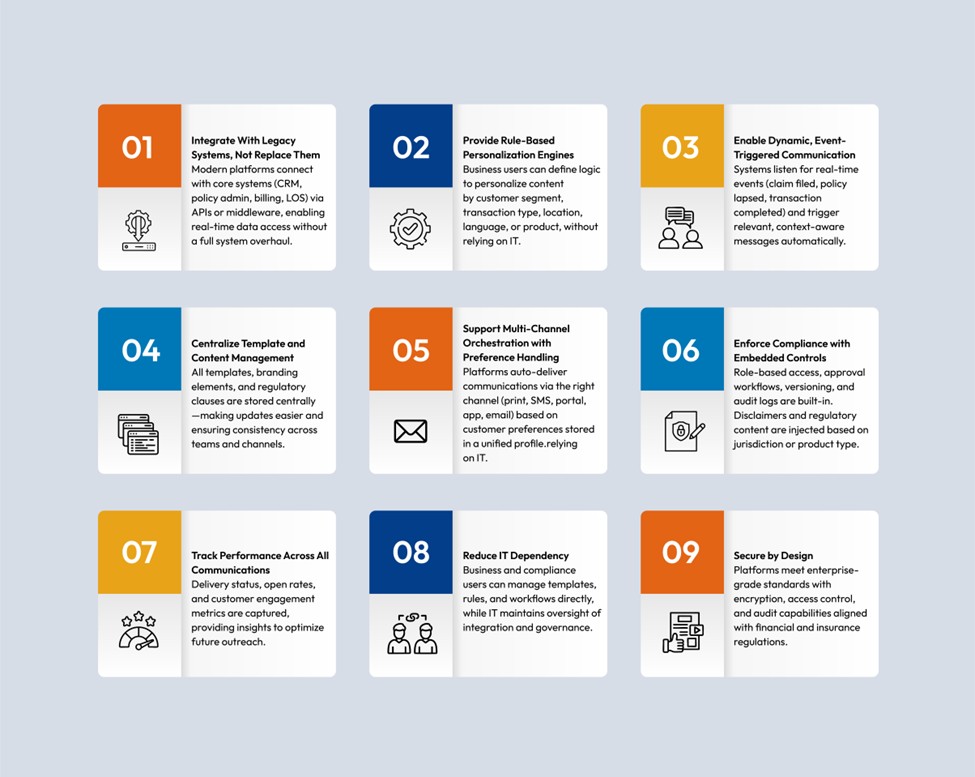
Modernizing Smartly: What to Know Before You Start
We’ve discussed the cracks in legacy systems and what modern platforms do differently to enable personalized digital experiences. However, modernization isn’t as simple as ripping out the old and plugging in the new.
In regulated industries, every system is tightly intertwined with compliance, risk, and operations. Therefore, the shift from a legacy system to a modern system needs to be thoughtful and strategic.
Here are a few things to keep in mind before you modernize:
Organizational Readiness
Modern systems empower business users. But are your teams ready to own configuration and communication logic without hand-holding from IT? Change management is just as critical as the tech itself.
Interoperability Matters
Your new platform must align and work with your core systems, but it shouldn’t depend on them. Therefore, before transitioning, implement APIs, connectors, and event-driven capabilities that allow real-time sync without disrupting full-scale operations.
Governance Can’t Be an Afterthought
Deploy a solution that has built-in compliance controls, such as version control, audit trails, access rules, etc., because you need to meet regulatory standards without slowing down CX initiatives.
Customer-Centric Design Over Tech-First Rollouts
Don’t let modernization be another IT project. Frame it around real outcomes such as reducing lapse rates, improving claims experiences, or personalizing account statements.
Start Small, Scale Fast
Don’t try to modernize every touchpoint at once and in the very beginning. Start with a high-impact use case (like onboarding or claims), see how it’s streamlining your communication, make the adjustments, and then expand from there.
Cincom Eloquence: Built for Personalized, Regulated Communication
In insurance and finance, every communication is a moment of truth—a chance to earn trust, show empathy, and meet both customer expectations and regulatory demands in real time.
But here’s the bottom line:
To deliver personalized customer experiences at scale—securely, compliantly, and contextually—you need a system built for it from the ground up.
That’s where Cincom Eloquence comes in.
With intelligent automation, centralized template control, seamless integration, and real-time rule-based logic, Cincom Eloquence empowers you to craft the right message to the right customer at the right moment—across any channel.
Communication isn’t a back-office function anymore.
It’s your front line.
It’s your brand.
It’s your promise.
Therefore, with Cincom Eloquence, make sure you speak with clarity, compassion, and compliance every time.
FAQs
1- What are legacy systems in regulated sectors?
Legacy systems are aging core technologies—often built on mainframes or static architectures—that manage critical operations like claims, underwriting, or transactions. While still functional, they lack the agility needed in real-time for personalizing customer experience.
2- Why do legacy systems hinder personalization efforts?
They rely on batch processing, siloed data, and static templates, making it nearly impossible to respond to customer behavior in real time and deliver a personalized digital experience.
3- How do compliance requirements complicate CX modernization?
Compliance demands precision, auditability, and consistency. Many modern CX tools prioritize speed and flexibility, but without governance controls, they risk non-compliance. The challenge is modernizing without losing the context and the customer’s preferences.
4- What are the risks of maintaining outdated infrastructure?
Beyond poor customer experience, legacy systems introduce compliance gaps, increased operational costs, slower time to market, and higher vulnerability to regulatory penalties.
5- What steps can organizations take to modernize securely?
To modernize securely, organizations should adopt platforms that extend—not replace—existing legacy systems. The goal is to enable personalized customer experiences without sacrificing compliance or operational stability. Look for solutions that offer embedded governance features like audit trails and disclosure management, real-time data integration for contextual communication, and business-user control so teams can make updates without IT bottlenecks. This approach ensures a smoother transition, minimizes disruption, and allows companies in regulated sectors to scale personalization efforts while staying fully compliant—a critical balance in industries where both trust and timing matter.